As $PLANCK TGE Looms, Modular Layer-0 Positions Itself as the Backbone for Sovereign AI Chains, Slashing Costs 90% and Targeting $500M TVL by Mid-2026.
Mainnet Activation & Ecosystem Momentum
Planck Network, the pioneering AI infrastructure protocol, has fully activated its mainnet on November 10, 2025, integrating over $60 million in enterprise-grade GPUs (H100s, H200s, and B200s) across global data centers, enabling instant spin-up of AI chains, clusters, and custom models. Backed by Tether co-founder Brock Pierce and a syndicate including DNA Fund, GDA Capital, DePIN X Capital, and Rollman Management, the launch follows a sold-out Huostarter IDO for $PLANCK tokens in 35 minutes and $7.5 million in total funding ($3.5 million raised, $4 million via staking). This milestone supports over 30 blockchains like Ethereum, BNB Chain, Near, and Polkadot, with real-world revenue already exceeding $1 million from GPU rentals and $1.5 million since February—90% cheaper than AWS or Google Cloud. Early adopters, including AI startups and Web2 enterprises, have processed $50 million in compute contracts, driving 25% QoQ growth in DePIN integrations and positioning Planck to capture 10-15% of the $10 billion decentralized AI compute market by 2026.
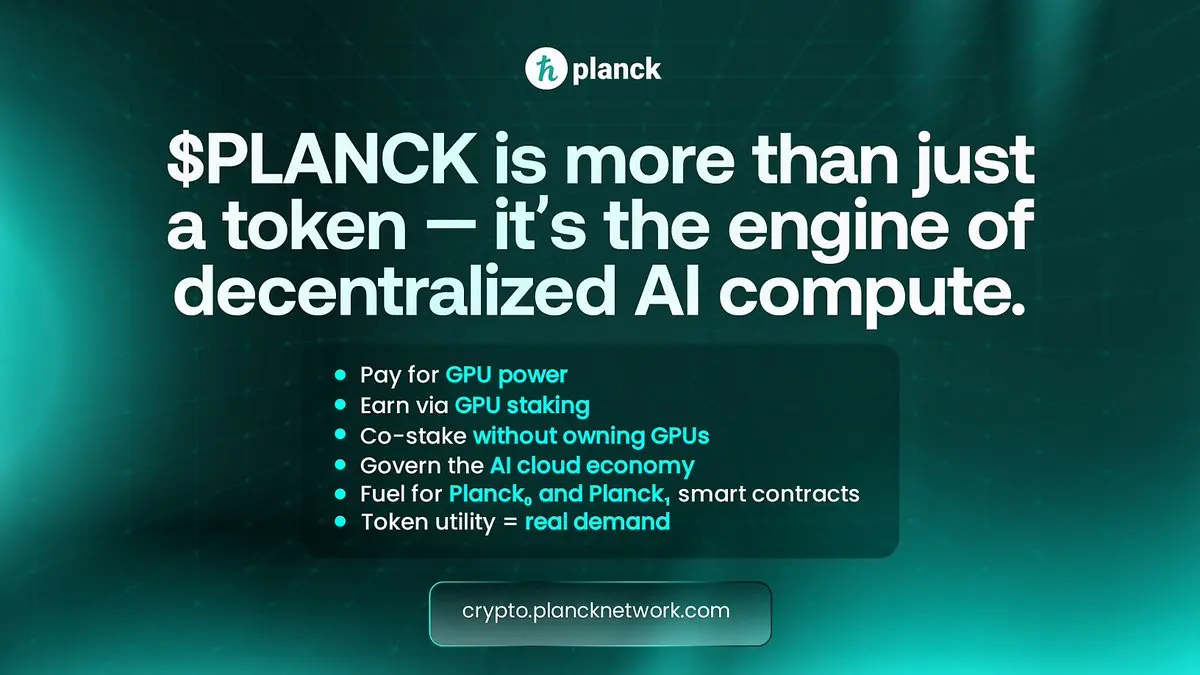
(Sources: Planck network)
Modular Layer-0 Architecture: Decentralizing AI Compute at Scale
Planck’s dual-layer stack—Planck₀ as a modular Layer-0 and Planck₁ as a GPU-native Layer-1—delivers shared validator infrastructure, cross-chain messaging via the Planck Tunnel (powered by VIA Labs), and tokenized GPU access, addressing the centralization plaguing hyperscalers where 80% of AI workloads run on AWS/Azure amid chip shortages and 2-5x markups. Traditional clouds impose vendor lock-in and 24-72 hour provisioning delays, while early DePINs like Render or Akash cap at 50% utilization due to siloed liquidity; Planck counters with proof-of-connectivity (uptime rewards) and proof-of-delivery (usage-based payouts) in $PLANCK, enabling sub-second GPU allocation at $0.50/hour for H100s—versus $2.50 on competitors—and EVM-compatible execution on Planck₁ for on-chain inference without token launches or L2s. Developers access via low-code AI Studio for model fine-tuning or bare-metal AI Cloud console, bridging to USDC rails for stable payments and reducing slippage by 95% through Chainlink oracles—composing seamlessly with Cosmos SDK for sovereign AI L1s and empowering unbanked regions with programmable compute, where Q3 pilots tokenized $20 million in RWAs for edge AI.
CEO Vision & Phased Rollout Blueprint
“Planck isn’t just infrastructure—it’s the coordination layer fusing AI intelligence with DePIN hardware, empowering builders to escape cloud monopolies and scale sovereign systems globally,” affirmed Diam Hamstra, CEO of Planck Network.
The post-mainnet roadmap intensifies:
- Q4 2025: $PLANCK TGE and token-claim portal, with co-staking live for GPU operators and 20% airdrop to early renters targeting $100 million TVL.
- Q1 2026: Enterprise SDKs for MiCA-compliant integrations, onboarding 50+ AI L1s via Planck₀ and $200 million in hardware expansions with Nvidia/AWS grants.
- Mid-2026: Full DePIN unification with IBC interoperability, embedding $PLANCK as a compute primitive for $500 million in tokenized yields and sovereign data markets.
Liquid staking incentives—yielding 15% APY on $PLANCK—have locked 30% of supply pre-TGE, with ChainGPT partnerships accelerating model discovery on the Pad platform.
From Vision to AI Infrastructure Powerhouse
Conceived in early 2025 by AI-blockchain veterans from Google Cloud, Nvidia, Coinbase, Polkadot, and NEAR, Planck emerged amid the AI compute crunch to merge DePIN with Layer-0 modularity, securing $7.5 million from Web3 luminaries like Brock Pierce (USDT co-founder) and Scott Walker (DNA Fund), plus $30 million+ in GPU commitments from Arcanum Ventures. Evolving from a February testnet that simulated $100 million in workloads with zero downtime (audited by PeckShield), it launched Planck₀ in July as the first AI-specific Layer-0, processing 1 million+ transactions in beta across 20 ecosystems. At a $150 million fully diluted valuation, Planck holds 5% of emerging DePIN TVL ($12 million current) with partnerships like CUTEC (Cambridge), Arkane Cloud, and BoostRun—outpacing Bittensor in hardware scale but trailing Fetch.ai in agent tooling, while grants from Microsoft and Google underscore its 20% share of Web3 AI pilots in a $50 billion sector projected to hit $200 billion by 2027.
Disclaimer: The information on this page may come from third parties and does not represent the views or opinions of Gate. The content displayed on this page is for reference only and does not constitute any financial, investment, or legal advice. Gate does not guarantee the accuracy or completeness of the information and shall not be liable for any losses arising from the use of this information. Virtual asset investments carry high risks and are subject to significant price volatility. You may lose all of your invested principal. Please fully understand the relevant risks and make prudent decisions based on your own financial situation and risk tolerance. For details, please refer to
Disclaimer.
Related Articles
ETH 8-Hour Average Funding Rate Turns Negative at -0.0016%
Summary: Ethereum funding rates are negative across major venues, with an 8-hour average of -0.0016%, indicating longs are paid by shorts; rates vary by platform, reflecting differing sentiment and leverage.
Abstract: This brief summarizes negative Ethereum funding rates across major exchanges, indicating short sellers pay long positions. It also notes platform-level variations, reflecting differing market sentiment and leverage across venues.
GateNews1h ago
Bitcoin, Ethereum and Solana ETFs Record Positive Net Inflows on April 21
Gate News message, according to the April 21 update, Bitcoin ETFs recorded a 1-day net inflow of 3,599 BTC (approximately $272.59 million) and a 7-day net inflow of 18,914 BTC (approximately $1.43 billion). Ethereum ETFs showed a 1-day net inflow of 34,380 ETH (approximately $79.25 million) and a 7-
GateNews2h ago
Charles Schwab to Launch Bitcoin and Ethereum Trading, Releases Educational Content on BTC
Charles Schwab plans to expand into crypto, offering Bitcoin education and direct BTC/ETH trading, allowing customers to buy Bitcoin in accounts; analysts call it a major mainstreaming moment.
Schwab announces an expansion into cryptocurrency with Bitcoin education and direct BTC/ETH trading, enabling clients to hold Bitcoin in their accounts; analysts view this as a turning point toward mainstream adoption.
GateNews2h ago
Newly Created Wallet Withdraws 35,000 ETH Worth $80.7M from Major CEX, Deposits into BitGo Custody
A newly created wallet withdrew 35,000 ETH (about $80.7M) from a major exchange within two hours, then transferred the full amount to a BitGo custody address.
Abstract: A new wallet moved 35,000 ETH (≈$80.7M) from a major exchange and deposited it into BitGo custody, per Lookonchain.
GateNews2h ago
SharpLink Earns 470 ETH in Staking Rewards Last Week
Gate News message, April 21 — SharpLink, an Ethereum treasury company, earned 470 ETH in staking rewards last week, bringing its cumulative staking rewards to 17,850 ETH.
GateNews3h ago
Ethereum Open Interest Falls $2B as Derivative Trading Stalls
Gate News message, April 21 — Ethereum's derivatives market saw a significant deleveraging event over the past week, with traders closing over $2 billion in futures positions. ETH open interest fell to $12.4 billion, according to Coinglass, marking the second major capitulation event in 30 days. ETH
GateNews3h ago


