Bitcoin (BTC) is accelerating towards mainstream asset status. The latest on-chain data shows that the total amount of Bitcoin held by publicly listed companies has surpassed 1 million for the first time, valued at over $111 billion at current prices. This milestone not only highlights the influx of institutional funds but also reveals the increasingly widening structural imbalance between BTC supply and demand.
The holdings of listed companies hit a record high
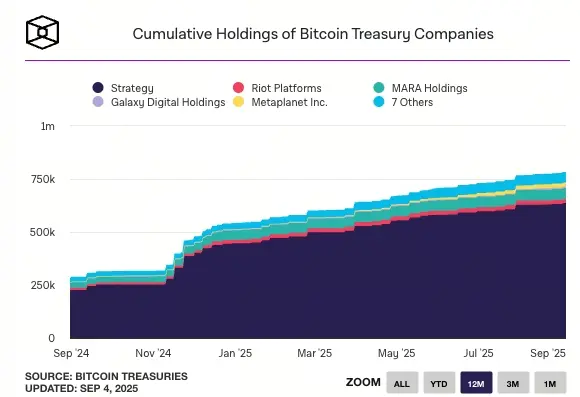
(Source: The Block)
According to statistics from BitcoinTreasuries, as of this Thursday, the total amount of Bitcoin held by publicly listed companies worldwide has surpassed 1 million coins, involving more than 100 enterprises. These companies include Bitcoin mining firms (such as Mara Holdings), technology and financial services companies (such as Metaplanet, Semler Scientific, GameStop), all of which have incorporated BTC into their balance sheets as part of their Digital Asset Treasury (DAT) strategy.
Bitcoin Treasuries President Pete Rizzo pointed out that despite reaching a historic milestone, institutional adoption is still in its early stages, “Many companies are just beginning to deploy long-term accumulation strategies, and there is still a large amount of capital yet to enter the market.”
Saylor's strategy leads the trend, more companies follow suit
The “HODL” strategy of Strategy founder Michael Saylor is regarded as a pioneering case for institutional BTC holdings. This model not only drove up the company's stock price but also increased the value of its Bitcoin assets, attracting more companies to follow suit.
Recently, the sales development company CIMG, listed on Nasdaq, announced the completion of a $55 million financing, which will be fully used to purchase BTC, becoming the latest member to join the “Bitcoin Treasury Club.”
Supply and demand imbalance is becoming increasingly apparent
Bradley Duke, the executive of Bitwise, commented on social media that the institutional holding of over 1 million BTC means that “approximately $111 billion worth of Bitcoin is being locked up long-term,” which will exacerbate the supply-demand imbalance in the market.
As of 10:53 AM Eastern Time on Thursday, the market capitalization of Bitcoin has exceeded 2 trillion USD, reporting at 110,142.10 USD, with an increase of over 90% in the past year. Against the backdrop of continuous depreciation of global fiat currencies, the appeal of BTC to institutional investors continues to rise.
Institution adoption is still accelerating
Rizzo expects that as Bitcoin continues to outperform fiat currencies in the global market, more publicly traded companies will incorporate BTC into their balance sheets in the future.
“There are over 50,000 publicly traded companies worldwide, and currently only a little over a hundred hold Bitcoin, which means there is enormous potential for growth,” he added.
Conclusion
Institutional holdings of Bitcoin have surpassed 1 million coins, marking an acceleration of digital assets' penetration into the traditional financial system. From the pioneering strategy of Saylor to the aggressive positioning of new entrants like CIMG, BTC's status as “digital gold” is gradually solidifying. As more capital enters the market, the imbalance in supply and demand may drive prices further upward. Investors should closely monitor the flow of institutional funds and the global policy environment, as these will be key drivers for the next phase of Bitcoin's market.
Disclaimer: The information on this page may come from third parties and does not represent the views or opinions of Gate. The content displayed on this page is for reference only and does not constitute any financial, investment, or legal advice. Gate does not guarantee the accuracy or completeness of the information and shall not be liable for any losses arising from the use of this information. Virtual asset investments carry high risks and are subject to significant price volatility. You may lose all of your invested principal. Please fully understand the relevant risks and make prudent decisions based on your own financial situation and risk tolerance. For details, please refer to
Disclaimer.


