This week, the market capitalization of the Crypto Assets market shrank from 4 trillion dollars to 3.8 trillion dollars, with approximately 200 billion dollars in funds withdrawn, but Bitcoin (BTC) and Ethereum (ETH) still firmly occupy the market’s dominant position. Although the pump in ETH has boosted its market share, the “peak season” for the altcoin market has yet to arrive, indicating that the flow of funds in this cycle is fundamentally different from that of 2021.
Capital Outflow of 200 Billion USD, Blue Chips Still Hold the Lead
This week, although BTC and ETH have fallen below some key price levels, they remain the main recipients of capital inflows. BTC’s market capitalization has reached a record 2.4 trillion USD, while ETH’s market capitalization has rebounded to a high point since November of last year, but is still below the peak of 550 billion USD in May 2021.
Data shows that the market capitalization gap between BTC and ETH has expanded from 750 billion dollars four years ago to 1.865 trillion dollars, meaning that BTC’s growth rate in this cycle is 2.5 times that of ETH.
ETH dominance rising ≠ alts season
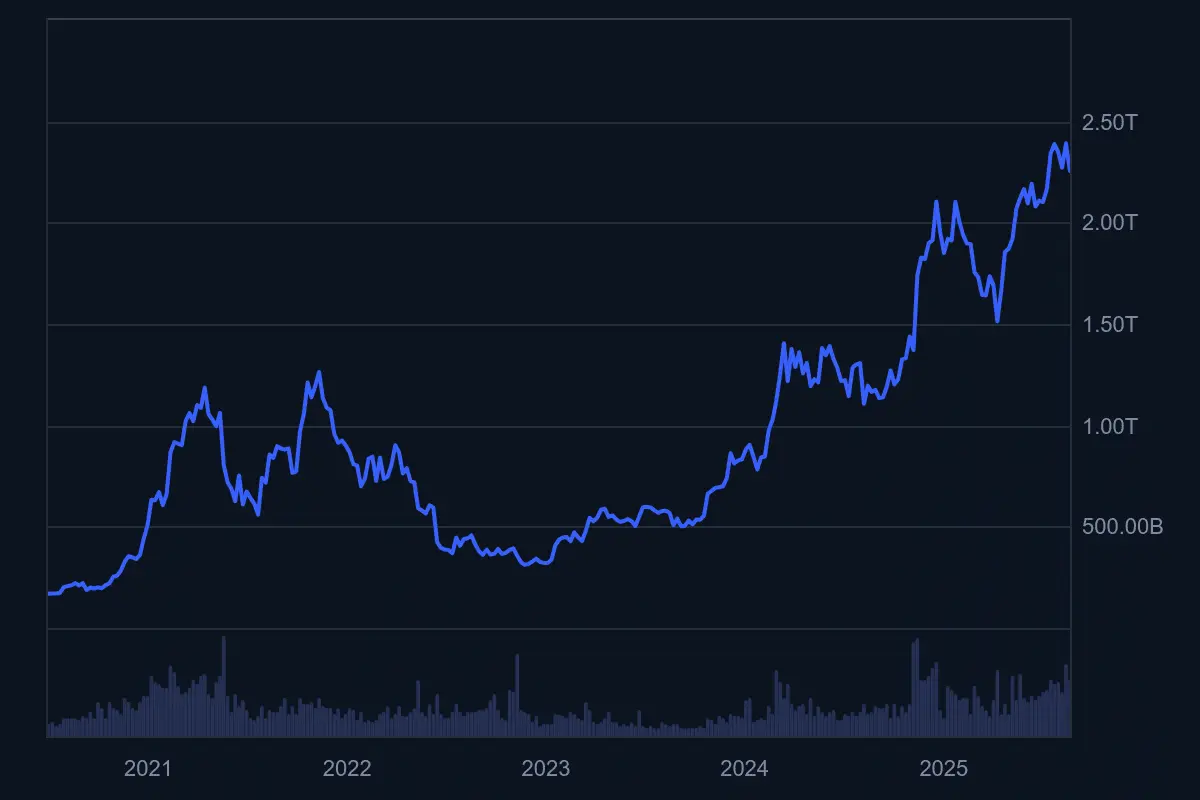
(Source: CoinMarketCap)
The market share of ETH (ETH.D) rose from 9.5% to 14%, reaching a nearly two-year high, but this does not indicate a full activation of the altcoin market.
The altcoin season index has dropped from 56 points last week to 51 points, marking the fourth consecutive failure to break through. Historically, whenever this index fails to exceed 60 points, funds tend to flow back to BTC, leading to a halt in the altcoin market.
Bitcoin remains the market’s “North Star”
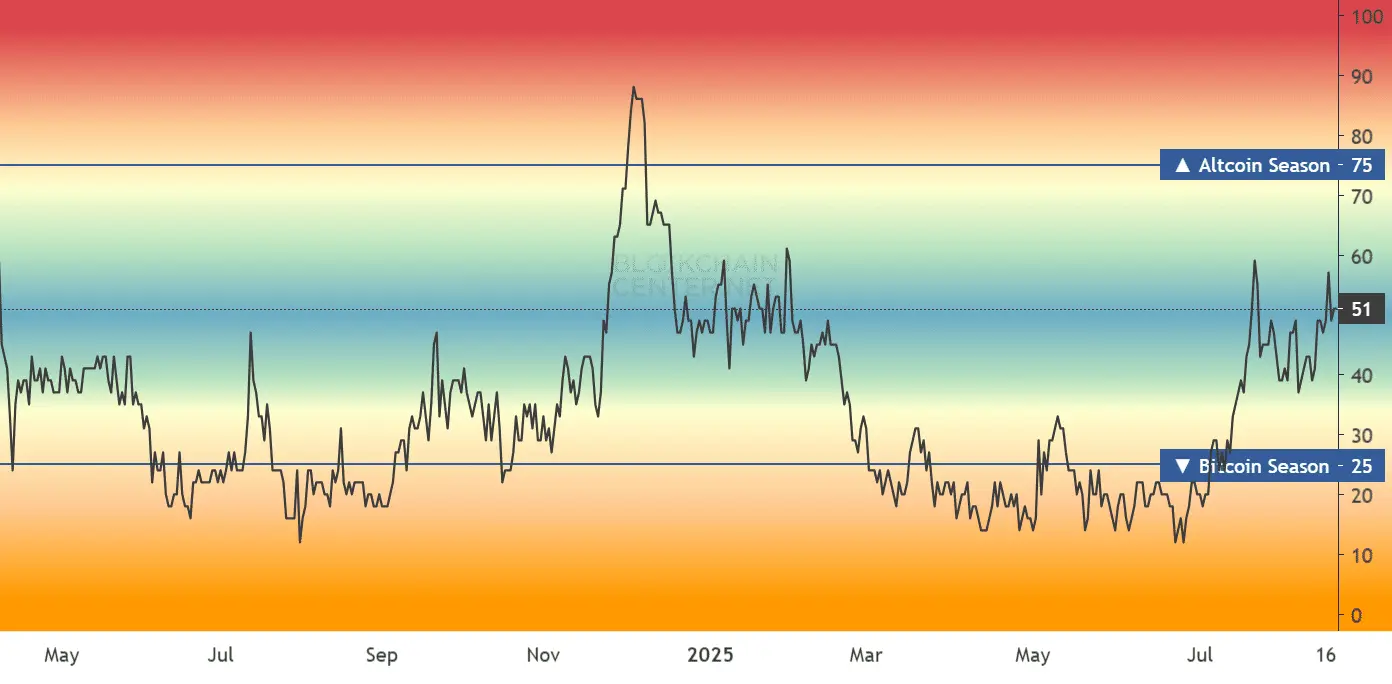
(Source: Blockchaincenter)
Even though the market share of BTC (BTC.D) has fallen from 65% to 59%, it remains the core asset of the market.
TOTAL2 (market capitalization excluding BTC) dropped by 4.56% this week, evaporating over $100 billion, while BTC only fell by 3.1%. This means that traders are more inclined to hold BTC under market uncertainty, while alts are facing greater selling pressure.
Key Differences Between 2025 and 2021
In the bull market of 2021, the rise of ETH often accompanied a widespread explosion of alts; whereas in the current cycle of 2025, the relative strength of ETH is more a result of capital hedging rather than broad market rotation.
This structural difference means that even if ETH performs better than other alts, it does not necessarily trigger a full altseason.
Conclusion
The current crypto market shows a funding structure that is drastically different from 2021: the dominance of blue-chip cryptocurrencies is more solidified, and the hype in the altcoin market is hard to sustain. Investors should be cautious not to misinterpret the relative rise of ETH as a signal for altcoin season, and closely monitor the market share changes of BTC and ETH, as they remain the true barometers of the market. For more real-time quotes and on-chain analysis, please follow the official Gate platform.
Disclaimer: The information on this page may come from third parties and does not represent the views or opinions of Gate. The content displayed on this page is for reference only and does not constitute any financial, investment, or legal advice. Gate does not guarantee the accuracy or completeness of the information and shall not be liable for any losses arising from the use of this information. Virtual asset investments carry high risks and are subject to significant price volatility. You may lose all of your invested principal. Please fully understand the relevant risks and make prudent decisions based on your own financial situation and risk tolerance. For details, please refer to
Disclaimer.


