The much-anticipated year-end surge in digital assets collapsed into a severe crypto crash, marking the worst quarterly decline since the 2022 bear market depths.
Expectations built around robust digital asset treasuries, new altcoin ETFs, and bitcoin’s historical seasonal strength all unraveled, leaving the market vulnerable to cascading liquidations and fading liquidity. A devastating $19 billion wipeout in October eroded market depth, while subsequent price recoveries appeared driven primarily by short squeezes rather than organic buying interest.
As enthusiasm for ETFs wanes and several treasuries trade below net asset value—risking potential forced sales—the crypto crash has stripped away major bullish narratives heading into 2026. With rate cuts failing to ignite risk appetite and no immediate catalysts in sight, the ongoing crypto crash highlights a fragile ecosystem still prone to sharp reversals despite growing institutional participation. Capitulation from over-leveraged holders could eventually pave the way for a bottom, though near-term risks remain elevated.
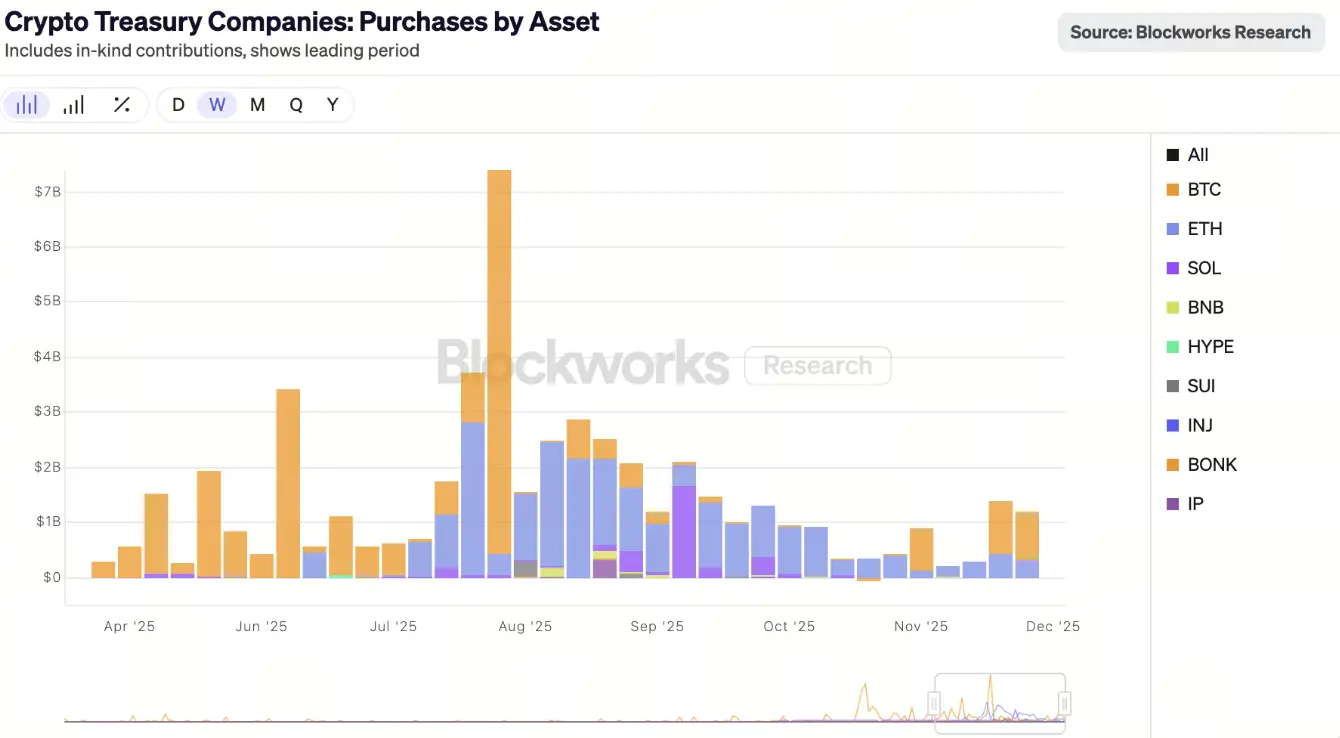
(Sources: Blockworks)
Key Highlights
- The crypto crash delivered bitcoin’s steepest Q4 drop in years, defying historical seasonality and expected tailwinds from ETFs and treasuries.
- Digital asset treasuries shifted from aggressive buyers to potential forced sellers as premiums evaporated and shares traded below NAV.
- Altcoin ETFs attracted billions in inflows but failed to prevent underlying token prices from plunging amid broader risk aversion.
- October’s massive liquidation event created a persistent liquidity void, with rebounds fueled mainly by short covering.
- The crypto crash leaves the market entering 2026 without clear positive drivers, raising odds of further downside pressure.
Crypto Crash: From Bullish Expectations to Harsh Reality
Optimism heading into late 2025 centered on strong ETF demand, proliferating digital asset treasuries modeled after high-profile strategies, and bitcoin’s proven track record of fourth-quarter gains. Looser monetary policy and a potentially supportive regulatory environment further fueled projections of new all-time highs.
Instead, the crypto crash materialized swiftly, with bitcoin shedding 23% since October’s start—underperforming surging equities and precious metals dramatically.
Digital Asset Treasuries Fuel the Crypto Crash
Initially hailed as a powerful accumulation mechanism, digital asset treasuries rapidly lost momentum during the crypto crash. Early enthusiasm gave way to sharp sell-offs as share prices collapsed, pushing many below net asset value and halting capital raises.
Purchasing activity dried up entirely for most, with funds redirected toward share buybacks. Extreme cases saw bitcoin holdings valued at multiples of enterprise value, heightening concerns of involuntary liquidations that could exacerbate the crypto crash.
Altcoin ETFs Fail to Stem the Crypto Crash
Spot altcoin ETFs launched amid high hopes but arrived during worsening sentiment, unable to counteract the crypto crash. Solana vehicles accumulated $900 million and XRP products exceeded $1 billion in inflows, yet underlying tokens suffered steep declines—SOL down 35% and XRP nearly 20% post-launch.
Smaller altcoin ETFs attracted minimal interest as risk tolerance evaporated, underscoring how inflows alone couldn’t arrest the broader crypto crash.
Seasonality Breaks Down in Historic Crypto Crash
Bitcoin’s reliable year-end strength—averaging 77% Q4 returns since 2013 with positive performance in most years—crumbled during this crypto crash. The current trajectory positions 2025 for one of the weakest final quarters on record, aligning with prior deep bear phases rather than typical bullish patterns.
Liquidity Damage Prolongs the Crypto Crash
October’s explosive $19 billion liquidation event not only triggered immediate losses but inflicted lasting harm during the crypto crash. Market depth remains impaired months later, amplifying volatility and deterring leveraged participation.
Post-low recoveries have coincided with declining open interest, confirming short covering as the primary driver rather than conviction buying—a dynamic that leaves the crypto crash vulnerable to renewed selling.
Outlook Following the 2025 Crypto Crash
The crypto crash has exposed the limits of 2025’s narrative drivers, from fading ETF momentum to treasury vulnerabilities and ineffective rate cuts. Bitcoin’s relative underperformance against traditional risk assets signals exhausted bullish themes.
While forced unwinds could intensify near-term pain, historical parallels suggest that peak capitulation often marks attractive re-entry points. For now, the crypto crash dominates sentiment, with meaningful catalysts scarce on the 2026 horizon.
Disclaimer: The information on this page may come from third parties and does not represent the views or opinions of Gate. The content displayed on this page is for reference only and does not constitute any financial, investment, or legal advice. Gate does not guarantee the accuracy or completeness of the information and shall not be liable for any losses arising from the use of this information. Virtual asset investments carry high risks and are subject to significant price volatility. You may lose all of your invested principal. Please fully understand the relevant risks and make prudent decisions based on your own financial situation and risk tolerance. For details, please refer to
Disclaimer.
Gerelateerde artikelen
地缘冲突与通胀预期交织:伊朗警告军事反击,美布两油大涨
伊朗警告将实施军事反击,美布两油大涨超4%。霍尔木兹海峡封锁风险升温,油价暴涨对加密挖矿、通胀预期与资金流向会有什么样的影响?
GateInstantTrends9m geleden
Bitcoin Holds Above $77,100 on April 29 as ETF Outflows Extend Ahead of FOMC
According to The Block's price data, Bitcoin traded above $77,100 on April 29 ahead of the Federal Reserve's policy decision, with intraday range between $75,689 and $77,837. U.S. spot Bitcoin ETFs recorded $89.68
GateNews32m geleden
GSR Launches Crypto Core3 ETF Focusing on Bitcoin, Ethereum, and Solana
According to Coindesk, GSR launched Crypto Core3 ETF, a cryptocurrency fund focusing on Bitcoin, Ethereum, and Solana, recently on April 29. The fund employs a weekly rebalancing strategy to dynamically adjust position allocations across the three assets, and incorporates staking yields from Ethereu
GateNews1u geleden
Czech Central Bank Governor Makes Case for Bitcoin in Reserves at Bitcoin 2026, Citing 1% Allocation Analysis
According to The Block, at the Bitcoin 2026 conference in Las Vegas, Czech National Bank Governor Ales Michl delivered a keynote titled "Diversifying Central Bank Reserves With Bitcoin," arguing that central banks should consider holding bitcoin as a portfolio diversifier. Michl said the CNB's
GateNews1u geleden
Bitcoin Capped at $82K Sell Wall as UAE OPEC Exit Triggers Oil Surge
Bitcoin retreated on Tuesday following the United Arab Emirates' announcement to exit OPEC effective May 1, with the move sending oil prices surging and pressuring broader financial markets, according to the article. Bitcoin dropped from $79,260 on April 27 to an intraday low of $75,849 on Tuesday a
CryptoFrontier2u geleden
Bhutan's Bitcoin Address Transfers 102 BTC Worth $7.89M in Latest Move
According to Arkham data, Bhutan's bitcoin address transferred 102 BTC approximately three hours ago on April 29, worth around $7.89 million. The receiving address now holds a total of 184 BTC previously transferred by Bhutan.
GateNews2u geleden


