Original | Odaily
Author | Husband How
As one of the “Four Kings” of L2, Arbitrum has recently attracted a lot of attention - the ArbOS upgrade of the core components, which is known as the first “hard fork” proposal in L2.
Odaily interprets the content of this proposal and understands how Arbitrum’s ArbOS upgrade will affect Arbitrum’s ecosystem.
What is the ArbOS upgrade?
ArbOS is the operating system for Arbitrum’s AVM (Virtual Machine). ArbOS is responsible for tracking and managing network resources, generating blocks from incoming messages, and executing smart contracts through its own Geth instance.
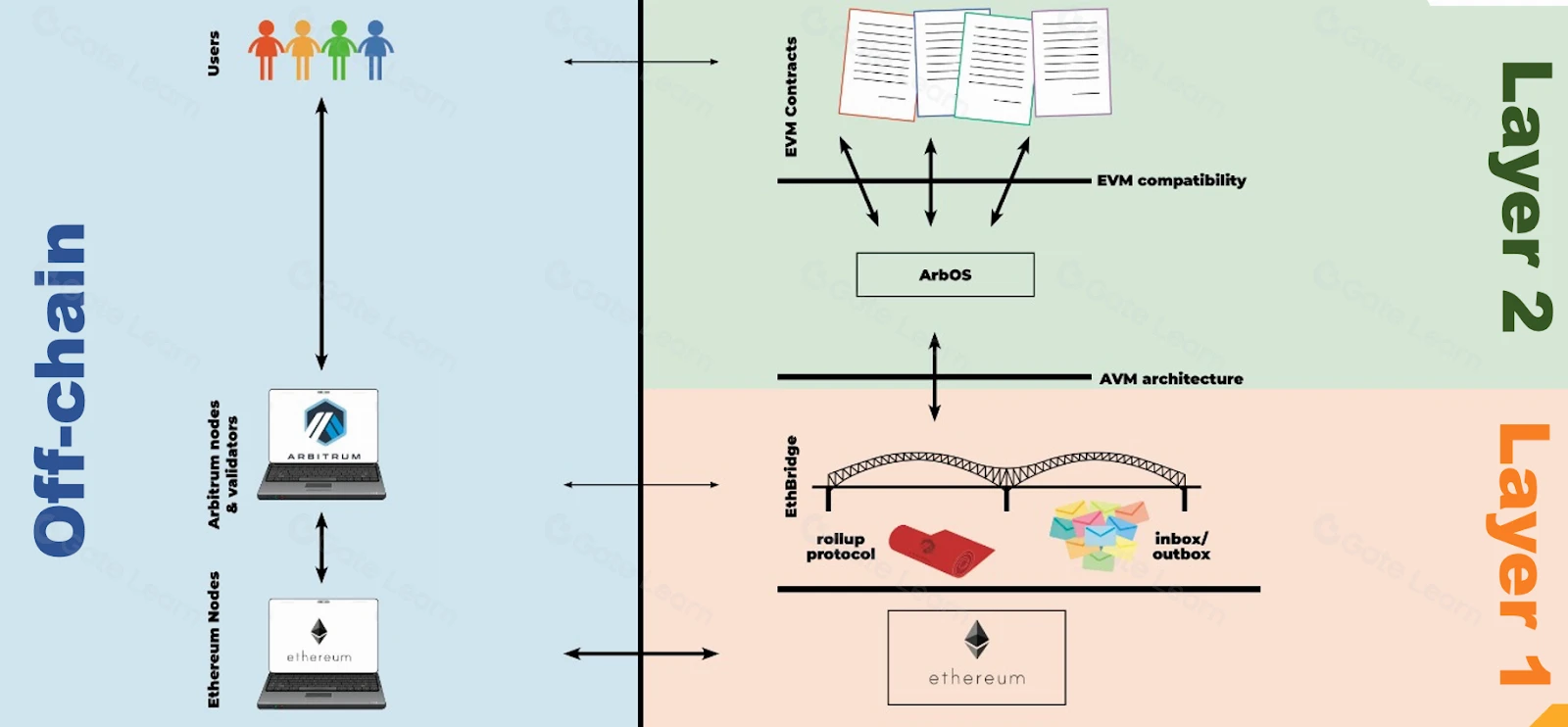
As you can see from the diagram above, you can see the importance of ArbOS in Arbitrum.
Arbitrum’s network structure is simplified into 5 parts:
- The ETH square is the ground floor of Arbitrum to ensure the security of the second floor;
- Verify the accuracy of the operation between the ETH and L2 by bridging the smart contract on the ETH;
- The AVM structure guarantees that the content output by the bridge smart contract on the ETH workshop can be recognized by Arbitrum.
- ArbOS is similar to an operating system, the glue component that helps the Arbitrum network function properly;
- Finally, ArbOS provides EVM compatibility for Arbitrum.
As an example, let’s say you have a DApp running on Arbitrum that needs to communicate with other chains and perform smart contract operations. ArbOS, as part of Arbitrum, will be responsible for tracking and processing messages from other chains, converting them into L2 blocks, and performing smart contract operations. It can also provide specific features such as cross-chain communication with other chains or resource billing through precompilation. With ArbOS support, DApps can run on Arbitrum at a lower cost and with greater efficiency, and are interoperable with other chains.
It can be seen that ArbOS plays a role as a link between the previous and the next, which can be compared to the client software of the L1 public chain. The impact of this ArbOS upgrade is no less than a “fork” of the public chain. However, compared with the upgrade of the L1 public chain, the upgrade of the core components of L2 will not cause the possibility of a real hard fork.
While ArbOS is upgraded, individual node operators need to coordinate the upgrade of their software, which may result in different versions of ArbOS running on the node, resulting in two inconsistent historical versions of the chain. However, the advantage of L2 is that L2 needs to verify the correctness of the state of the ETH square on the mainnet through the bridge smart contract “Arbitrum Bridge” of the ETH. This avoids forking due to consensus.
Because during the ArbOS upgrade process, validators can make claims about the state of the chain, and other validators can challenge it. The bridge contract will adjudicate these challenges and ensure that the bridge’s view of the Arbitrum chain is accurate through a series of assertions and fraud proofs. This ensures that only chains that are consistent with the rules set forth by the Arbitrum bridge contract are canonical chains.
What will be the impact of the ArbOS upgrade?
According to the description of the official proposal, this upgrade will not have much impact on the entire Arbitrum as a whole, and will be more about the support for the EVM Shanghai upgrade and PUSH 0 opcode, as well as various bug fixes. These improvements have now been reviewed and are ready for adoption, and the proposal is also for Arbitrum One and Arbitrum Nova.
This upgrade has a high correlation with the underlying validators and a low correlation with ordinary users. Judging from the current percentage of votes, the approval rate is as high as 99.79%, and the probability of passing is extremely high. At that time, we will determine whether a series of on-chain operations such as transfers can be carried out during this upgrade according to the official news.
Disclaimer: The information on this page may come from third parties and does not represent the views or opinions of Gate. The content displayed on this page is for reference only and does not constitute any financial, investment, or legal advice. Gate does not guarantee the accuracy or completeness of the information and shall not be liable for any losses arising from the use of this information. Virtual asset investments carry high risks and are subject to significant price volatility. You may lose all of your invested principal. Please fully understand the relevant risks and make prudent decisions based on your own financial situation and risk tolerance. For details, please refer to
Disclaimer.


