


Ethereum 2026: Interpreting EF's latest protocol roadmap and officially entering the "engineering upgrade" era?
Written by: imToken
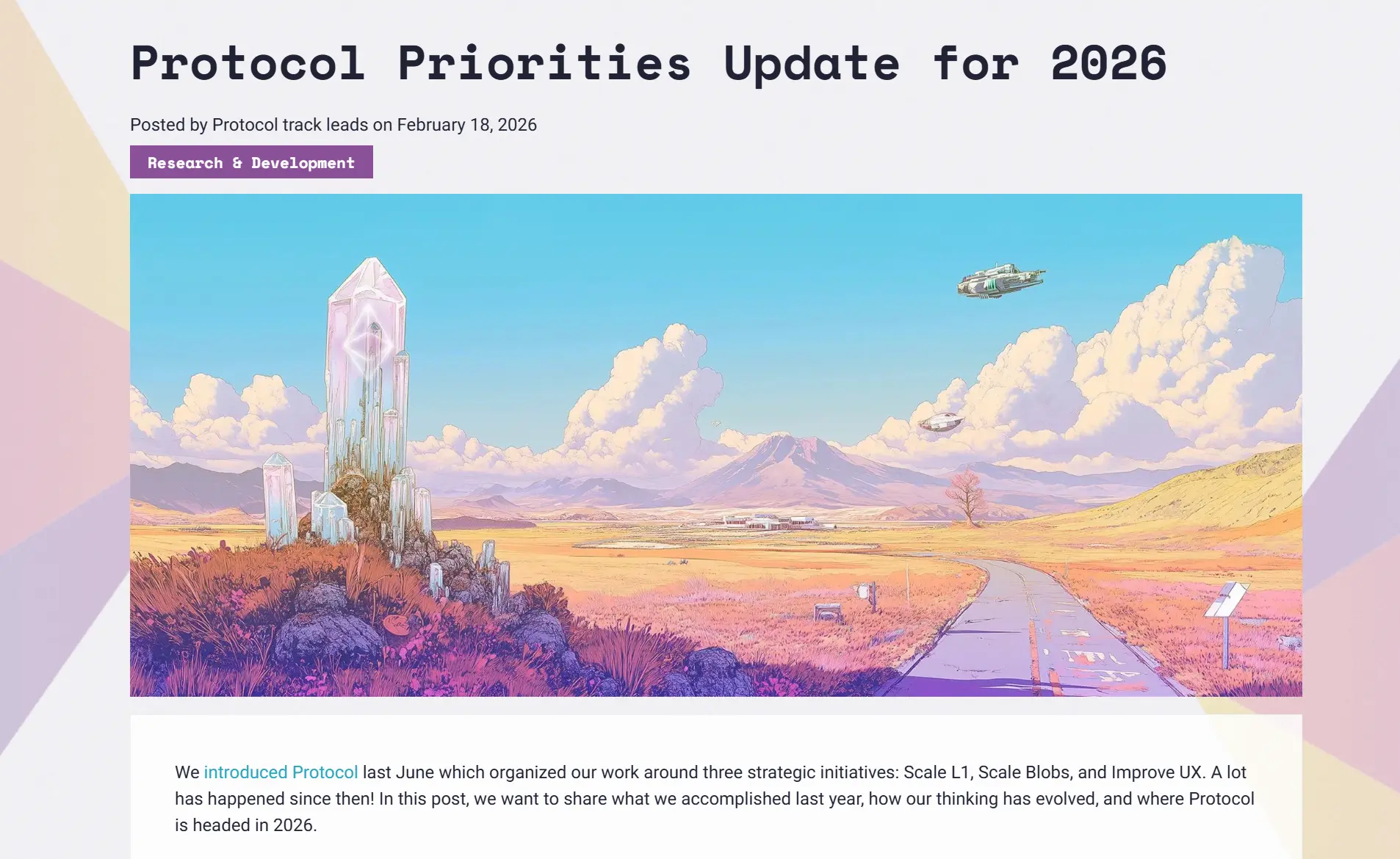
On February 18, the Ethereum Foundation (EF) released the “Protocol Priorities Update for 2026.” Compared to previous fragmented updates centered around EIPs, this roadmap resembles a strategic schedule, clarifying the upgrade pace, priority allocation, and the three main themes that the protocol layer will focus on over the next year: Scale, Improve UX, Harden the L1.
Behind this, from the successful delivery of two hard forks in 2025 (Pectra/Fusaka) to the early planning of dual mainline upgrades in 2026 (Glamsterdam and Hegotá), we see a deep shift in Ethereum’s development toward “predictable engineering delivery.” This may be the most significant protocol signal in recent years.
1. Ethereum in 2025: Turmoil and Institutionalization
If you follow Ethereum closely, you know that 2025 was a year of contradictions for the protocol. ETH price may have hovered at lows, but the protocol layer underwent unprecedented intensive changes.
Especially in early 2025, Ethereum experienced a rather tumultuous period. At that time, EF was at the center of a storm of public opinion—community criticism was loud, and some even called for a “wartime CEO” to push reforms. Eventually, internal power struggles became public, leading to the highest-level leadership restructuring since EF’s founding:
- In February, Executive Director Aya Miyaguchi was promoted to President, with Vitalik Buterin pledging to overhaul the leadership;
- Subsequently, Hsiao-Wei Wang and Tomasz K. Stańczak took on joint executive director roles;
- Former researcher Danny Ryan led the new marketing narrative agency Etherealize;
- EF further restructured the board, emphasizing core values rooted in cypherpunk principles;
- By mid-year, the foundation reorganized its R&D department, consolidating teams and personnel to focus on key protocol priorities.
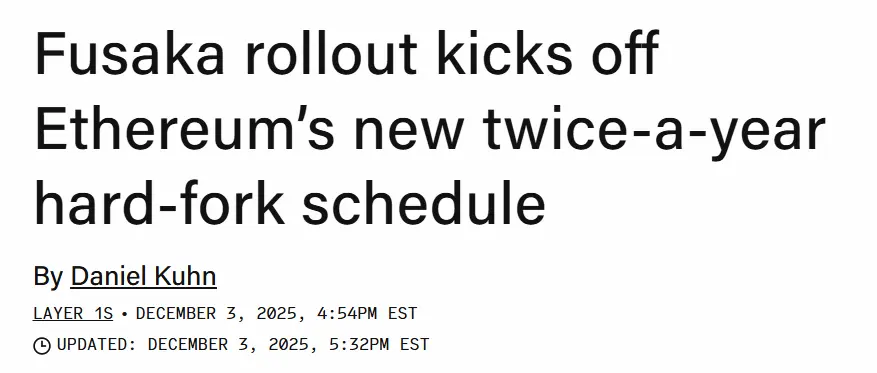
This combination of moves proved effective—Ethereum’s execution capability significantly strengthened. Notably, just seven months after the Pectra upgrade in May, the successful deployment of Fusaka at year’s end demonstrated that EF, despite major leadership changes, still had the capacity to deliver major updates. It also marked Ethereum’s entry into an accelerated development rhythm of “two hard forks per year.”
Since the network’s switch to PoS via The Merge in September 2022, Ethereum has typically aimed for one major upgrade annually—such as the Shapella upgrade in April 2023 and the Dencun upgrade in March 2024: the former enabling staked ETH withdrawals, a key step in PoS transition; the latter introducing EIP-4844, opening the Blob data channel, significantly reducing L2 costs.
In 2025, Ethereum completed two major hard forks—Pectra and Fusaka—and more importantly, it systemically planned for the next two years’ upgrades: Glamsterdam and Hegotá.
Although not explicitly mandated, interestingly, at the end of last year, The Block cited sources from Consensys stating that since The Merge, researchers aimed for one major upgrade per year. Now, they are planning to “accelerate the hard fork schedule to every six months,” and openly acknowledged that Fusaka initiated a cycle of “two upgrades per year.”
This “institutionalization” of upgrade cadence is quite milestone-worthy. The reason is simple: previously, release timing depended heavily on development readiness, making the window unpredictable for developers and infrastructure providers. Those familiar know delays were common.
This also means that the successful delivery of two major upgrades in 2025 validated the feasibility of “biannual upgrades.” The first systematic plan for two named upgrades in 2026 (Glamsterdam and Hegotá), with three development tracks prioritizing these milestones, further institutionalizes this process.
In essence, it’s akin to the release rhythm of Apple or Android systems—aimed at reducing developer uncertainty. This could bring three positive effects: increased predictability for L2 (e.g., rollups can plan parameter adjustments and protocol adaptations in advance); clearer windows for wallet and infrastructure compatibility, enabling product teams to plan feature rollouts; and stable risk assessment cycles for institutions, as upgrades become routine rather than sudden events.
This structured rhythm reflects engineering management practices and highlights Ethereum’s shift from research exploration to engineering delivery.
2. The “Three Pillars” of Protocol Development in 2026
Looking at the 2026 protocol priorities, EF no longer simply lists scattered EIPs but reorganizes protocol development into three strategic directions: Scale, Improve UX, and Harden the L1.
First, Scale combines the previous “Scale L1” and “Scale blobs” initiatives because EF recognizes that L1 execution layer scaling and data availability are two sides of the same coin.
In the upcoming Glamsterdam upgrade in the first half of the year, the most notable technology is “Block-level Access Lists,” which aims to fundamentally change Ethereum’s transaction execution model—shifting from a sequential “single-lane” process to parallel “multi-lane” processing:
- Block producers will precompute and mark which transactions can run concurrently without conflicts. Clients can then assign transactions to multiple CPU cores for parallel processing, greatly boosting efficiency.
- Additionally, ePBS (embedded proposer-builder separation) will be included, integrating the current MEV-Boost relay-dependent process into the protocol itself. This reduces centralization risk and provides more time for validators to verify ZK proofs.
Alongside these low-level optimizations, gas limit competition will intensify in 2026, with EF targeting “over 100 million” gas limit. Some predict that after ePBS, the gas limit could double to 200 million or more. For L2s, increasing blob capacity is also critical—each block could support over 72 data blobs, enabling L2 networks to process hundreds of thousands of transactions per second.
Second, Improve UX aims to eliminate cross-chain barriers, promote interoperability, and advance native account abstraction. As mentioned earlier, EF believes that solving L2 fragmentation hinges on making Ethereum “feel like a single chain” again—this depends on the maturity of the “intent” architecture.
For example, the Open Intents Framework, developed by EF and multiple teams, is becoming a universal standard. It allows users to transfer assets across L2s by simply declaring “desired results,” with the underlying solver network calculating complex paths (see “When ‘Intent’ Becomes Standard: How OIF Will End Cross-Chain Fragmentation and Return Web3 to User Intuition”). Further, the Ethereum Interoperability Layer (EIL) aims to build a trustless transmission layer, enabling cross-L2 transactions to have the same experience as on a single chain (see “Ethereum Interop Roadmap: Unlocking the ‘Last Mile’ for Mass Adoption”).
At the wallet level, native account abstraction remains a key focus. After the first step with EIP-7702 in Pectra 2025, EF plans to push proposals like EIP-7701 or EIP-8141 in 2026, with the goal that every wallet on Ethereum becomes a smart contract wallet—eliminating the need for complex EOAs and third-party gas relayers.
Additionally, implementing fast confirmation rules for L1 will drastically reduce confirmation times from 13-19 minutes to 15-30 seconds, directly benefiting cross-chain applications relying on L1 finality—crucial for bridges, stablecoin settlements, and RWA asset trading.
Finally, Harden the L1 targets trillion-dollar security defenses, driven by the increasing value locked in the Ethereum ecosystem.
In terms of censorship resistance, FOCIL (Fork Choice Inclusion List, EIP-7805) is emerging as a core solution. It grants multiple validators the power to enforce inclusion of specific transactions, ensuring that even if block producers attempt censorship, honest nodes can still get user transactions on-chain.
Facing the long-term threat of quantum computing, EF has assembled a post-quantum (PQ) research team early this year. In 2026, their focus will be on studying quantum-resistant signature algorithms and exploring seamless migration strategies to the mainnet, safeguarding assets worth billions from future quantum attacks.
3. Ethereum’s “Collaborative” Future
Overall, if we had to summarize 2026 for Ethereum in one word, it might be “collaboration.”
The upgrades will no longer revolve around a single explosive innovation but will advance through the coordinated effort of three main tracks: Scale (throughput and cost), Improve UX (usability and adoption), and Harden the L1 (security and neutrality). These collectively determine whether Ethereum can support the next decade of on-chain economy.
More importantly, beyond the technical roadmap, this “three-track” structure reflects a strategic shift.
As noted earlier, when Fusaka’s upgrade completes at the end of 2025 and the biannual hard fork rhythm is established, Ethereum effectively completes a “systematization” of its development model. The 2026 priority update further extends this institutionalization into the realm of technical planning—where previously, upgrades often centered around a “star proposal” (like EIP-1559, Merge, EIP-4844), now the process is driven by the coordinated progress of three tracks.
From a macro perspective, 2026 is also a pivotal year for Ethereum’s “value narrative” reconstruction. In recent years, market valuation has largely been driven by “L2 scaling and fee growth.” But as mainnet performance improves and L2 shifts from “sharding” to “trust spectrum,” Ethereum’s core value is re-anchored as “the most secure settlement layer globally,” an irreplaceable position.
What does this mean? Simply put, Ethereum is transitioning from a platform reliant on “transaction fee revenue” to an asset anchored by “security premium.” This shift could have profound implications over the coming years—when stablecoin issuers, RWA tokenization firms, and sovereign wealth funds choose a settlement layer, they will prioritize security over cost.
Ethereum is evolving from a “tech experiment” into an “engineering delivery platform,” with its governance system maturing in 2026.
We may be at a fascinating node: as underlying technologies grow more complex (parallel execution, PQ algorithms), user experience becomes simpler. The maturation of account abstraction and intent frameworks is pushing Ethereum toward that ideal endpoint—making Web3 intuitive for users.
If achieved, 2026 could see Ethereum transforming from a blockchain experiment into a global financial infrastructure capable of supporting trillions of dollars in assets, with users unaware of the underlying protocols.
Related Articles
Bitcoin ETF inflow strength rebounds: over $500 million poured in in a single day, hitting a 3-week high
Data: If ETH falls below $1,887, the total long liquidation strength on major CEXs will reach $705 million.
Bitmine buys the dip again! Tom Lee is optimistic about Ethereum with "three major bullish factors" supporting it