The latest report from blockchain analysis company TRM Labs reveals that Iran’s crypto assets market experienced a significant cooling in the first seven months of 2025, with total inflows amounting to approximately $3.7 billion, a decline of 11% compared to the same period last year. This drop is related to multiple shocks, including the breakdown of nuclear negotiations with Israel, the $90 million hack of Nobitex, and Tether’s largest-ever asset freeze related to Iran.
Israel Conflict and Economic Turmoil Trigger Market Decline
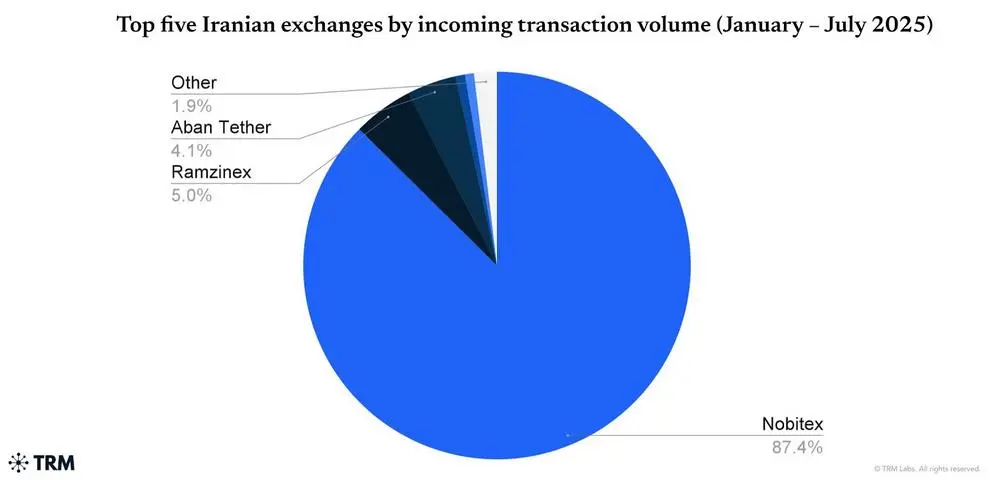
(Source: TRM Labs)
TRM Labs pointed out that June and July were the periods of the most severe falls, coinciding with the 12-day Israel conflict that erupted on June 13, the breakdown of nuclear negotiations, and nationwide blackouts.
These power outage incidents are considered a significant blow to market sentiment due to the combined effects of Israel’s kinetic and cyber actions, as well as internal strategies of the Iranian government.
Nobitex hacking incident severely undermines market confidence
Iran’s largest crypto assets exchange, Nobitex, handles 87% of the country’s trading volume, but on June 18, it was breached by the pro-Israel organization Predatory Sparrow, resulting in losses of up to $90 million.
After the event occurs:
-
Liquidity is hindered, and transaction processing speed decreases.
-
Users are shifting to other platforms in the short term.
-
The market’s trust in Iranian Virtual Asset Service Providers (VASP) has declined.
TRM pointed out that during the worst week, capital outflows surged by 150%, with a large amount of funds flowing into high-risk foreign exchange exchanges that lack “Know Your Customer” (KYC) procedures.
Tether Blacklist Action Intensifies Fund Transfer
On July 2, the stablecoin issuer Tether blacklisted 42 addresses holding USDT and froze the associated funds, marking its largest-scale sanction action against Iranian funds.
This move has triggered a collaborative action among Iranian exchanges, opinion leaders, and government-supported channels to promote users:
-
Uninstall TRON-based USDT (the most commonly used stablecoin network in Iran)
-
Transfer funds to Dai (DAI) on Polygon.
Nevertheless, TRM emphasizes that many people in Iran still rely on stablecoins to hedge against inflation and evade sanctions.
The Political and Economic Uses of Crypto Assets
The TRM report also pointed out that Iran continues to use Crypto Assets to pay Chinese chip dealers for the procurement of artificial intelligence, drones, and other sensitive electronic equipment, thereby circumventing international sanctions.
In addition, encryption funds have also been used to support intelligence operations of overseas agents.
However, illegal transactions account for less than 1% of the total crypto asset transactions in Iran.
Conclusion
The Iranian crypto market faces unprecedented pressure in 2025: geopolitical conflicts, exchange security incidents, and international sanctions have led to a double-digit decline in trading volume. Although stablecoins remain a hedging tool for the Iranian people, market confidence and liquidity have been severely impacted, and future trends will depend on geopolitical conditions and international regulatory dynamics.
Disclaimer: The information on this page may come from third parties and does not represent the views or opinions of Gate. The content displayed on this page is for reference only and does not constitute any financial, investment, or legal advice. Gate does not guarantee the accuracy or completeness of the information and shall not be liable for any losses arising from the use of this information. Virtual asset investments carry high risks and are subject to significant price volatility. You may lose all of your invested principal. Please fully understand the relevant risks and make prudent decisions based on your own financial situation and risk tolerance. For details, please refer to
Disclaimer.


