Iranian President Masoud Pezeshkian said that any decision to end the war with the United States and Israel must guarantee the security and interests of the Iranian people, reaffirming conditions Tehran has held since hostilities began.
Tehran Holds Firm on Reparations, Rights as Conflict Continues
Speaking at a cabinet meeting reported by state news agency IRNA on March 30, 2026, Pezeshkian told ministers that peace talks carry no meaning unless Iran receives firm protections against future attacks. The remarks follow more than a month of direct military conflict that began Feb. 28, 2026, when U.S.-Israeli forces struck Iranian targets in what Tehran has described as unprovoked aggression.
Iranian officials report more than 1,340 deaths since the offensive began, including Supreme Leader Ayatollah Ali Khamenei. Iran has responded with drone and missile strikes against Israeli territory and U.S.-linked assets in Jordan, Iraq, and Gulf countries, escalating a conflict that has disrupted regional markets, infrastructure, and air travel.
Pezeshkian first outlined Iran’s formal terms for ending the war on March 11, following calls with the leaders of Russia and Pakistan. Writing on X from his official account, the president said the only path to peace requires recognizing Iran’s legitimate rights, payment of reparations, and firm international guarantees against future aggression.
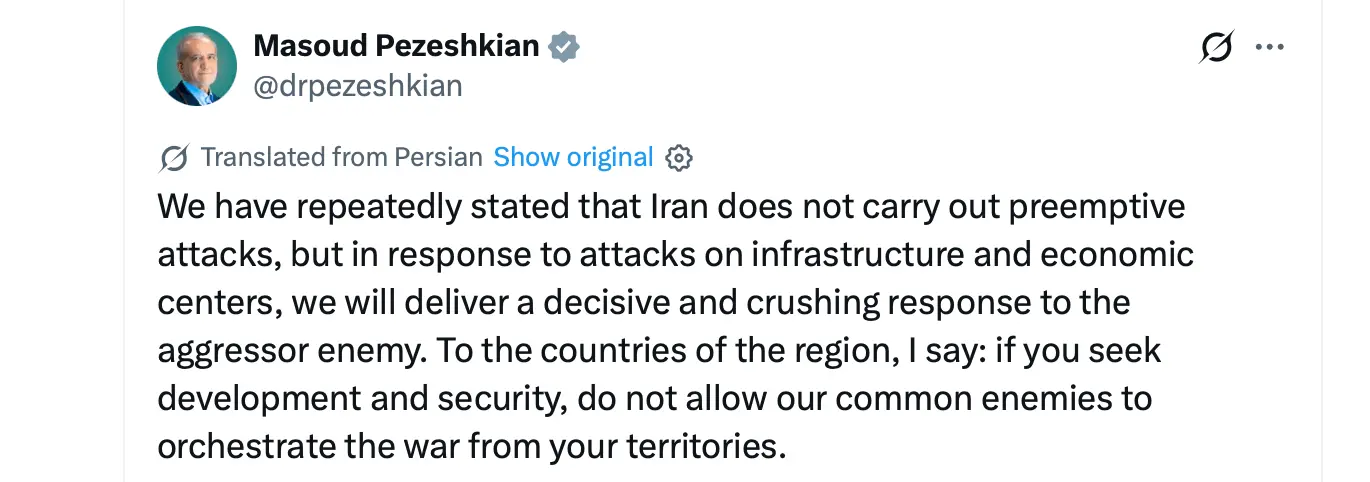
Analysts widely interpret “legitimate rights” to include Iran’s nuclear program and its sphere of regional influence, two issues at the center of Iran’s long-standing disputes with Washington and Tel Aviv. Five days later, on March 16, Pezeshkian returned to X to sharpen the point. He wrote that speaking of ending the war is meaningless until Iran can ensure no more attacks will occur on its soil.
The March 30 cabinet statement is the most recent iteration of that position. Pezeshkian praised the Iranian military’s resistance and cited national unity as a factor in withstanding the crisis. He also highlighted pro-government demonstrations as boosting Iran’s standing and inspiring what he called “freedom fighters.”
Tehran‘s insistence on reparations and binding international guarantees — likely through U.N. or multilateral mechanisms, reflects a distrust built over decades. Iranian officials have pointed repeatedly to the U.S. withdrawal from the 2015 JCPOA nuclear deal as evidence that verbal or bilateral commitments from Washington carry limited weight.
As of March 31, 2026, none of Iran’s stated conditions have been met. The conflict is ongoing. Pezeshkian has consistently framed Iran’s military actions as defensive, stating that Iran does not strike first and only retaliates when attacked. He has attributed the war’s origins to what he describes as aggression ignited by Israel and the United States.
Some analysts have read the repeated public statements as a diplomatic signal, Iran is willing to negotiate, but the threshold for any agreement is high. Others view the conditions as structured to delay resolution while Iran maintains a posture of resistance at home. The statements align with a pattern Tehran has held through prior crises: declare openness to resolution, attach non-negotiable preconditions, and frame any conflict as externally imposed.
Whether the U.S. or Israel engages with those conditions formally remains unclear. No public response from either government to Pezeshkian’s March 30 remarks has been reported. Following the news, U.S. equities soared and bitcoin prices jumped above the $68,000 mark. At press time, bitcoin is trading for $67,403 per unit.
FAQ 🔎
- What are Iran’s conditions for ending the war with the U.S. and Israel? Iran requires recognition of its legitimate rights, payment of war reparations, and firm international guarantees against future attacks.
- When did the U.S.-Iran-Israel war begin? Direct military conflict began Feb. 28, 2026, following U.S.-Israeli strikes on Iranian targets.
- Has Iran’s Supreme Leader been killed in the conflict? Iranian officials report that Ayatollah Ali Khamenei was among those killed, with reported Iranian deaths exceeding 1,340.
- Is Iran open to peace negotiations? President Pezeshkian has signaled openness to talks but has not offered an unconditional ceasefire, stating any deal must protect Iranian security and sovereignty.
Disclaimer: The information on this page may come from third parties and does not represent the views or opinions of Gate. The content displayed on this page is for reference only and does not constitute any financial, investment, or legal advice. Gate does not guarantee the accuracy or completeness of the information and shall not be liable for any losses arising from the use of this information. Virtual asset investments carry high risks and are subject to significant price volatility. You may lose all of your invested principal. Please fully understand the relevant risks and make prudent decisions based on your own financial situation and risk tolerance. For details, please refer to
Disclaimer.


