


Jane Street Bitcoin Manipulation Theory Debunked: Bitwise CIO Reveals Real Cause
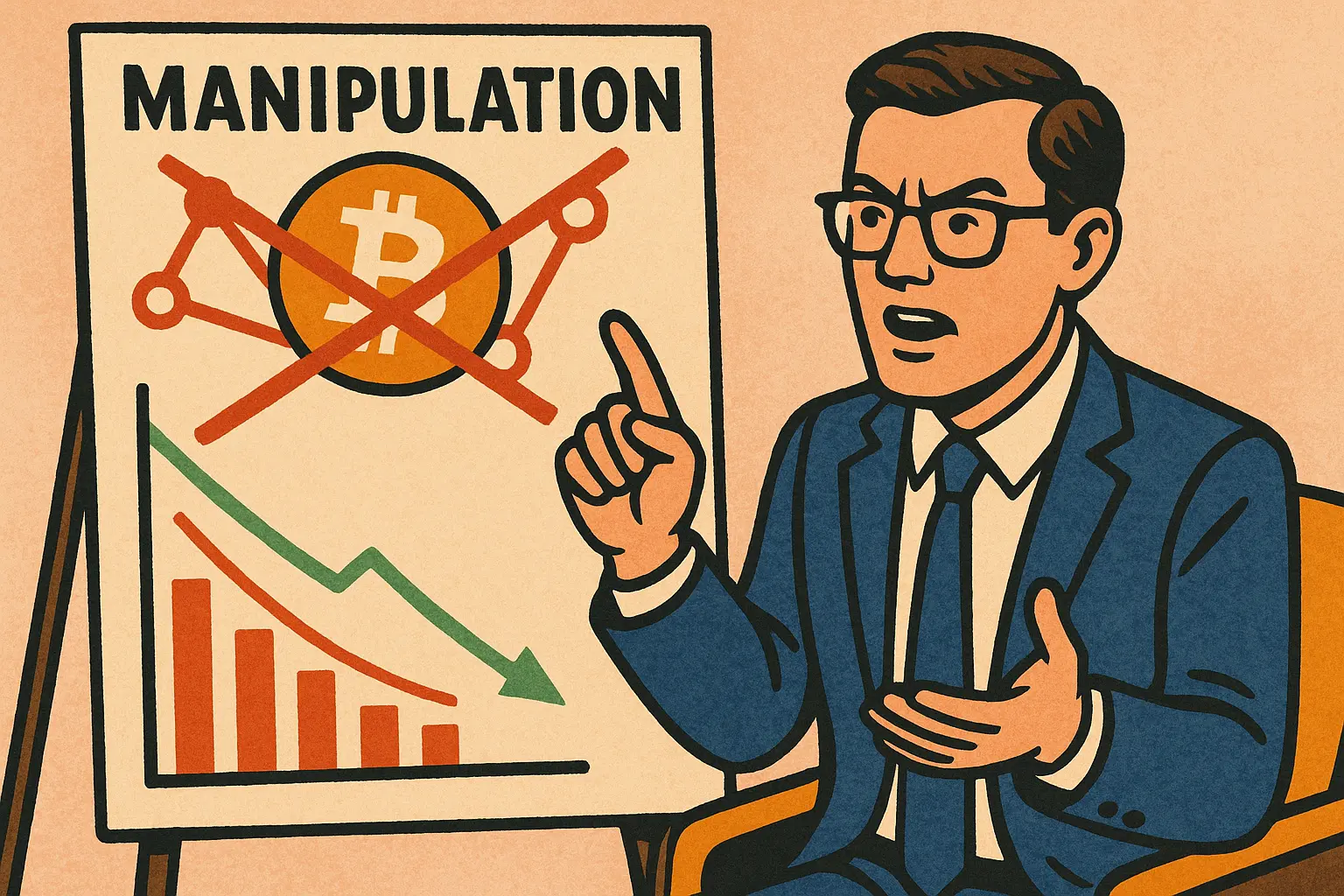
Jane Street Bitcoin conspiracy theories claiming coordinated market manipulation have been dismissed by Bitwise CIO Matt Hougan, who states long-term holders drove Bitcoin’s decline, not institutional schemes.
The Jane Street Bitcoin Conspiracy Theory Explained
Bitcoin’s downturn spurred conspiracy theories around alleged market manipulation by firms. However, Bitwise’s Chief Investment Officer, Matt Hougan, argues the primary reasons are more straightforward. This narrative highlights ongoing debate about what drives major crypto market moves—institutional strategies, technological threats, or fundamental market cycles.
Hougan addressed widespread speculation on social media that Bitcoin’s drop resulted from coordinated moves. Some community members pointed to recurring patterns such as alleged “10 a.m. Bitcoin dump” by Jane Street. The executive dismissed these narratives directly, calling the actual explanation “far more boring” than theories suggest.
“The conspiracy theories are wild. First it was Binance and then it was Wintermute and then it was an unknown offshore macro hedge fund and then it was paper bitcoin and today it is Jane Street and next week it will be someone else,” he said. This rotating cast of alleged manipulators suggests pattern-seeking behavior rather than evidence-based accusations.
The Jane Street Bitcoin theory gained traction because the firm serves as key ETF authorized participant and is defendant in new lawsuit tied to 2022 Terraform Labs collapse. Jane Street’s role in Bitcoin ETF creation/redemption mechanism places it at nexus of institutional Bitcoin flows, making it convenient scapegoat when prices decline during specific intraday windows.
What’s Really Behind Bitcoin’s Decline According to Bitwise
Hougan said the “real reason Bitcoin is down” is that long-term holders have been reducing exposure. According to him, investors cut positions by selling spot Bitcoin, closing leveraged trades, and writing covered calls, creating downward pressure on price. This explanation aligns with on-chain data showing long-term holder distribution patterns consistent with prior cycle peaks.
Three Factors Driving Long-Term Holder Selling:
Four-Year Market Cycle Theory: Bitcoin historically experiences post-halving euphoria followed by extended corrections. Long-term holders familiar with this pattern take profits during peaks anticipating cyclical downturns.
Quantum Computing Concerns: Recent quantum computing breakthroughs sparked fears about Bitcoin’s cryptographic security. Some investors are reducing exposure until industry demonstrates credible quantum-resistance solutions.
Capital Rotation Into AI: AI sector’s explosive growth is attracting capital from cryptocurrency markets. Investors are rotating from Bitcoin into AI startups and infrastructure plays offering perceived higher growth potential.
The quantum computing discussion has gained traction in crypto community recently. While MicroStrategy co-founder Michael Saylor recently downplayed concerns about quantum risks, some investors remain cautious. Kevin O’Leary, the Canadian businessman and Shark Tank investor, warned that institutional investors are capping Bitcoin allocations around 3% until industry demonstrates credible solution to quantum vulnerabilities.
Jefferies’ global head of equity strategy, Christopher Wood, went further, removing 10% Bitcoin allocation from model portfolio over same concerns. These high-profile position reductions create psychological pressure even if quantum threats remain distant, as institutional hesitation signals risk that retail investors interpret as selling signal.
On-Chain Data Contradicts Jane Street Bitcoin Theory
James Check, on-chain analyst at Checkonchain, directly refuted Jane Street Bitcoin manipulation argument, stating that long-term holders selling spot Bitcoin better explains price action. On-chain metrics provide transparent view into holder behavior that conspiracy theories ignore.
Data from SoSo Value shows institutional investors reduced Bitcoin ETF exposure for five consecutive weeks, with total outflows from spot Bitcoin ETFs reaching roughly $4.5 billion. This sustained outflow pattern reflects genuine demand reduction rather than intraday manipulation schemes. If Jane Street or other market makers were suppressing prices through coordinated selling, institutional ETF flows would show different patterns.
Julio Moreno, Head of Research at CryptoQuant, echoed this view, arguing the theory overlooks more obvious driver: sharp contraction in spot Bitcoin demand since early October 2025. He added that mechanisms blamed on Jane Street closely resemble delta-neutral position management widely adopted across trading firms. Market makers hedging ETF inventory naturally buy and sell throughout trading days to maintain neutral exposure, creating flow patterns that conspiracy theorists misinterpret as manipulation.
Meanwhile, Glassnode data indicates repeated market stress has triggered structural shift in Bitcoin options market toward greater instability. The firm notes all-time gamma exposure (GEX) heatmap shows negative gamma expanding below current price levels, while positive gamma “resistance wall” above spot price is fading. When price resides in short-gamma zone, market makers’ delta hedging tends to follow price movement rather than cushion declines, amplifying volatility without requiring manipulation.
Why the U.S. Equity Market Open Feels Like Selling Zone
The “10 a.m. theory” sounds plausible because—even absent deliberate manipulation—U.S. equity market open is inherently volatile window. This period concentrates cross-asset rebalancing, equity-linked risk adjustments, and derivatives hedging. In markets where ETF intermediaries hedge inventory using futures or other instruments, futures can pull spot prices rather than merely follow them.
When order books are thin, these moves can appear larger and more conspiratorial than they actually are. Bloomberg reported Bitcoin market depth remains over 35% lower than October levels, highlighting how fragile liquidity has become. In thin markets, ordinary market-making operations create price impacts that would be absorbed without notice in deeper markets.
Macro analyst Alex Kruger says existing data does not support notion of systematic daily 10 a.m. selloff. He notes that since January 1, IBIT’s cumulative return between 10:00-10:30 a.m. ET was +0.9%, while 10:00-10:15 a.m. ET window saw -1% decline. In his view, this is noise—not evidence of repeatable suppression program.
More importantly, he adds, performance patterns across both windows closely mirror Nasdaq movements, indicating broad risk-asset repricing rather than Jane Street Bitcoin-specific activity. This interpretation aligns more closely with broader market context than viral conspiracy theory.
The ETF Black Box Problem
The Jane Street Bitcoin controversy exposes rift between two realities. On-chain scarcity is transparent—Bitcoin’s supply is fixed by protocol. However, institutional layer built atop it is not. Investors can see ETF circulating shares and partially disclosed holdings but cannot see every hedge, every internal net exposure, or every cross-market position behind market makers’ books.
As Jeff Park, Chief Investment Officer at ProCap Financial, argues, real question isn’t whether any single firm exclusively suppresses Bitcoin—but whether ETF market structure grants authorized participants discretionary latitude that remains opaque to public. This opacity makes distinguishing genuine spot demand from market-making, hedging, and arbitrage activity increasingly difficult.
BlackRock’s IBIT prospectus states the trust may rely on authorized participants for share creation and redemption, and may transact with designated Bitcoin counterparties. At filing time, those counterparties included JSCT, LLC (Jane Street affiliate) and Virtu Financial Singapore. The list has since expanded to include JPMorgan, Citadel Securities, Citigroup, Goldman Sachs, UBS, and Macquarie—increasing firms with access to ETF creation/redemption mechanism.
After SEC approved physical creation and redemption for crypto ETPs in July 2025, authorized participants gained greater flexibility in acquiring and delivering underlying assets. While this change lowers product costs and improves efficiency, it also means authorized participants’ exposures can be managed via broader toolkit, making it harder to discern when ETF activity reflects genuine spot demand versus inventory management or hedge construction.
Willy Woo’s Timeline: Recovery in Q4 2026?
On-chain analyst Willy Woo offered nuanced view of Jane Street Bitcoin situation and broader market outlook. He said recent sell-off appears exhausted but cautioned that deteriorating spot and futures liquidity could cap any near-term rebound. This perspective acknowledges oversold conditions while recognizing structural headwinds preventing immediate V-shaped recovery.
Woo’s timeline places end of bearish conditions in Q4 2026, with bullish momentum potentially returning in Q1 or Q2 2027. This extended bear market projection contrasts with Hougan’s more optimistic near-term outlook. “$45k would be typical bear market bottom. BTC has only ever existed in secular global macro bull market 2009-2026. If global macro breaks down, then $30k is fall back level of support, $16k as final line to maintain BTC’s bull trend,” Woo wrote.
The distance between these timelines reflects broader uncertainty about where exactly market sits in cycle. What analysts broadly agree on is that Bitcoin’s current weakness reflects structural and psychological forces, not Jane Street Bitcoin manipulation. Whether recovery begins in months or requires over a year depends on macro conditions, ETF flow stabilization, and restoration of market liquidity depth.
Lessons From the Jane Street Bitcoin Controversy
The Jane Street Bitcoin episode reveals how ETF era has transformed Bitcoin price discovery in ways retail investors struggle to interpret. Increased institutional participation brings benefits like deeper liquidity and regulatory legitimacy, but also introduces complexity and opacity that enables conspiracy theories to flourish.
Rather than focusing on unprovable manipulation accusations, investors should acknowledge that Bitcoin’s new institutional infrastructure creates genuinely different market dynamics. ETF authorized participants serving multiple roles—liquidity providers, hedgers, arbitrageurs—naturally generate flow patterns that appear suspicious to observers lacking full market visibility.
The solution isn’t rejecting ETF participation but demanding greater transparency in how authorized participants operate. Regulators could require enhanced disclosure of hedging positions, standardized reporting of creation/redemption mechanics, and clearer guidelines distinguishing market-making from proprietary trading. Until such transparency improves, Jane Street Bitcoin conspiracy theories will recur whenever markets decline during specific windows.
FAQ
Is Jane Street manipulating Bitcoin prices?
No credible evidence supports Jane Street Bitcoin manipulation claims. Bitwise CIO Matt Hougan and on-chain analysts attribute Bitcoin’s decline to long-term holder distribution, quantum computing fears, and capital rotation into AI—not coordinated institutional suppression schemes.
What is the 10 a.m. Bitcoin dump theory?
The theory claims Jane Street systematically sells Bitcoin near U.S. equity market open (10 a.m. ET), suppressing prices. Data analysis by Alex Kruger shows IBIT performance during this window mirrors Nasdaq movements, suggesting broad risk-asset repricing rather than Bitcoin-specific manipulation.
Why do Bitcoin conspiracy theories target Jane Street?
Jane Street serves as key Bitcoin ETF authorized participant with access to creation/redemption mechanisms. Recent lawsuit related to Terraform Labs collapse and prior regulatory issues in India make the firm convenient scapegoat despite lack of evidence for Bitcoin manipulation.
When will Bitcoin’s bear market end according to analysts?
Matt Hougan believes Bitcoin is “in process of bottoming” with recovery near-term. Willy Woo projects bearish conditions ending Q4 2026 with bullish momentum returning Q1 or Q2 2027. Divergent timelines reflect uncertainty about macro conditions and liquidity recovery.
What’s the real problem with Bitcoin ETF structure?
The ETF framework creates opacity around authorized participants’ hedging activities and internal exposure management. Investors see disclosed positions but not the futures, options, and swaps wrapped around them, making genuine spot demand difficult to distinguish from inventory management.
Could quantum computing really threaten Bitcoin?
While quantum computing advances raise theoretical long-term concerns about Bitcoin’s cryptographic security, the technology remains years or decades from breaking current encryption. However, institutional investors like Kevin O’Leary are capping allocations until industry demonstrates quantum-resistance solutions.
Related Articles
Will Bitcoin Go Back Up in March? BTC & SOL Latest Performance Isn’t Promising; DeepSnitch AI, on the Other Hand, Is Ready for a 100x Space Trip
X Layer Integrates Solv Protocol to Unlock Bitcoin Liquidity for DeFi