


Bitcoin Tax Nightmare: Netherlands 36% Unrealized Gains Levy Faces U-Turn
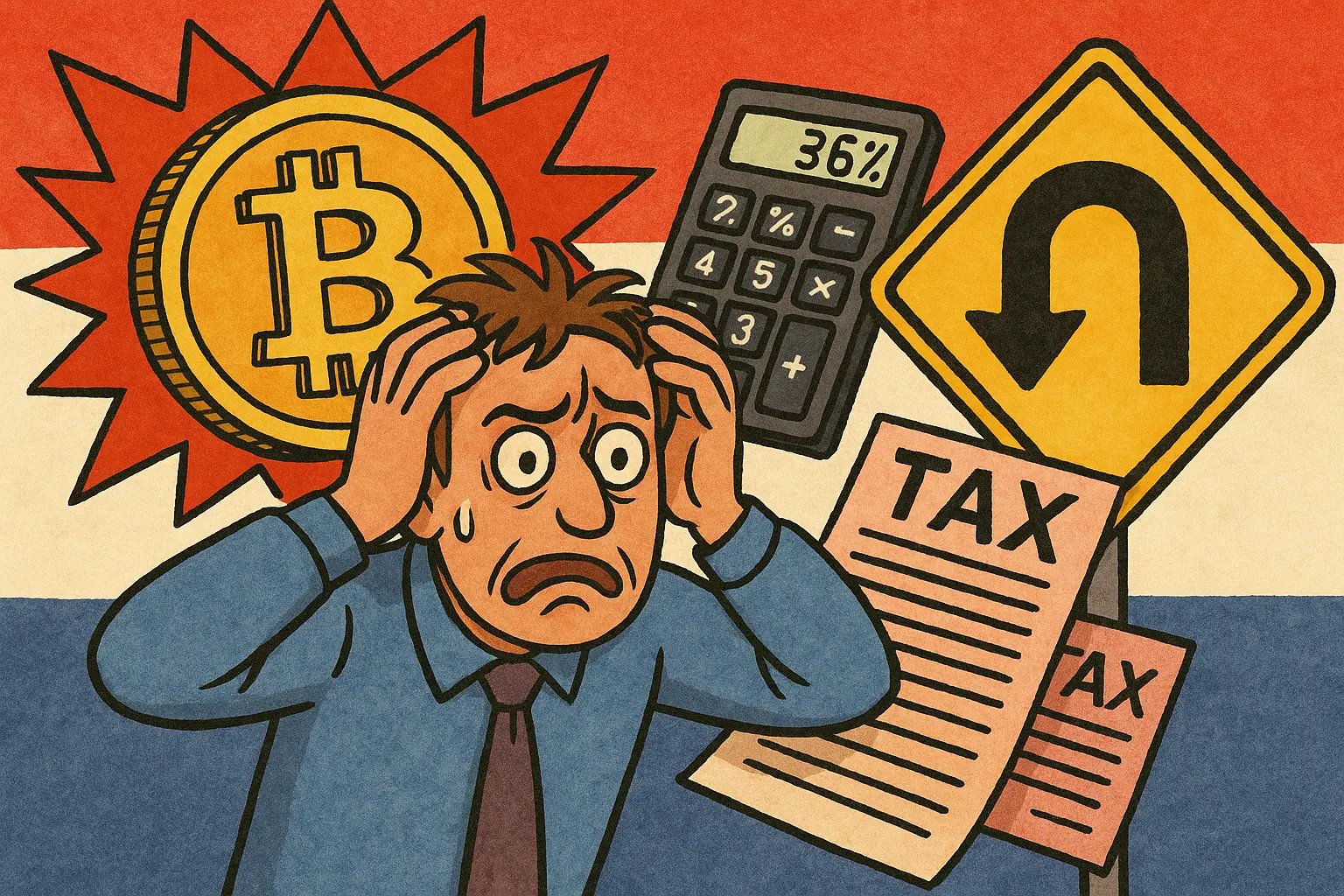
Bitcoin tax controversy erupted as Netherlands approved 36% levy on unrealized crypto gains, forcing investors to pay taxes on unsold Bitcoin and Ethereum holdings annually starting 2028.
Netherlands Passes Unprecedented Bitcoin Tax on Paper Gains
Dutch lawmakers approved new tax law imposing 36% levy on actual investment returns, including both realized and unrealized gains from cryptocurrencies such as Bitcoin and Ethereum. The law, called the Actual Return in Box 3 Act, takes effect January 1, 2028 and applies annually, meaning investors will owe bitcoin tax even if assets are not sold.
This represents unprecedented taxation approach at scale proposed by developed economy. While some jurisdictions tax unrealized gains on specific asset types, applying this framework broadly to cryptocurrencies creates novel compliance challenges and economic distortions. The Dutch House of Representatives approved the measure on February 12, triggering immediate backlash from crypto community and broader investment sector.
Real estate and startup shares are exempt from mark-to-market taxation, raising concern among crypto investors about discriminatory treatment. Critics say taxing paper gains may force investors to sell assets to generate cash for bitcoin tax payments or consider moving to more favorable jurisdictions. The government defended the measure as essential to prevent significant revenue losses following Dutch Supreme Court’s 2021 ruling striking down previous Box 3 tax system.
Key Features of Dutch Bitcoin Tax Law:
36% Rate: Applied to all cryptocurrency investment returns annually
Unrealized Gains Included: Taxes owed on paper gains even without asset sales
2028 Implementation: Law takes effect January 1, 2028 giving transition time
Asset Discrimination: Real estate and startup shares exempt while crypto faces full tax
Annual Application: Tax calculated and owed every year regardless of holding period
The legislation includes some relief measures, such as tax-free annual return for small savers and unlimited loss carry-forward above certain thresholds, allowing investors to offset downturns against future gains. Despite these provisions, many crypto advocates argue that taxing unrealized gains remains fundamentally problematic.
Finance Minister Heinen Announces Bitcoin Tax Reversal
Dutch crypto investors released collective sigh of relief when Eelco Heinen, the country’s finance minister, said he planned to amend controversial legislation that would tax unrealized gains on digital assets and other investments. “I don’t think the law can pass as it is,” Heinen told Dutch television news service RTL Nieuws. “Something simply went wrong here, and the current law needs to be amended.”
The policy, dubbed the Actual Return in Box 3 Act, has been widely criticized from both crypto industry and more broadly. The biggest issue is that under new bitcoin tax law, if asset’s value rises one year but crashes the next, taxpayers could owe hefty tax bills even if they lost money on investments overall. This creates absurd scenarios where investors experience net losses but still owe substantial taxes.
Heinen said he already discussed the issue with his state secretary. “We also said together: let’s go back to the drawing board, start discussion with House of Representatives and Senate, and see how we can amend the law,” he stated. The law still needs to pass through Eerste Kamer, the Dutch Senate, and won’t take effect until January 1, 2028, giving Heinen time to make amendments.
It’s not clear if bitcoin tax law needs complete rework or only partial amendments. The finance minister did not specify scope of changes. The debate now shifts back to Parliament for further deliberation before Senate approval.
Industry Backlash: “The Dumbest Thing Any Government Is Pursuing”
“This is the dumbest thing any government on planet Earth is pursuing right now. And that’s saying something,” Shopify CEO Tobias Lütke said in February 13 X post. His remarks drew widespread attention across crypto community and mainstream business circles, elevating controversy beyond crypto-specific forums into broader economic policy discussions.
Lütke’s criticism resonates because it articulates fundamental economic problem with bitcoin tax on unrealized gains. Taxing paper profits forces investors to generate cash from other sources to pay bills, potentially requiring asset sales at inopportune times. This creates forced selling pressure during market downturns, amplifying volatility and disadvantaging long-term holders.
The policy particularly harms investors using cryptocurrency as long-term savings vehicle rather than speculative trading. Someone holding Bitcoin for retirement may see valuations swing wildly year-to-year. Under Dutch bitcoin tax law, they would owe 36% on gains during up years but potentially cannot fully offset losses during down years within same time periods, creating asymmetric tax burden.
Critics warn the new law may force crypto holders to sell assets to cover bitcoin tax obligations, while some exemptions provide limited relief for small investors. The exemption for real estate and startup shares creates further controversy, suggesting government views these traditional assets more favorably than digital assets despite crypto’s growing economic importance.
Dutch Crypto Adoption Growth
Crypto adoption in Netherlands is growing rapidly despite looming bitcoin tax changes. Indirect holdings by Dutch companies, institutions, and households reached $1.42 billion by October 2025, up from $96 million in 2020. This 1,380% increase over five years demonstrates sustained growth trajectory in Dutch crypto market.
The Netherlands has historically been relatively crypto-friendly jurisdiction within European Union. Major cryptocurrency exchanges maintain operations in country, and Dutch financial regulators have established clear licensing frameworks for crypto businesses. This regulatory clarity combined with tech-savvy population has fostered healthy crypto ecosystem.
However, the proposed bitcoin tax threatens to reverse this growth trajectory. If Netherlands implements 36% annual tax on unrealized gains while neighboring jurisdictions maintain more favorable regimes, capital and talent may relocate. Belgium, for instance, generally doesn’t tax crypto gains for individual investors holding for long term. Portugal recently introduced crypto taxation but only on realized gains, not paper profits.
The competitive dynamics within European Union mean small differences in bitcoin tax treatment can trigger significant capital flows. Dutch crypto businesses and high-net-worth individuals holding substantial positions may establish residency in more favorable jurisdictions to avoid punitive taxation, reducing Netherlands’ tax base despite intentions to increase revenue.
Global Context: How Other Countries Tax Bitcoin
Taxing unrealized gains remains rare among developed economies. Most countries tax cryptocurrency profits after investors sell assets, treating them similarly to capital gains on stocks or other investments. Understanding global bitcoin tax approaches provides context for Netherlands’ controversial proposal.
Global Bitcoin Tax Approaches:
United States: Taxes realized gains at 15-20% for long-term holdings, 0-37% for short-term trades based on income brackets
Germany: Tax-free if held over one year; taxed as income if sold within one year
Portugal: Recently introduced 28% tax on realized crypto gains; no tax on unrealized gains
United Kingdom: Taxes realized gains above £3,000 annual allowance at 10-20% rates
Singapore: Generally no capital gains tax on personal crypto holdings
Dubai/Abu Dhabi: Zero tax on crypto gains creating “tax haven” status
Few jurisdictions tax crypto havens, such as Dubai, Abu Dhabi, and Cayman Islands, impose zero taxes on cryptocurrency gains. This creates competitive pressure on countries like Netherlands attempting to implement aggressive bitcoin tax regimes. High-net-worth crypto holders have mobility to relocate to favorable jurisdictions, making confiscatory tax policies potentially counterproductive.
Legal Background: Supreme Court Decision Forcing Reform
The proposal emerged after Dutch Supreme Court struck down previous Box 3 tax system in 2021. The court ruled old regime violated property-rights protections by taxing assumed returns rather than actual investment performance. That decision forced lawmakers to search for replacement taxation framework.
Lawmakers designed the Actual Return bill to tax actual investment returns instead of assumed returns. The previous system relied on hypothetical gains based on asset categories rather than individual performance. The new structure aimed to align taxation with real performance, addressing Supreme Court’s concerns about arbitrary taxation.
However, the solution created new problems by extending taxation to unrealized gains. While actual returns represent improvement over assumed returns, annual taxation of paper gains introduces different constitutional and economic concerns. Property rights advocates argue forcing taxes on unsold assets creates indirect confiscation, particularly if investors must sell holdings to generate tax payment cash.
What Happens Next for Dutch Bitcoin Tax
Officials say long-term goal is moving towards realized gains model, but annual taxation of paper gains is currently seen as necessary to safeguard public finances during transition period. This suggests bitcoin tax on unrealized gains may be temporary measure rather than permanent policy, though no specific timeline for transitioning to realized-gains-only system has been announced.
The legislation’s fate now depends on Senate deliberations and Finance Minister Heinen’s proposed amendments. Several outcomes are possible: complete withdrawal of unrealized gains provisions, partial amendments reducing bitcoin tax scope or rates, exemption thresholds protecting smaller investors, or delayed implementation beyond 2028 start date.
Dutch crypto community is mobilizing opposition through advocacy groups and direct engagement with parliamentarians. Industry representatives argue that reasonable bitcoin tax policy should tax only realized gains, provide clear guidance on cost basis calculations, allow full loss offsetting across years, and treat crypto similarly to other investment assets without discrimination.
Implications for European Crypto Regulation
The Netherlands’ bitcoin tax controversy has broader implications for European cryptocurrency regulation. As EU member states develop individual crypto taxation frameworks, policy divergence creates arbitrage opportunities and competitive pressures. Harmonized approach across EU would prevent regulatory shopping, but achieving consensus among 27 member states with different fiscal priorities remains challenging.
The episode demonstrates growing pains as traditional tax systems adapt to digital assets. Cryptocurrencies’ 24/7 global markets, high volatility, and easy cross-border transfers create unique challenges that conventional tax frameworks struggle to address effectively. Finding balanced approaches that generate government revenue without stifling innovation or driving capital flight requires careful policy design.
FAQ
When does the Netherlands bitcoin tax take effect?
The Actual Return in Box 3 Act is scheduled for January 1, 2028 implementation. However, Finance Minister Eelco Heinen announced plans to amend the law before Senate approval, potentially delaying or modifying implementation.
What rate is the Dutch bitcoin tax?
The law imposes 36% tax on cryptocurrency investment returns, including both realized and unrealized gains. This applies annually to paper profits even without selling assets.
Do other countries tax unrealized crypto gains?
No, taxing unrealized bitcoin gains at scale is unprecedented among developed economies. Most countries tax only realized gains after investors sell cryptocurrencies, treating them similarly to stocks or other capital assets.
Are there any exemptions to the Dutch bitcoin tax?
The law includes tax-free annual return for small savers and unlimited loss carry-forward above certain thresholds. However, real estate and startup shares receive full exemption from mark-to-market taxation while cryptocurrencies do not.
What happens if my crypto crashes after I pay bitcoin tax on gains?
This is the law’s most controversial aspect. If Bitcoin rises one year (you pay 36% tax) but crashes the next, you could owe tax bills despite net losses. Loss carry-forward provisions provide some relief but may not fully offset timing mismatches.
Will the Netherlands bitcoin tax actually become law?
Uncertain. While the House of Representatives approved it, Finance Minister Heinen stated it cannot pass as written and needs amendments. Senate approval remains pending while ministers rework the proposal.
Related Articles
Analysts Rebuke Jane Street 10am Dump; Bitcoin Not Easily Manipulated
In the past 24 hours, the entire network's contract liquidations reached $212 million, mainly from long positions.
ETF Capital Rotates as XRP and SOL ETFs Gain Ground While BTC and ETH Holdings Decline
Bitcoin, Ethereum and Solana ETFs Record Positive Net Inflows on February 27