


Wintermute, JPMorgan Data Shows Retail Investors Pivoting From Crypto to Equities as Risk Assets Decouple
Data from Wintermute’s proprietary retail flow indicators and JPMorgan’s equity inflow analysis reveals that retail investor behavior has fundamentally shifted since late 2024, with crypto and equities now functioning as substitute rather than complementary risk assets.
The correlation between retail activity in the two asset classes has turned negative for the first time, as retail capital flows increasingly into equities at a record pace while remaining sidelined in cryptocurrency markets, despite crypto’s historically higher volatility profile.
Historical Relationship Breaks Down
Between 2022 and late 2024, retail activity in cryptocurrencies and equities moved broadly in tandem, with both treated as a cluster of higher-risk investments during periods of strong risk appetite and excess liquidity. This relationship reflected the traditional role of both asset classes as outlets for speculative capital during bullish market conditions.
According to Wintermute’s proprietary retail flow data overlaid with JPMorgan’s retail equity inflow metrics, that relationship has broken down significantly since late 2024. The divergence has reached its widest point in recent history, with retail investors piling into equities at an unprecedented pace while crypto markets experience sustained retail outflows or stagnation.
The altcoin market cap, used as a longer-term proxy for retail crypto activity due to its unbiased historical record, confirms this decoupling. Rolling correlation analysis shows what was once an oscillating but broadly positive relationship between retail activity and crypto exposure has flipped negative, indicating that retail now allocates between the two asset classes rather than into both simultaneously.
Key Catalysts and Market Dynamics
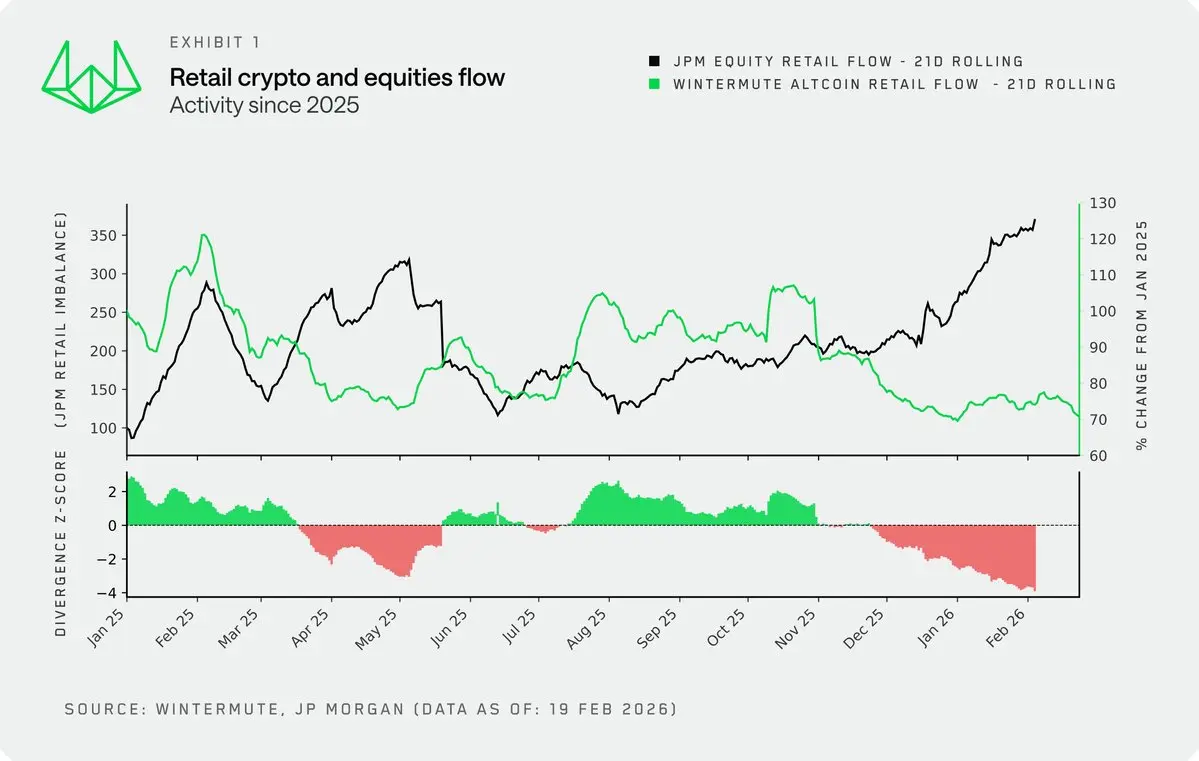
Examining 2025 activity with key market catalysts overlaid reveals several distinct phases in the evolving retail dynamic:
-
Memecoin and AI agent cycles experienced periods of elevated activity when equity market momentum stagnated, suggesting retail speculation found outlets in crypto when equity opportunities appeared limited
-
Equity dip-buying remained aggressive throughout 2025, particularly around the April tariff announcement and in recent months, demonstrating sustained retail conviction in stock market pullbacks
-
Post-October 10 pivot marked a near-complete rotation into equities that continues to the present, following the market crash that eliminated $19 billion in leveraged crypto positions
Analysts emphasize that crypto retail activity is not large enough to pull capital away from equities. Rather, the causality runs in the opposite direction: heightened retail engagement in equities is drawing speculative capital out of cryptocurrency markets, creating headwinds for sustained crypto rallies.
Volatility Compression Erodes Crypto’s Competitive Advantage
Volatility has historically been crypto’s primary product and retail attraction point. The outsized price movements that defined the 2021-2022 cycle drew in a generation of retail investors seeking asymmetric returns. However, realized volatility in cryptocurrency markets has been structurally compressing, and data suggests this trend is unlikely to reverse.
The Bitcoin/Nasdaq 100 (NDX) volatility ratio has consistently trended downward, with volatility profiles compressing below a 2x ratio during the first half of 2025. This compression means crypto’s volatility advantage over equities has diminished significantly.
Key drivers of volatility compression include:
-
Market maturation — The growing presence of sophisticated investors alongside new liquidity vehicles such as ETFs and digital asset treasuries has dampened the reflexive volatility spikes that characterized earlier cycles
-
Increased market size — At approximately $2.3 trillion market capitalization, even 40% off all-time highs, it requires substantially larger capital flows to move the market compared to five years ago
As volatility compresses, crypto’s core retail selling point erodes correspondingly. For retail investors specifically chasing volatility, equities are becoming an increasingly compelling alternative.
Technological Drivers Accelerating the Shift
Beyond crypto-specific market structure changes, technological developments are accelerating capital mobility and reshaping retail investor psychology:
Seamless access infrastructure — The integration of crypto trading into traditional fintech and broker platforms, combined with crypto-native platforms adding equity access, has lowered barriers to entry. However, the more consequential effect is reduced friction on the way out. In prior cycles, onboarding friction kept capital captive within crypto once deployed, leading to organic recycling across tokens. Today, seamless on/off ramps mean capital flows easily between crypto and equities without significant hurdles.
Perceived analytical edge — Retail investors appear increasingly drawn to equities partly due to a sense of newly obtained analytical edge unlocked through artificial intelligence. Large language models have significantly empowered retail analysis capabilities, creating a perception of level playing field with institutional investors. This feeling is largely absent in crypto markets, which lack consensus valuation frameworks, established token value accrual mechanisms, and face an constantly expanding investable universe that makes sustained analytical edge difficult to achieve.
Implications for Market Analysis
The structural shift in retail behavior has implications for how investors should approach crypto market analysis. Several tried-and-tested indicators that previously relied on retail participation patterns have already broken down.
Analysts suggest that successful crypto investing now requires viewing the market through a multi-asset portfolio lens, similar to the approach standard practice for equities and fixed income. Crypto no longer exists in isolation but competes directly with other risk assets for retail capital allocation.
Monitoring retail activity in equities has become a new factor that crypto investors should track to identify windows of opportunity when crypto can see more sustained bids from retail participants. Periods of equity market stagnation or pullbacks may present the most favorable conditions for renewed crypto retail engagement.
FAQ: Understanding Retail’s Shift From Crypto to Equities
Q: How has the relationship between retail crypto and equity activity changed?
A: From 2022 to late 2024, retail activity in both asset classes moved together during risk-on periods. Since late 2024, that relationship has broken down, with the correlation turning negative. Retail now allocates between crypto and equities rather than into both simultaneously, with current data showing record equity inflows and crypto sidelined.
Q: Why is crypto losing its appeal to retail investors?
A: Key factors include structural volatility compression that reduces crypto’s historical advantage over equities; seamless on/off ramps that allow capital to exit crypto easily rather than recycling within the ecosystem; and a perceived analytical edge in equities enabled by AI tools, which is harder to achieve in crypto due to lack of valuation frameworks and constant expansion of the investable universe.
Q: How does volatility affect retail investment decisions?
A: Volatility is crypto’s primary product and retail attraction point. As realized volatility has structurally compressed due to market maturation and increased size, crypto’s core selling point has eroded. For retail investors specifically seeking volatility, equities have become increasingly competitive, particularly as the Bitcoin/NDX volatility ratio has consistently declined.
Q: What should crypto investors monitor given this shift?
A: Investors should track retail activity in equities as a new factor influencing crypto market dynamics. Periods of equity stagnation or pullbacks may present windows for renewed crypto retail engagement. Additionally, analysis should adopt a multi-asset portfolio perspective, recognizing that crypto now competes directly with other risk assets for retail capital allocation rather than operating in isolation.