
The Executive Yuan has approved the draft Virtual Assets Services Act, which will categorize service providers into 7 types and adopt a licensing-credential system. The new law will strictly regulate asset custody and explicitly prohibit stablecoins from issuing interest-bearing yields. If fraud is involved, the maximum penalty will be as high as NT$200 million, signaling that Taiwan’s crypto industry has entered a compliance era.
- This article was updated and revised on 2026/4/8 to the version approved by the Executive Yuan
The draft Virtual Assets Services Act approved by the Executive Yuan—one quick rundown to read it all
Taiwan’s cryptocurrency industry has finally entered a clear regulatory era! After the Financial Supervisory Commission published a preliminary draft last year, the Executive Yuan has approved the revised draft of the “Virtual Assets Services Act” in early April this year and will submit it to the Legislative Yuan for review. The purpose is to improve the development and management of Taiwan’s virtual asset businesses, protect the rights and interests of traders, and promote innovation in financial technology.
Compared with the 2025 version, the Executive Yuan’s approved version is stricter in both penalties and management! After reading through the complex legal provisions, “Crypto City” has organized 4 key takeaways to help readers understand quickly. If you want the latest complete draft text, you can read this Virtual Assets Services Act PDF file.
4 Key Takeaways from the Draft Virtual Assets Services Act
Key Point One: Classification of virtual asset service providers and license-credential applications
The draft Virtual Assets Services Act clearly provides that virtual asset service providers must obtain the required permits from the competent authority according to their respective types, and may only operate after being issued license credentials (a license/permit). Virtual asset businesses may not be conducted for any of the relevant virtual asset services without such permits and license credentials.
In addition, the revised draft explicitly states that “businesses may not operate unless they join an industry association,” implementing industry self-regulation. After obtaining permission, traditional financial institutions can also “engage in” virtual asset businesses and are exempt from some requirements.
The Financial Supervisory Commission classifies virtual asset service providers into 7 categories:
- Virtual asset exchange providers: Businesses that operate exchange and related services between virtual assets and New Taiwan dollars, foreign currencies, and currencies issued in Mainland China, Hong Kong, or Macau; or exchange and related services between virtual assets.
- Virtual asset trading platform providers: Businesses that operate virtual asset exchange markets.
- Virtual asset transfer providers: Businesses that operate the transfer of virtual assets and related services, including related services for virtual-asset payments.
- Virtual asset custody providers: Businesses that operate the custody or management of virtual assets or tools used to control virtual assets, and related services.
- Virtual asset underwriting providers: Businesses that operate the issuance or sale of virtual assets and related services.
- Virtual asset lending providers: Businesses that acquire virtual assets and agree to return or deliver virtual assets and related services of the same or a higher quantity or value.
- Other virtual asset service providers: Businesses that operate other virtual asset services approved by the competent authority
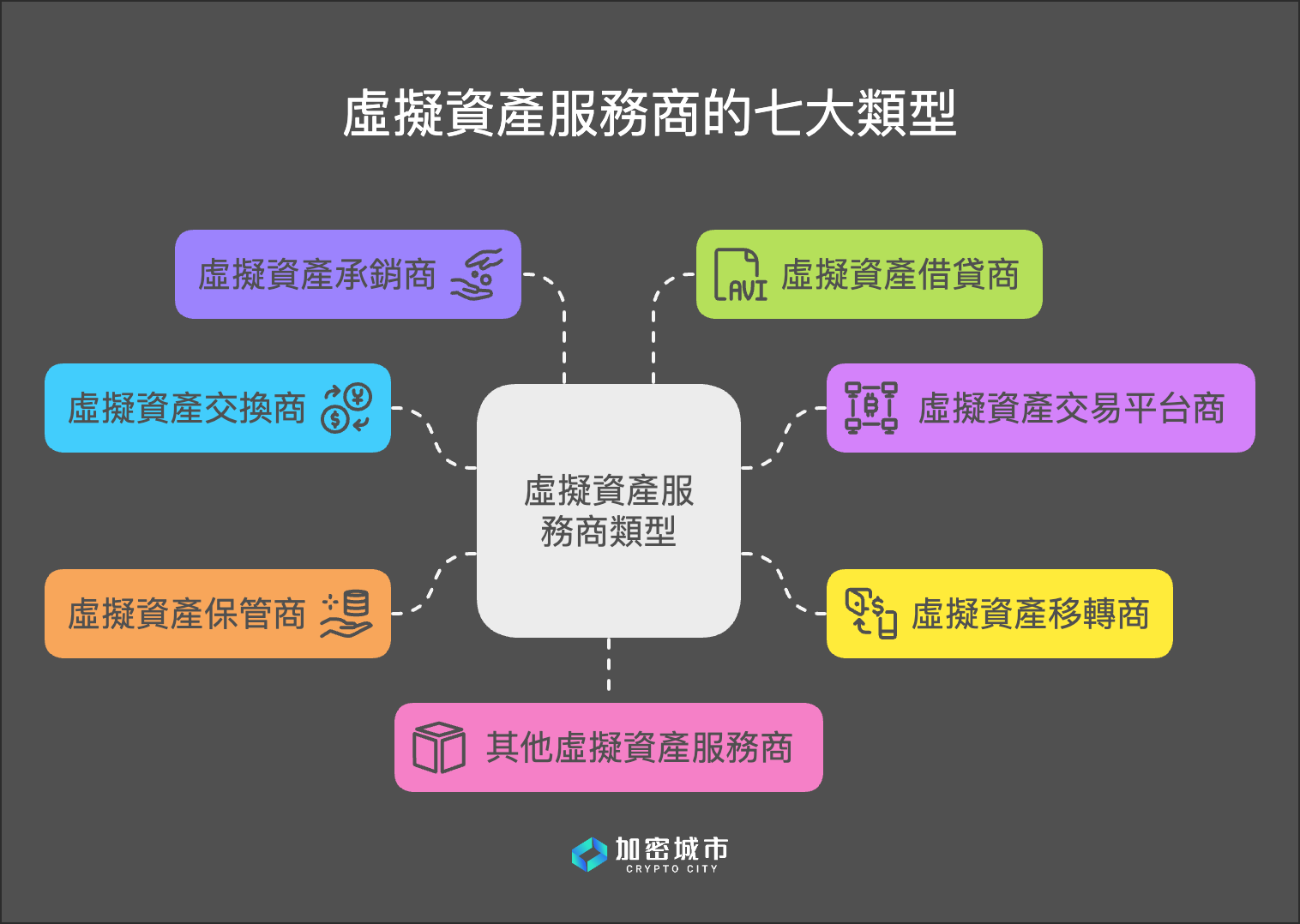
Image source: Made by Crypto City Quick rundown of the draft Virtual Assets Services Act—key takeaways: types of virtual asset service providers, license/permit credentials
License/permit application deadline
For the transition period that businesses care about most, the Executive Yuan version includes clearer provisions: businesses that have already completed anti–money laundering registration must submit their applications within 9 months after the law takes effect, and must obtain license credentials within 18 months. If they fail to apply by the deadline or fail to pass the review, they may not continue operating.
Regulations for overseas currency businesses to establish in Taiwan
As for overseas virtual asset service providers (e.g., overseas crypto exchanges, etc.), if they want to establish branches within Taiwan, they must obtain approval from the competent authority and be issued license credentials, and must complete company or branch establishment registration in Taiwan.
Key Point Two: Management framework for virtual asset service providers
The Financial Supervisory Commission also referenced regulations such as the EU MiCA and frameworks in Japan and Singapore, and proposed stringent requirements for virtual asset service providers. Crypto City has organized the following key takeaways:
Total amount of liabilities
A virtual asset service provider’s total external liabilities may not exceed the specified multiple of its net worth; its total current liabilities may not exceed the specified percentage of its total current assets. However, this limitation does not apply to providers that operate as financial institutions in addition to other businesses; the competent authority will determine the aforementioned multiples and percentages.
Internal control and administrative fines
Service providers must establish internal control systems and cybersecurity regulations. If internal controls are inadequate, if they fail to report financial statements in accordance with the law, or if they fail to implement spot-checking and review processes for both listing and delisting, they will face administrative fines ranging from NT$300,000 to NT$6,000,000, and may be fined for each occurrence.
Custody of customers’ assets
For assets that a virtual asset service provider keeps on behalf of customers, aside from its own property, they must be independently separated in accordance with the manner prescribed by the competent authority. Customer assets include customers’ virtual assets, legal tender currencies, and other assets. Creditors of a virtual asset service provider may not make any claims against the customer assets it is custodying, nor exercise any other rights.
In the event of bankruptcy, customer assets do not form part of the bankrupt estate (Note). Except for customer instructions, lawful setoff of fee debts as required by law, or with permission from the competent authority, customer assets may not be used. For customer virtual assets custodyed by a virtual asset custody provider, the property rights belong to the customer and cannot be agreed to be transferred. They may not be mixed-custodyed with the provider’s own virtual assets.
- Note: “The bankrupt estate” refers to all assets owned by a company before the conclusion of bankruptcy proceedings, including movable property, immovable property, property claim rights, and so on—all of which are part of the bankrupt estate.
Customer legal tender currency deposit special accounts
With the customer’s consent, a virtual asset service provider may handle legal tender currency retained in connection with its virtual asset business by keeping it in a same-currency deposit special account opened at a financial institution, and must deliver the retained legal tender currency to a trust or obtain a bank’s full performance guarantee. For retained customer legal tender currency, the account reconciliation requirements applicable to virtual asset custody providers shall apply.
Periodic review reports
Virtual asset service providers must periodically report to and publish financial reports that have been audited, attested, or reviewed by certified public accountants. The application procedures, publication items, and formats will be determined by the competent authority.
Virtual asset custody providers must, for the customer assets they custody, establish ongoing account reconciliation measures, appoint certified public accountants to issue reports, and report to and publish them with the competent authority.
Review of virtual asset listing and delisting
Virtual asset exchange providers must publish offering documents (whitepapers) describing the issuance of the virtual assets for which they provide exchange services. If the virtual assets do not have offering documents that are prepared and published in accordance with the requirements of the competent authority, in principle, the virtual asset exchange provider may not provide exchange services for those virtual assets.
Virtual asset trading platform providers must set review standards and review procedures for listing and delisting. Virtual assets that have not been approved by the competent authority may not be included in trading platform services provided by the virtual asset trading platform provider.
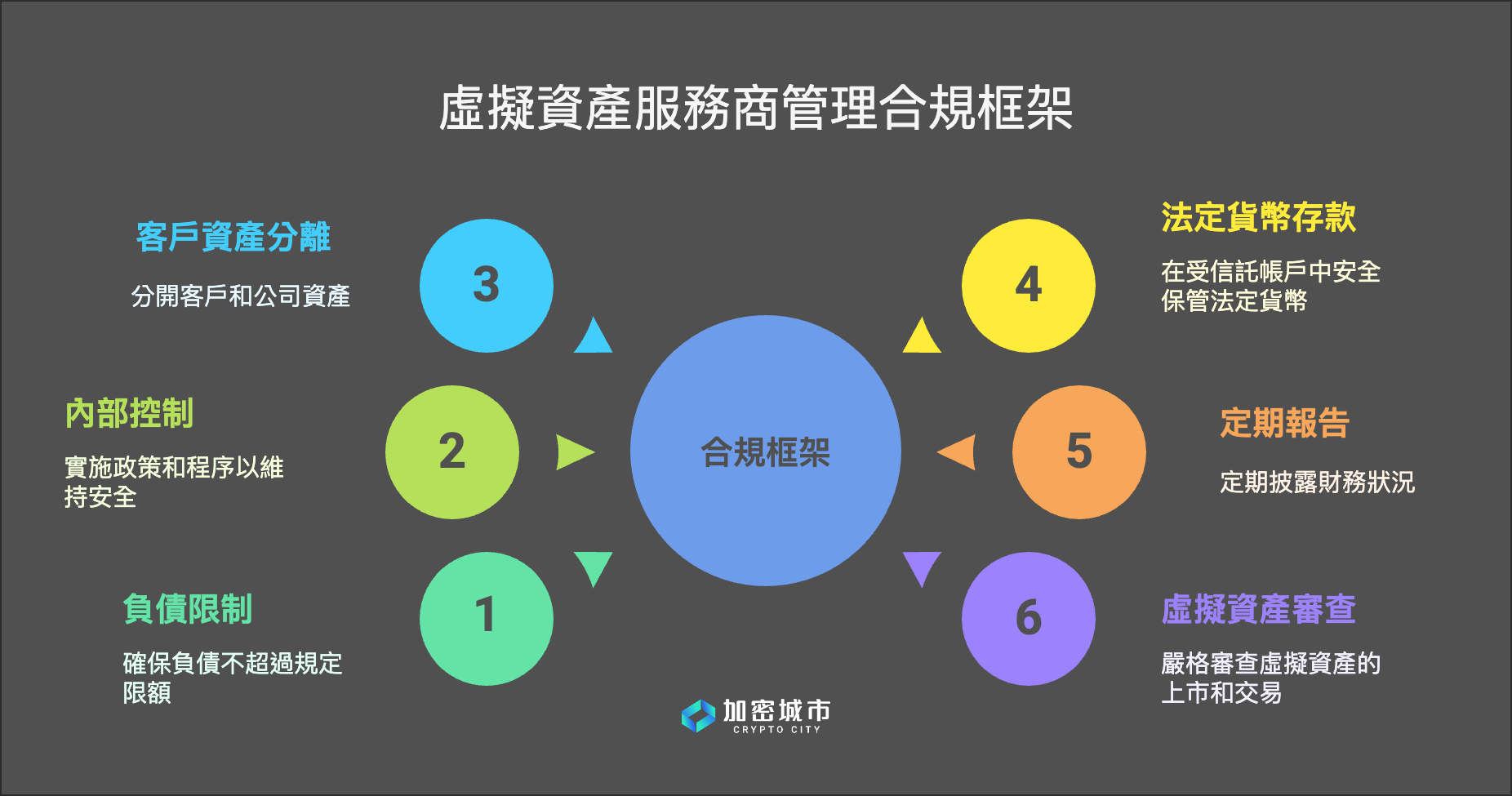
Image source: Made by Crypto City Quick rundown of the draft Virtual Assets Services Act—key takeaways: management compliance framework for virtual asset service providers
Key Point Three: Regulations for issuing stablecoins in Taiwan
If a business wants to issue stablecoins within Taiwan, it must obtain approval from the competent authority, and the competent authority will consult the central bank. The Executive Yuan version adds very strict red lines for stablecoins:
- Bans on interest and yields: Stablecoin issuers may not pay any form of interest or yields, and must issue and redeem at par value. The U.S. current stablecoin regulation, the “Titan Act,” also includes this provision.
- Reserve requirements and central bank penalties: The issuer must maintain sufficient reserve assets and store them independently. If the reserves are insufficient, the central bank will charge “an annual interest rate of 5%” on the insufficient portion as a penalty, based on the minimum lending interest rate.
Key Point Four: 8 major penalty provisions—harsh punishment for fraud and market manipulation
In the draft Virtual Assets Services Act, penalties for conduct such as sanctioning fraud, market manipulation, and similar acts are extremely severe; the Executive Yuan version further substantially increases practical prosecution mechanisms:
- Fraud or manipulation provisions: Imprisonment for a fixed term of more than 3 years but less than 10 years, and in addition may be subject to fines of not less than NT$10 million and not more than NT$200 million.
- Voluntary surrender and plea/self-incrimination sentence reductions: For fraud or manipulation, if the offender voluntarily surrenders or confesses during investigation and compensates the victims for the full amount within 6 months, the sentence may be reduced or exempted, making it easier for investigators to trace back to sources.
- Operating without permission or issuing stablecoins: Imprisonment for not more than 7 years, and in addition may be subject to fines of not more than NT$100 million.
- Illegally using customer assets: The responsible person will be punished with imprisonment for not more than 5 years, and in addition may be subject to fines of not more than NT$50 million.
- Corporate penalty mechanism: If an employee commits crimes such as operating without permission or illegally using assets, in addition to penalizing the individual, the company (legal entity) will also be imposed an equivalent high fine, such as up to NT$100 million or NT$50 million.
- Enhanced punishment by conversion to labor service: If the fine is NT$50 million or more, the term of labor service is increased to no more than 2 years; if it reaches NT$100 million or more, it is increased to no more than 3 years.
- Forfeiture of criminal proceeds: It expressly provides that if criminal proceeds were obtained by the actor or a third party, they shall be confiscated, except for returning them to the victims.
- Falsely concealing and misusing names: Submitting false applications, failing to submit reports, and other acts are punishable by imprisonment of not more than 3 years or fines of not more than NT$2.4 million; using a similar name that is not a service provider is punishable by imprisonment of not more than 1 year or fines of not more than NT$1.2 million.
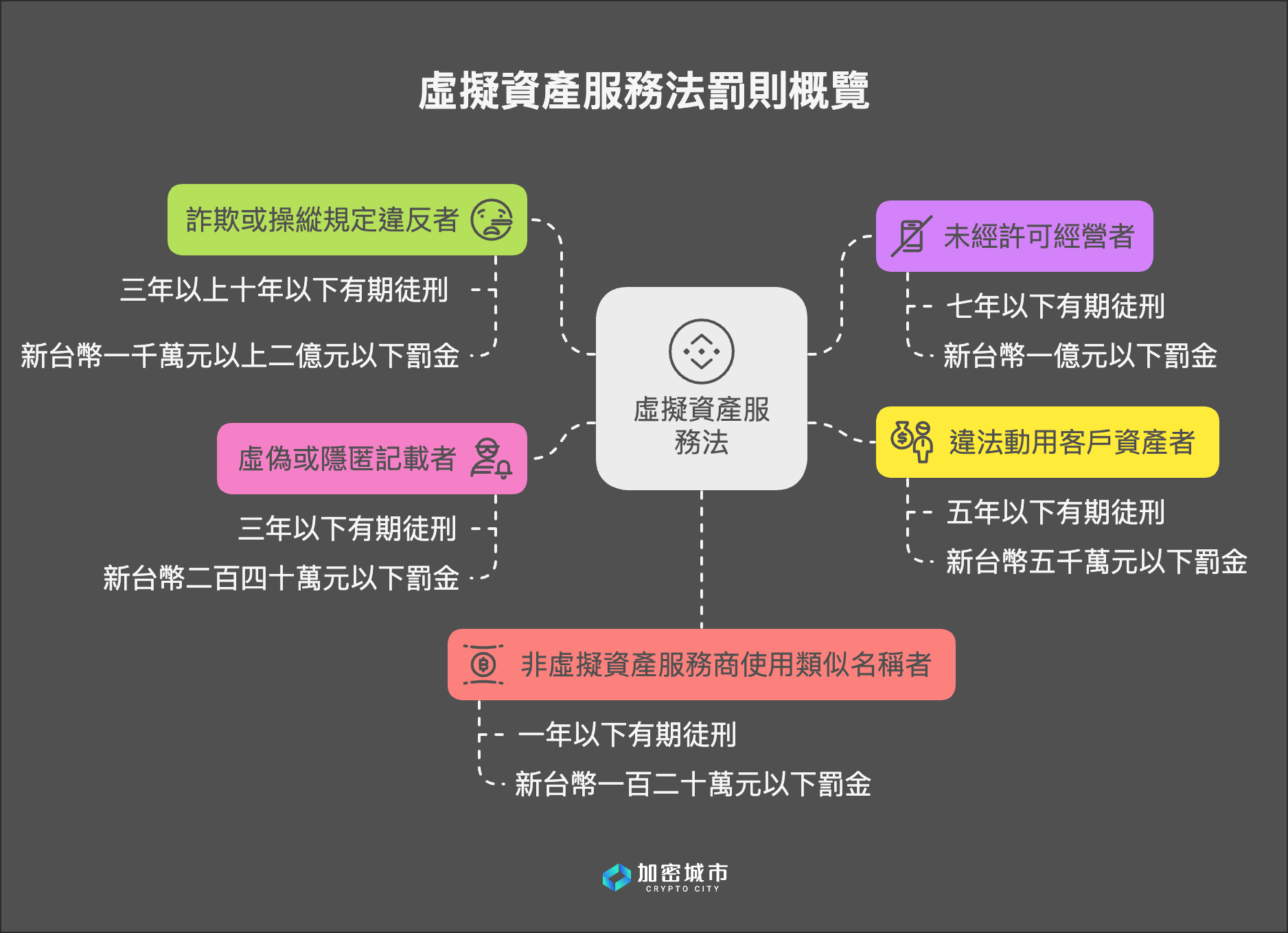
Image source: Made by Crypto City Quick rundown of the draft Virtual Assets Services Act—key takeaways: oversight and penalties for virtual asset service providers
Controversies over the Virtual Assets Services Act: Can it balance protection + innovation?
The Financial Supervisory Commission said that, given that the U.S., the EU, Japan, South Korea, Hong Kong, and other places have been issuing virtual-asset-related regulations one after another, international views on virtual asset supervision have gradually formed consensus. Based on the need to develop Taiwan’s virtual asset business in a sound manner, protect investors, and also balance innovation in financial technology, establishing a special law is necessary.
After amendments, this draft Virtual Assets Services Act has finally been formally approved by the Executive Yuan. The industry is also hotly discussing it right now. There are positive views that the introduction of regulatory rules will help the industry become healthier and more orderly, but negative views argue that the rules are extremely strict and may stifle startups.
However, it is worth noting that the Executive Yuan version has also specifically added provisions for “innovation experiments” and “international cooperation.” It expressly provides that businesses may apply for innovation experiments (regulatory sandbox), and the competent authority will be authorized to conduct cross-border information exchanges.
Overall, the introduction of the Virtual Assets Services Act means that Taiwan’s crypto industry has officially moved from the frontier development stage to a compliance era with improved, well-established regulation—and that businesses will inevitably face a period of painful transition they cannot avoid.
Taiwan news related to the virtual assets industry
- Planning to issue an NT dollar stablecoin? Capital Layer partners with Dunyung Technology—blockchain settlement to be introduced into banks
- Another lawmaker proposes a Bitcoin and stablecoin reserve strategy! Yang Chin-long: stance unchanged for now, but time and circumstances will change
- Can Taiwan stablecoins earn interest? The Legislative Yuan submits a legal and policy report on interest-bearing stablecoins; the Financial Supervisory Commission has responded preliminarily
- Binance wants to set up in Taiwan! Businesses worry about the impact on local crypto platforms—will a China-funded background affect national security?


