
Apple, in accordance with China’s regulatory requirements, removed the decentralized messaging app Bitchat from the app store. The program was deemed to carry social mobilization risk due to its Bluetooth offline and mesh network characteristics, sparking attention and discussion regarding freedom of communication and the regulatory boundary.
Block CEO Jack Dorsey (Jack Dorsey) posted on the social platform X to confirm that Apple, at the request of China’s internet network regulatory authorities, has removed the decentralized messaging app Bitchat from the Chinese mainland. The app was determined by China to violate relevant communications regulations regarding social mobilization authority, because it has Bluetooth offline transmission and decentralized features.
Bitchat violates China’s Cybersecurity Law; Apple notifies it of removal
According to information Dorsey publicly shared, the Cyberspace Administration of China (CAC) stated that Bitchat violates Article 3 of the Provisions on the Security Assessment of Internet-based Information Services with Attribute of Public Opinions or Capable of Social Mobilization (具有輿論屬性或社會動員能力的網際網路資訊服務安全評估規定). This regulation requires that online services with public-opinion attributes or social-mobilization capability must go through an official security assessment process before formally launching to provide services. Apple’s app review team subsequently notified developers that both Bitchat’s official version and the TestFlight test version cannot continue to be supplied in the Chinese market, but the app can still be used and accessed in other countries and regions.
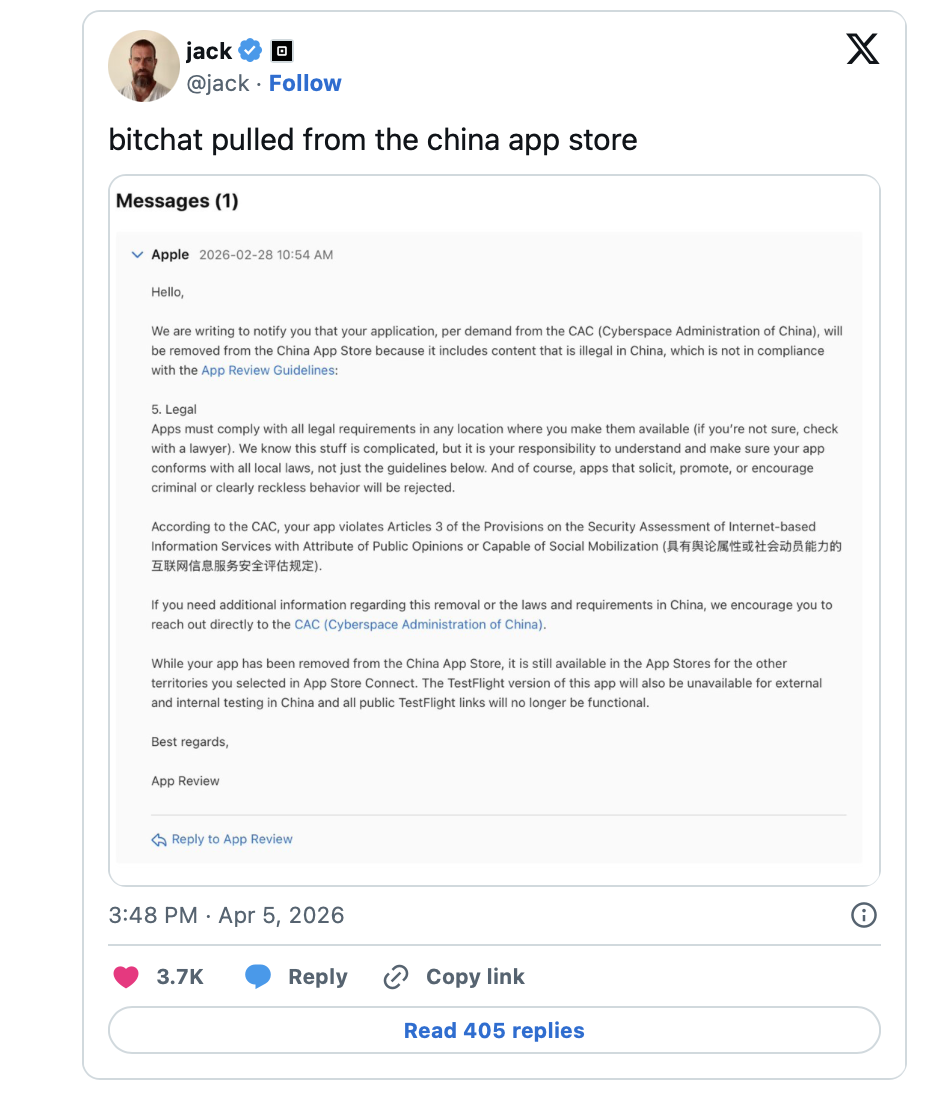
Image source: X/@jack
How does Bitchat work?
Bitchat’s technical architecture is markedly different from traditional communication software. The app operates entirely based on Bluetooth and Mesh Network technology. This peer-to-peer (P2P) communication mode does not rely on telecom infrastructure or an internet connection; users can maintain basic communication within a 30 to 100 meter range. By using node forwarding, it enables transmission over longer distances. For regulators, this design bypasses traditional network firewall filtering and content inspection systems, making it extremely difficult for the government to block it through conventional methods such as blocking the internet.
Bitchat is often used for international activism
Because Bitchat operates without needing a network connection, it becomes a communication tool used during protests and internet shutdown events in many countries. In the past, in countries such as Iran, Madagascar, Uganda, Nepal, and Indonesia, when governments tried to restrict information dissemination through technical means, Bitchat’s decentralized features helped it perform communication functions. This ability to keep operating in special environments puts it in conflict with the Beijing authorities’ current internet security review mechanisms, leading to its ban in the Chinese market. This is also why the application supported by Dorsey was taken down in China again after the decentralized social app Damus.
As of early April 2026, Bitchat’s cumulative downloads across global platforms have exceeded 3 million. In just the past week, downloads increased by more than 92k. Public information from the Google Play store also shows the app has more than 1 million registered downloads. Although detailed download distribution data by regional market is currently lacking, its growth trend indicates that decentralized communication tools are drawing attention in certain markets. Currently, the app is still provided normally in regions outside China, continuing to offer offline communication solutions.
- This article is reproduced with authorization from: 《鏈新聞》
- Original title: 《Jack Dorsey posts confirming that Apple, at China’s request, removes Bitchat decentralized communication app》
- Original author: DW
Disclaimer: The information on this page may come from third parties and does not represent the views or opinions of Gate. The content displayed on this page is for reference only and does not constitute any financial, investment, or legal advice. Gate does not guarantee the accuracy or completeness of the information and shall not be liable for any losses arising from the use of this information. Virtual asset investments carry high risks and are subject to significant price volatility. You may lose all of your invested principal. Please fully understand the relevant risks and make prudent decisions based on your own financial situation and risk tolerance. For details, please refer to
Disclaimer.


