
Trump posted in anger online, lashing out at the UK and France for standing by as the U.S.-Iran conflict escalates, urging them to resolve the oil crisis on their own. Experts analyze that Trump’s move is aimed at creating a “victory narrative.” They say his promise to withdraw troops within two or three weeks may be difficult to fulfill, and they call for ending the fighting as soon as possible through negotiations.
Trump fires back at the UK for observing the fighting, saying he’ll take “his” oil himself
After days of joint military action by the U.S. and Israel against Iran, Trump took to his social media platform, Truth Social, to openly criticize the UK and other countries for watching the fighting.
He said: “All those countries that can’t get aviation fuel because of the Strait of Hormuz—like the UK, which refused to take part in the assassination of Iran—here’s my advice to you: First, buy from the United States—we have plenty. Second, show the courage you’re so late to bring and go to the strait and take it directly.”
And then added: “You have to start learning how to fight for yourselves. The United States won’t help you anymore, just like you didn’t help us back then. Iran has basically been destroyed—the hardest part is already done. Go get your own oil!”
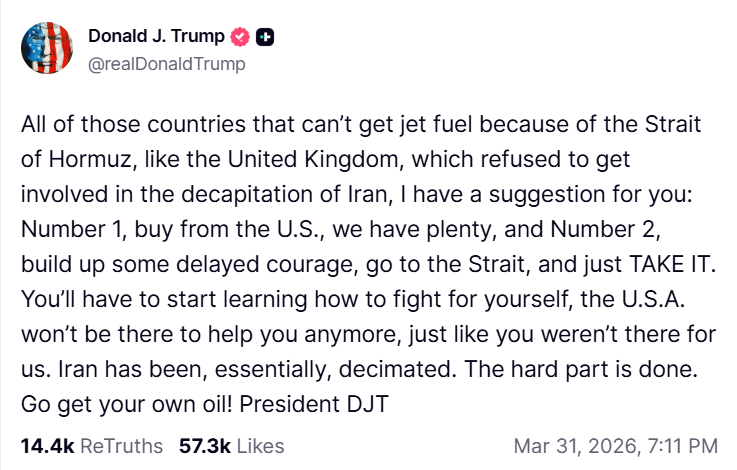
Image source: Truth Social Trump slams the UK for watching the fighting, saying he’ll take “his” oil himself
British media retaliate, saying the UK is increasing the deployment of troops in the Middle East
Although it is mainly the U.S. and Israel jointly carrying out military actions against Iran, the Independent reports that the UK is also planning to deploy additional troops to the Middle East, which would bring the number of British troops in that region to about 1,000.
British Defense Minister John Healey has also recently visited Saudi Arabia, Qatar, and Bahrain, which have been hit by Iranian retaliation. He said that the UK is doing everything it can to protect regional allies, and emphasized that leaders in the Persian Gulf countries place a high priority on the UK’s defense assistance.
Meanwhile, multiple countries are working to ensure freedom of navigation through the Strait of Hormuz. Currently, Iran has carried out an effective blockade of the waterway, driving up global energy prices. Iran is implementing a toll-booth system in the waters; for some ships, the cost can be as high as $2 million per trip.
Trump also takes aim at France for refusing to allow transit; experts say it’s about crafting a victory narrative
After he finished scolding the UK, Trump posted again criticizing France for not helping—especially for refusing to allow aircraft carrying military supplies to head to Israel, and for flying over French airspace.
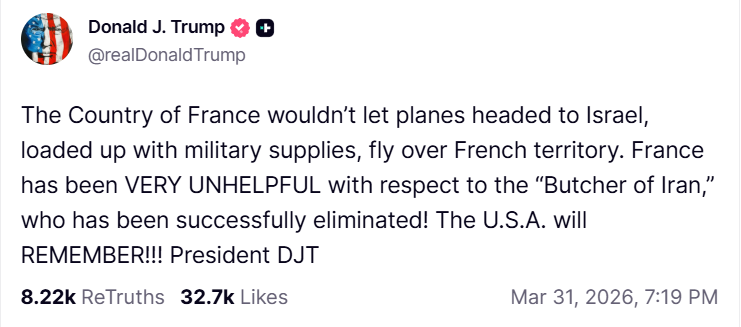
Image source: Truth Social Trump criticizes France for refusing transit
The office of French President Emmanuel Macron responded, saying that France’s position has been very clear since the first day the U.S.-Iran conflict broke out—for example, it will not authorize the use of French bases to attack Iran.
An expert from the Quincy Institute, Trita Parsi, analyzed that Trump’s claim about reopening the Strait of Hormuz is not the U.S.’s goal, but an attempt to craft a victory narrative. He also said he is frustrated that European countries are unwilling to help.
Parsi questioned, if the United States—which has vast defense resources—can’t do it, what difference could European countries like France make by getting involved, and he expects Iran to continue controlling the Strait of Hormuz.
Trump says he’ll withdraw troops within two or three weeks—but will that happen?
Trump had previously claimed that Iran was begging to reach an agreement, but later during an interview with White House reporters he changed his stance, saying that Iran doesn’t need to reach an agreement and that the U.S. will leave soon, possibly taking two or three weeks.
- Related report: The dawn of a U.S.-Iran war is in sight! Trump: Withdraw from Iran in 2–3 weeks; Taiwan stocks surge, and Bitcoin jumps past 68,000
Regarding this claim, Parsi said the public should be cautious in how they view it. The conflict has already spread across the entire region and has caused the deaths of thousands of people, mainly in Iran and Lebanon, so it would be difficult for Trump to easily step back.
He said Trump’s best approach would be to end the conflict as soon as possible through substantive negotiations. Continuing with the current hardline measures provides no benefit. Otherwise, after three weeks, the public will very likely only hear that the United States needs to wait another three weeks before fully ending military operations.
- Further reading: Powell’s Harvard speech—war impacts supply chains and maintaining cautious monetary policy; U.S. Treasury yields fall
Disclaimer: The information on this page may come from third parties and does not represent the views or opinions of Gate. The content displayed on this page is for reference only and does not constitute any financial, investment, or legal advice. Gate does not guarantee the accuracy or completeness of the information and shall not be liable for any losses arising from the use of this information. Virtual asset investments carry high risks and are subject to significant price volatility. You may lose all of your invested principal. Please fully understand the relevant risks and make prudent decisions based on your own financial situation and risk tolerance. For details, please refer to
Disclaimer.


