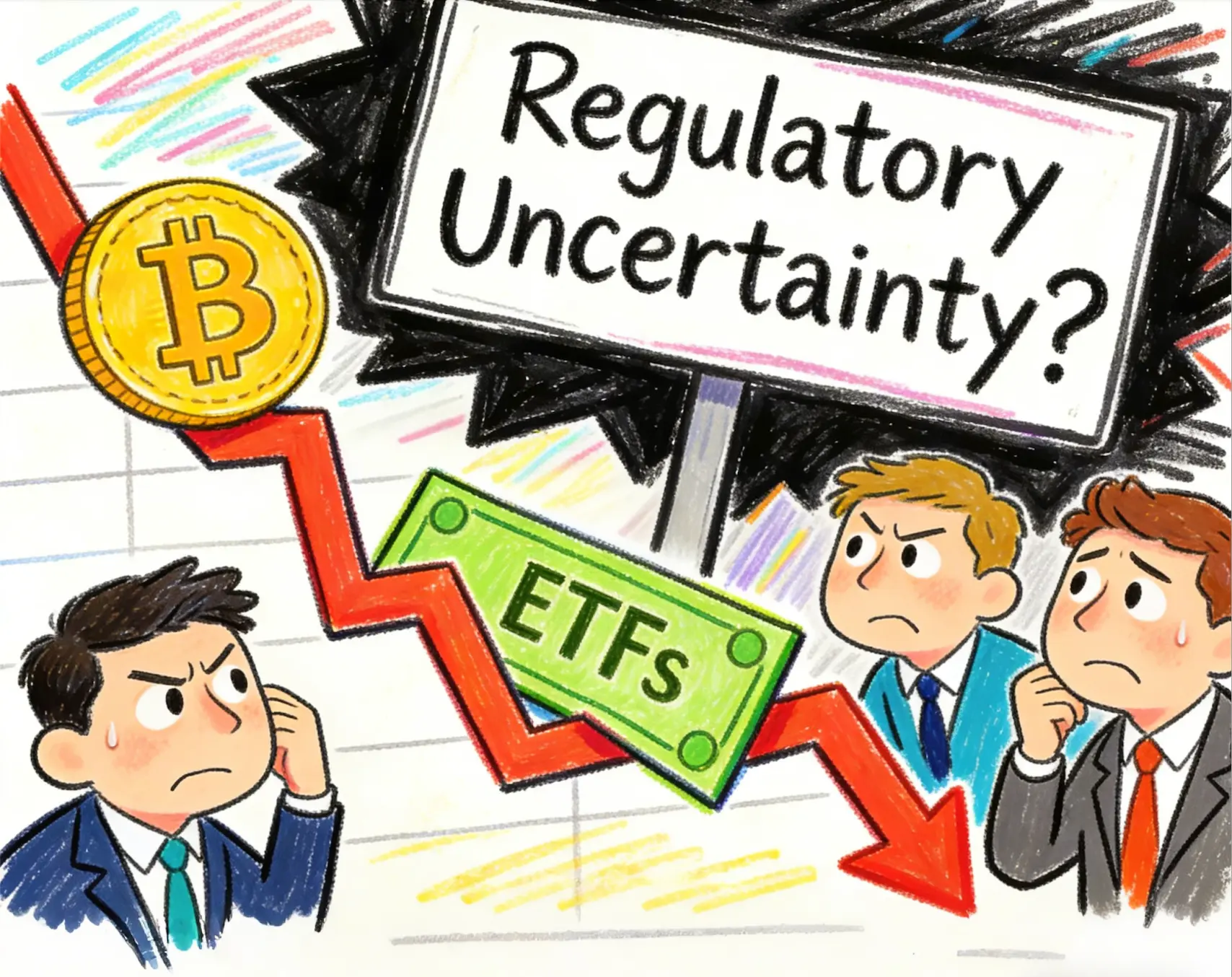
 Bitcoin and Ethereum exchange-traded funds recorded combined net outflows of $503 million during the week ending March 27, 2026, with Bitcoin ETFs losing $296 million and Ethereum ETFs shedding $207 million, marking the first weekly net negative for crypto investment products in five weeks.
The selling pressure coincided with growing investor concern over the Clarity Act’s implications for staked Ethereum products and yield-bearing stablecoin programs, alongside broader macroeconomic headwinds including escalating US-Iran tensions and shifting Federal Reserve rate expectations.
Bitcoin ETFs Reverse Early Momentum with $296 Million in Weekly Outflows
Bitcoin spot ETFs recorded net outflows of $296.18 million for the week, reversing the positive momentum seen in early trading. BlackRock’s IBIT emerged as the largest driver of outflows overall, including a sharp $201 million withdrawal on March 27 alone. Fidelity’s FBTC followed with consistent redemptions across multiple sessions yet finished the week with a positive net flow of $46.88 million.
Bitwise’s BITB and Ark & 21Shares’ ARKB posted notable weekly losses contributing to the outflow total. Grayscale’s GBTC continued its steady decline, while smaller products including the Bitcoin Mini Trust, VanEck’s HODL, Franklin’s EZBC, and Valkyrie’s BRRR saw mixed flows that did little to offset the broader trend.
The early inflow on March 23, driven by strong allocations into IBIT and FBTC, proved short-lived as sentiment shifted by midweek. CoinShares data indicated that US investors accounted for $445 million of the total outflows across crypto products, with Switzerland seeing minor outflows of $4 million.
Ethereum Funds Shed $222 Million as Clarity Act Concerns Intensify
Ethereum investment products recorded $222 million in outflows for the week, representing the heaviest losses among all digital assets tracked by CoinShares and bringing Ethereum’s year-to-date net flow to negative $273 million. BlackRock’s ETHA dominated the downside with multiple heavy redemptions throughout the week, while Fidelity’s FETH, Grayscale’s ETHE and its Mini Trust, Bitwise’s ETHW, 21Shares’ TETH, VanEck’s ETHV, and Invesco’s QETH all contributed to negative flows.
CoinShares Head of Research James Butterfill stated that the Ethereum fund drawdown was likely related to Clarity Act news, noting that a new draft of the legislation has drawn scrutiny for its potential implications for staked ETH products and yield-bearing stablecoin programs.
One Ethereum fund stood apart from the trend. BlackRock’s ETHB continued to attract steady inflows throughout the week, supported by its staking feature, closing the week with $141 million in inflows. The performance signaled where investor interest is beginning to concentrate, though it was insufficient to reverse the broader outflow trend.
Clarity Act and Macro Headwinds Drive Risk-Off Sentiment
The Clarity Act, proposed US crypto market structure legislation, has emerged as a key concern for investors. USDC issuer Circle saw its shares decline approximately 25% in the past week on speculation that the new Clarity Act draft will specifically target yield-bearing stablecoin programs. Circle does not offer yield on USDC directly but benefits from exchanges including Kraken and Coinbase paying users rewards to hold USDC balances.
Escalating geopolitical tensions around Iran and a sharp reversal in Federal Reserve rate expectations have also contributed to the sell-off. The CME FedWatch Tool shows traders are 97.4% certain the Federal Open Market Committee will hold rates steady at its April 28 meeting, with 2.6% pricing in a potential rate hike. One month ago, approximately 25% of traders anticipated a rate cut during the June meeting.
Prediction market platform Myriad data shows 91.5% of users believe the Fed will not cut rates by more than 25 basis points before July, reflecting diminished expectations for monetary easing that typically supports risk assets.
Solana and XRP ETFs Show Divergent Performance amid Broader Outflows
Solana ETFs posted net outflows of $4.2 million for the week, weighed down by late-week selling in Bitwise’s BSOL and earlier weakness in funds including Fidelity’s FSOL and VanEck’s VSOL.
XRP ETFs recorded net inflows of $2.66 million, driven primarily by Bitwise’s XRP product despite multiple sessions of no trading activity. The modest inflows contrasted with broader market outflows, suggesting targeted capital allocation rather than broad-based rotation.
Ethereum traded at $2,041 on March 31, gaining 2.3% over the preceding 24 hours as it recovered from weekend lows. Bitcoin traded near $67,662, approximately 46% below its late-2025 all-time high.
FAQ
How much did Bitcoin and Ethereum ETFs lose in the week ending March 27, 2026?
Bitcoin ETFs recorded net outflows of $296.18 million, while Ethereum ETFs recorded $207 million in outflows, bringing total crypto ETF outflows to approximately $503 million for the week. Ethereum investment products tracked by CoinShares showed $222 million in outflows, representing the heaviest losses among digital assets.
What factors drove the crypto ETF outflows?
Investor concerns over the Clarity Act’s implications for staked Ethereum products and yield-bearing stablecoin programs were primary factors, alongside escalating US-Iran geopolitical tensions and shifting Federal Reserve rate expectations. US investors accounted for $445 million of total outflows.
Which Ethereum ETF attracted inflows despite the overall trend?
BlackRock’s ETHB continued to attract steady inflows throughout the week, closing with $141 million in net inflows. The fund’s staking feature offered additional yield potential, making it more attractive to investors compared to traditional Ether ETFs.
Disclaimer: The information on this page may come from third parties and does not represent the views or opinions of Gate. The content displayed on this page is for reference only and does not constitute any financial, investment, or legal advice. Gate does not guarantee the accuracy or completeness of the information and shall not be liable for any losses arising from the use of this information. Virtual asset investments carry high risks and are subject to significant price volatility. You may lose all of your invested principal. Please fully understand the relevant risks and make prudent decisions based on your own financial situation and risk tolerance. For details, please refer to
Disclaimer.


