
The UK exchange-traded product (ETP) issuer Leverage Shares filed an application with the U.S. Securities and Exchange Commission (SEC) on March 30, with plans to launch an inverse ETF that bets on the decline in the price of Bitcoin, offering daily inverse return exposure with two leverage ratios: -1x and -2x. Bloomberg ETF analyst Eric Balchunas noted that the product’s structure is similar to the XIV.
Product Design: The Operational Logic Behind -1x and -2x Daily Inverse Returns
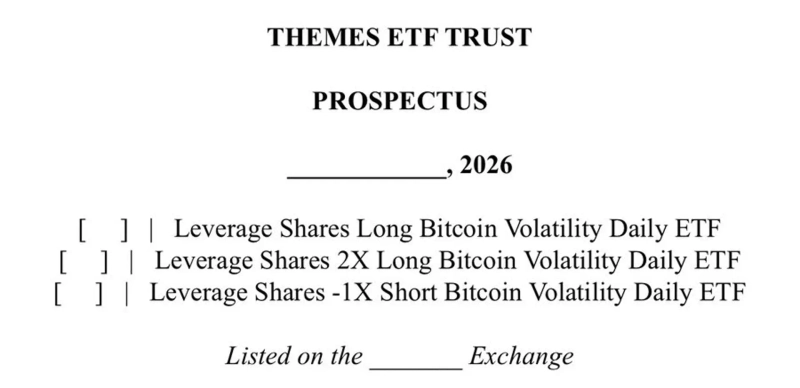 (Source: SEC)
The key design of this application lies in replicating Bitcoin’s daily price performance inversely within the ETF structure. If Bitcoin falls 5% on a given trading day, the -1x version should theoretically rise by about 5%; the -2x version should rise by about 10%. This daily reset mechanism means the fund manager must rebalance positions after each trading day, typically by entering into swap agreements with counterparties (Swap) or using futures contracts to achieve this.
Leverage Shares was founded in 2018 and currently manages multiple leveraged and inverse ETPs on European exchanges. This is the first attempt to enter the U.S. market, where competition includes institutions such as BlackRock, Fidelity, and VanEck, which dominate the spot Bitcoin ETF market.
Five Core Risks of Inverse Bitcoin ETFs
Volatility decay effects: The daily compounding effect can cause long-term holding losses in highly volatile markets; inverse returns are not the same as long-term inverse performance
Counterparty risk: Reliance on swap contract counterparties means that a counterparty default could substantially erode the product’s value
Liquidity mismatch: Bitcoin trades globally 24 hours a day, but the ETF pricing occurs only during traditional trading hours, which may create arbitrage differences
Tracking error: Trading costs generated by daily rebalancing and the compounding effect may cause long-term deviation from the target leverage
Lessons from XIV: The similar XIV ETN lost more than 90% of its value overnight during extreme volatility in February 2018, providing a historical reference for the risks of this type of structure
SEC Review Focus: New Regulatory Developments After Bitcoin ETF Approvals in 2024
The SEC’s review of inverse Bitcoin ETFs will focus on three core issues: assessing manipulation risk in the underlying Bitcoin market, custody arrangements for fund assets, and warnings about the complexity of derivative structures for retail investors. The approval of spot Bitcoin ETFs in January 2024 set an important regulatory precedent, but inverse leveraged crypto products fall into a completely new category, so the review is expected to be more stringent.
Previously, the SEC had taken a cautious stance toward crypto derivatives for many years. If the application is ultimately approved, it will mark the formal entry of crypto derivative products into mainstream regulated markets, providing two-way trading tools for hedge funds and professional traders. Regulators are expected to require robust risk disclosures, including explanations of how daily compounding effects impact returns for long-term holders.
Frequently Asked Questions
What is an inverse ETF, and how does Leverage Shares’ inverse Bitcoin ETF work?
An inverse ETF tracks the daily inverse return of the target asset through derivative contracts (such as swap agreements or futures). The -1x version that Leverage Shares has applied for aims to provide, on a daily basis, an equal upside move corresponding to the daily downside of Bitcoin—for example, if Bitcoin falls 5%, the ETF rises by about 5%. Because it uses a daily reset mechanism, the actual long-term returns may differ significantly from the target leverage ratio.
What are the structural similarities between the XIV ETN and an inverse Bitcoin ETF, and what do their risks imply?
The XIV ETN tracks the inverse VIX volatility index, and there are structural similarities with Leverage Shares’ inverse Bitcoin ETF—both are designed around daily inverse leverage and rely on derivative contract agreements to achieve exposure. But the case in which XIV lost more than 90% of its value overnight during extreme volatility in February 2018 highlights that structures of this type carry extreme downside risk under abnormal volatility conditions, making it a key reference case for SEC review.
How can the timing and likelihood of the SEC approving this application be assessed?
There is currently no clear timeline. After the SEC approved spot Bitcoin ETFs in 2024, it established a clearer regulatory framework for crypto ETFs, but inverse leveraged crypto products are a completely new category, so the review will be more stringent. Regulators will focus on evaluating investor protection provisions, the adequacy of risk disclosures, and whether the complex derivatives structure meets market integrity requirements.
Disclaimer: The information on this page may come from third parties and does not represent the views or opinions of Gate. The content displayed on this page is for reference only and does not constitute any financial, investment, or legal advice. Gate does not guarantee the accuracy or completeness of the information and shall not be liable for any losses arising from the use of this information. Virtual asset investments carry high risks and are subject to significant price volatility. You may lose all of your invested principal. Please fully understand the relevant risks and make prudent decisions based on your own financial situation and risk tolerance. For details, please refer to
Disclaimer.


