
As of Monday, Pi Network (PI) was trading at about $0.1750, up more than 2% from the previous day. However, the second mainnet migration event also triggered a rapid increase in deposits to centralized exchanges (CEX), creating near-term selling pressure that tests bulls. According to PiScan data, in the past 24 hours, more than 1.12 million PI tokens net flowed into CEX, testing the bulls’ resolve to hold support.
Second Mainnet Migration: 119,000 Pioneer Users Complete, CEX Selling Pressure Heats Up in Tandem
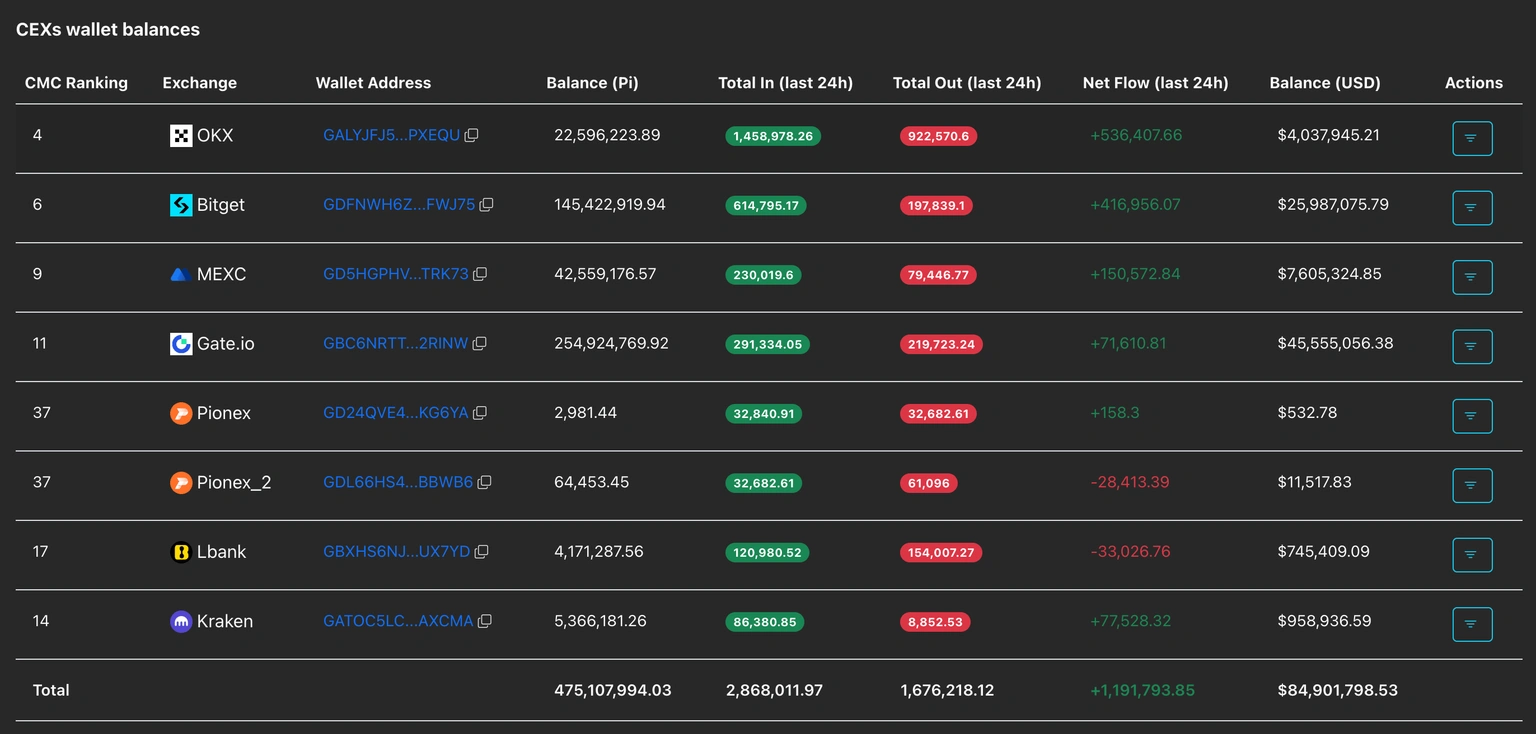 (Source: PiScan)
During Pi Network’s second mainnet migration, more than 119,000 pioneer users (Pioneers) who have passed KYC identity verification successfully completed on-chain migration, officially transferring the PI tokens they hold from the sandbox environment to the mainnet.
The special feature of this mechanism is that only users who have completed the mainnet migration are eligible to deposit PI tokens into CEX, meaning each migration event directly corresponds to an expansion in the supply available to CEX. This is an important leading indicator for assessing near-term selling pressure. After this migration, the PI token is still holding above support rather than breaking down quickly, indicating that there is enough buy-side demand to absorb this added supply.
Technical Analysis: $0.1736 Is the Core Battle Line Between Bulls and Bears
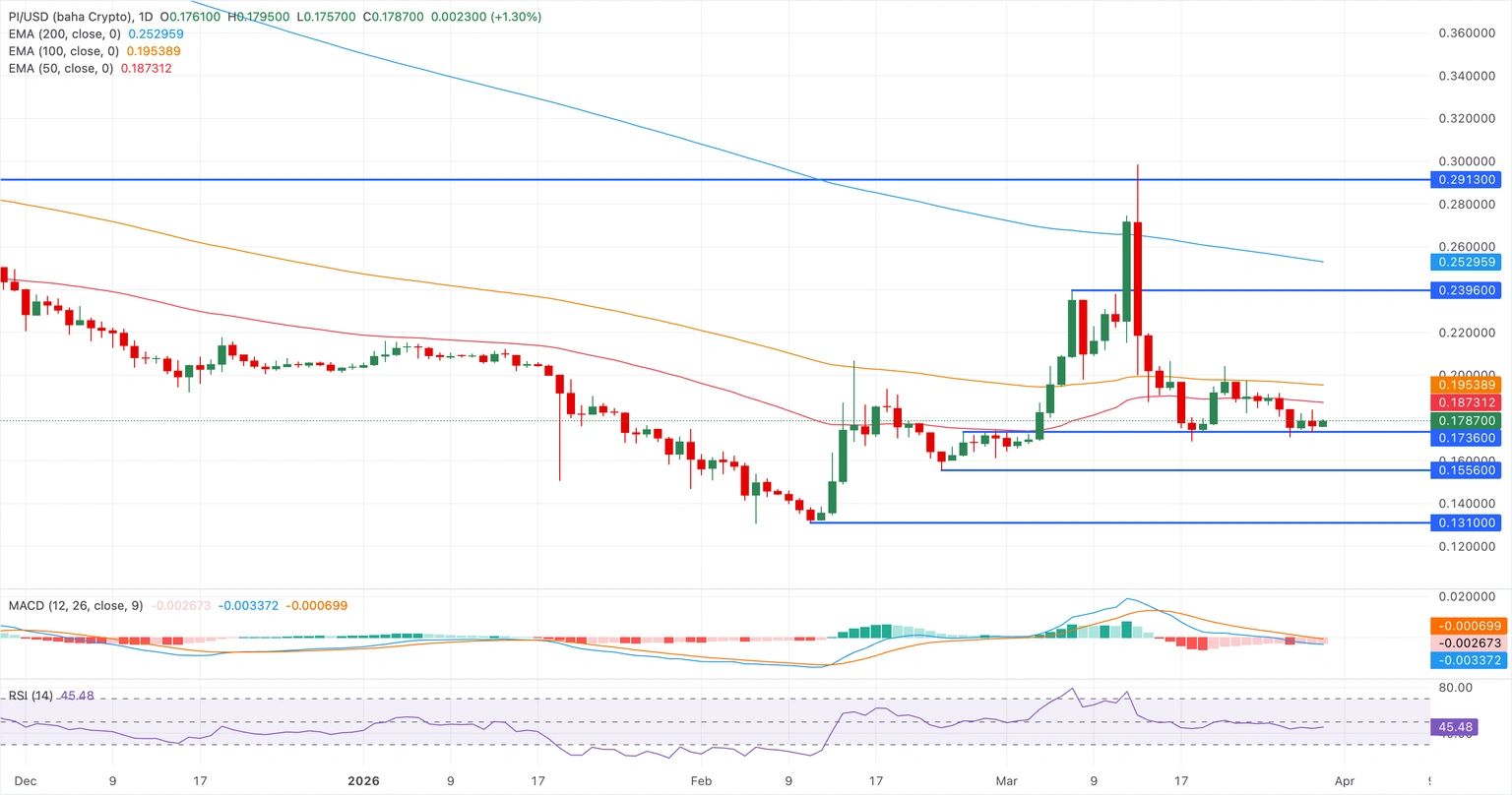 (Source: Trading View)
From a technical perspective, PI’s current trend is neutral with a slight bearish tilt. The core defense level that bulls are holding is at $0.1736. The following key technical levels determine the near-term direction:
Current holding range: $0.1736 to $0.1750 (bulls currently defending)
50-day EMA resistance: $0.1872 (a break above this level would confirm a short-term bullish reversal signal)
100-day EMA resistance: $0.1953 (the next target threshold for a medium-term bullish turn)
Direct support below: $0.1556 (the Feb 23 low point; if it breaks below $0.1736, this becomes the key bottom)
Regarding momentum indicators, the MACD line is slightly below the signal line and the zero axis, but the negative histogram bars are contracting, indicating that downward momentum is weakening rather than accelerating. RSI is 45, below the 50 midline level, reflecting that bullish confidence has not fully recovered, though there is no obvious sign that the technical-side bearish pressure is intensifying.
Protocol 21 Upgrade Deadline: April 6 Becomes a Key Upcoming Time Node
Pi Network’s core team announced that it plans to upgrade the network to Protocol 21 based on the Stellar blockchain architecture, and set the upgrade deadline for all mainnet nodes as April 6. The rollout of Protocol 21 will directly affect the stability of Pi Network’s technical infrastructure and the expansion of potential application scenarios. It is an important milestone for evaluating the PI token’s mid-term fundamentals.
Worth noting is that April 6 is also an important time window for the Iraq-Iran ceasefire talks, and the overlap between the two deadlines makes this date a core observation point for near-term changes in both the macro outlook and fundamentals of the PI token.
Frequently Asked Questions
How does Pi Network mainnet migration affect the number of CEX deposits?
Pi Network mainnet migration is a key process that allows pioneer users to transfer PI tokens from a closed testing environment to the mainnet. Only users who complete the mainnet migration and pass KYC verification are eligible to deposit PI into centralized exchanges. Therefore, each migration event directly corresponds to an expansion in the supply available to CEX, making it an important leading indicator for assessing near-term selling pressure.
What are the most critical technical support and resistance levels for the PI token right now?
The most critical support level is $0.1736. If it fails to hold, the direct support below lies at the Feb 23 low of $0.1556. On the upside, bulls need to break above $0.1872 (the 50-day EMA) to confirm a short-term reversal signal. After clearing this level, they can further challenge the $0.1953 area at the 100-day EMA.
What is the potential impact of the Protocol 21 upgrade on Pi Network’s token?
Protocol 21 is an important upgrade planned by Pi Network to migrate the underlying technology to the Stellar blockchain architecture. Its goal is to improve network transaction efficiency and scalability. The April 6 node upgrade deadline is the most important project progress time node in the near term. If the upgrade is completed as scheduled, it could provide a positive fundamental-level signal for the PI token, and the resulting support action on the technical side would reinforce each other in effect.
Disclaimer: The information on this page may come from third parties and does not represent the views or opinions of Gate. The content displayed on this page is for reference only and does not constitute any financial, investment, or legal advice. Gate does not guarantee the accuracy or completeness of the information and shall not be liable for any losses arising from the use of this information. Virtual asset investments carry high risks and are subject to significant price volatility. You may lose all of your invested principal. Please fully understand the relevant risks and make prudent decisions based on your own financial situation and risk tolerance. For details, please refer to
Disclaimer.


