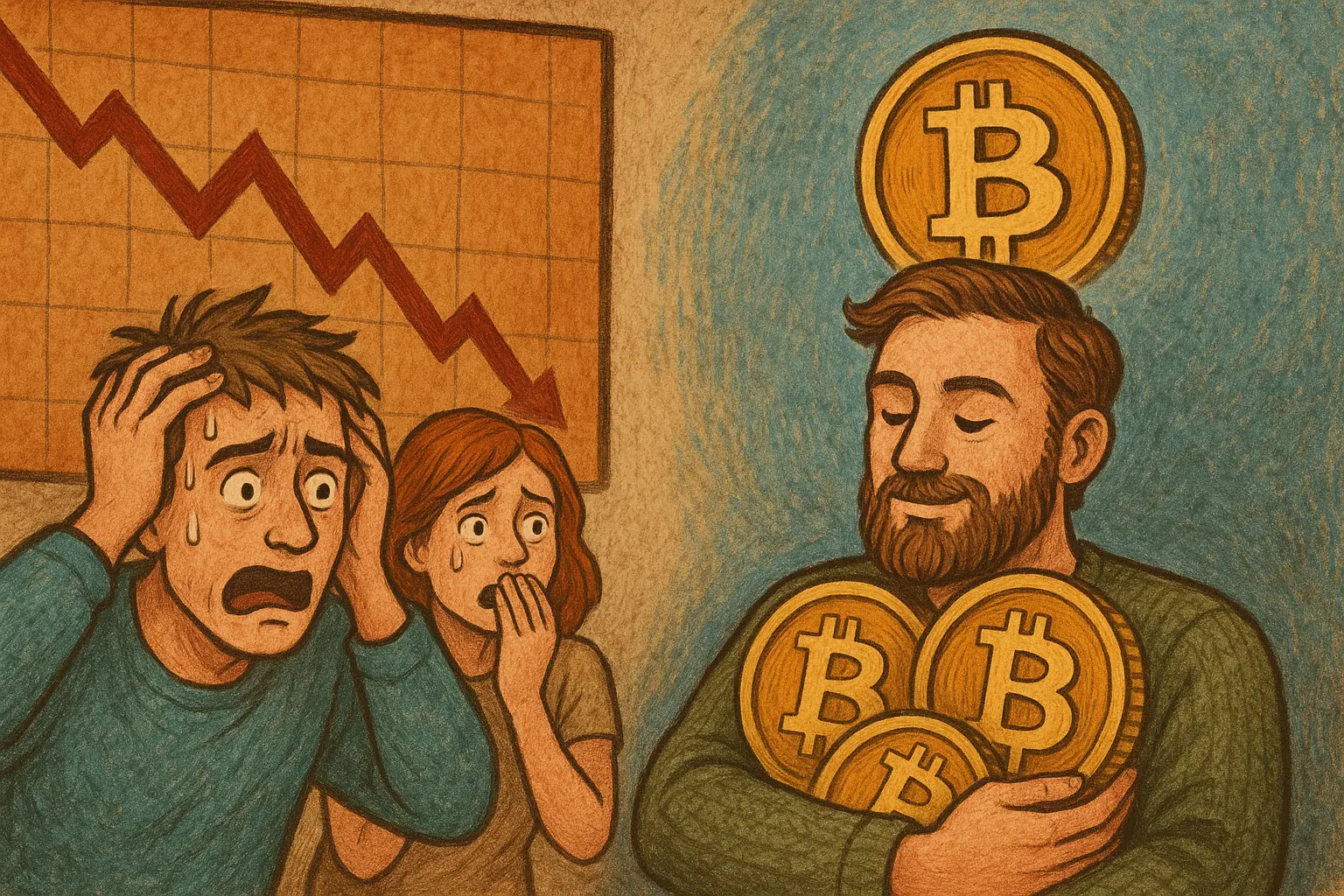
The Bitcoin Fear and Greed Index recorded a value of 8 on March 30, and the number of days in the “Extreme Fear” range has reached a continuous 59 days—the longest bearish sentiment cycle since the end-of-2022 FTX collapse. However, on-chain data tells a completely different story: as retail confidence collapses, long-term holders are moving Bitcoin from exchanges to self-custody accounts, rather than selling.
Fear and Greed Index Interpretation: What a Value of 8 Means
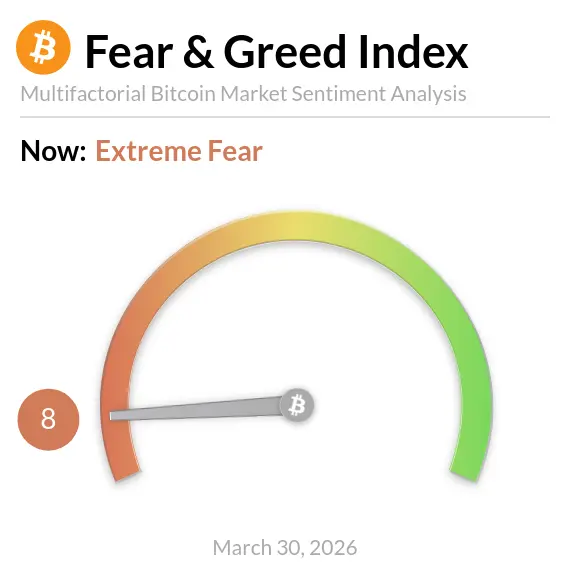
The Fear and Greed Index is a comprehensive sentiment quantification tool with a range of 0 to 100, aggregating data from multiple market dimensions:
Price volatility: measures the deviation of short-term fluctuation magnitude relative to the historical average
Market momentum and trading volume: tracks the strength comparison between current buy/sell pressure and past averages
Bitcoin market share: monitors changes in BTC’s share of the overall cryptocurrency market
Social media activity: analyzes the market sentiment tone and mention frequency on platforms such as X
Google search trends: tracks signals of changes in retail investors’ proactive search behavior
When the index reading is 8, it means that nearly all of the above dimensions are simultaneously showing extreme bearish signals, indicating that the market is in its most emotionally fragile quantified state.
Why Market Sentiment Collapses: Multiple Macroeconomic Pressures in 2026
Unlike the 2022 crypto winter, this Bitcoin greed index has remained subdued with no clear single trigger. In 2022, a chain of domino-like events—Terra/Luna’s collapse, Three Arrows Capital’s liquidation, and FTX’s bankruptcy—formed a sequence, and each shock had a clear origin and an identifiable bottom.
The worsening market in 2026 follows a “slow deterioration” pattern formed by the accumulation of multiple macro factors: the Federal Reserve delays rate cuts and incorporates expectations of potential rate hikes; the Iran-U.S. conflict pushes up oil prices and strengthens inflation pressure; and a continuously strong U.S. dollar suppresses valuations of global risk assets. A key feature of this pattern is that it is difficult to confirm the bottom timing, because there is no single event “resolution” that can become a turnaround catalyst.
From a historical cycle comparison, after the March 2020 COVID crash, Bitcoin rose by about 133% within six months and recovered quickly; after the 2022 FTX collapse, the recovery took nearly a year. Many market analysts generally believe the current environment is closer to the latter—long compression with no clear rebound catalyst.
On-Chain Signals Diverge: Typical Structural Features of Fear Bottoms
Although the Bitcoin Fear and Greed Index has fallen to historic lows, on-chain data shows a divergence structure that closely matches past bottom cycles. Long-term holders (address groups holding for more than a year) are withdrawing Bitcoin from exchanges to self-custody accounts rather than selling—this behavior pattern has historically often appeared in the accumulation phase of market bottoms.
Institutional investors’ actions also form a contrast with retail. Even though U.S. spot Bitcoin ETFs recorded over $296 million in outflows over the past week, institutions generally maintain their positions rather than executing a systematic liquidation, indicating that institutional belief has not yet collapsed.
This structure of “retail sentiment collapsing while long-term capital quietly accumulates” also appeared in the final stage of the 2022 bear market bottom, and was ultimately validated as a leading indicator of recovery. But the complexity of the current macro environment makes it hard to predict the timing of the turn; whether the second quarter of 2026 can bring decisive factors for macro improvement is the market’s most core unanswered question.
Frequently Asked Questions
What is the historical significance of the Bitcoin Fear and Greed Index staying below 25 for 59 straight days?
This is the longest extreme fear cycle since the end-of-2022 FTX collapse, reflecting that market sentiment has entered a structural pessimism phase. Historical data shows that after fear cycles lasting this long, there is often a significant price rebound—however, the timing window for recovery depends on when macro conditions change, and it is not necessarily immediate.
Why is market panic in 2026 different from the 2022 FTX collapse pattern?
The 2022 collapse had a clear sequence of “bad events.” Once the biggest impact (FTX bankruptcy) is digested by the market, a recognizable bottom forms. The panic in 2026 is driven by macro factors (interest rates, geopolitics, a strong U.S. dollar) and lacks a single event resolution point; as the market waits for the macro environment to turn, it forms a longer pattern of stagnation, making bottom confirmation harder.
Is the signal bullish or bearish when long-term holders move Bitcoin to self-custody accounts?
This is typically interpreted as a bullish signal. When long-term holders move Bitcoin out of exchanges, it means they choose not to sell at the current price while reducing potential sell pressure in the future. Historically, this behavior pattern has been validated as a reliable contrarian accumulation indicator in multiple market bottom cycles, such as at the end of 2018 and the end of 2022.
Disclaimer: The information on this page may come from third parties and does not represent the views or opinions of Gate. The content displayed on this page is for reference only and does not constitute any financial, investment, or legal advice. Gate does not guarantee the accuracy or completeness of the information and shall not be liable for any losses arising from the use of this information. Virtual asset investments carry high risks and are subject to significant price volatility. You may lose all of your invested principal. Please fully understand the relevant risks and make prudent decisions based on your own financial situation and risk tolerance. For details, please refer to
Disclaimer.


