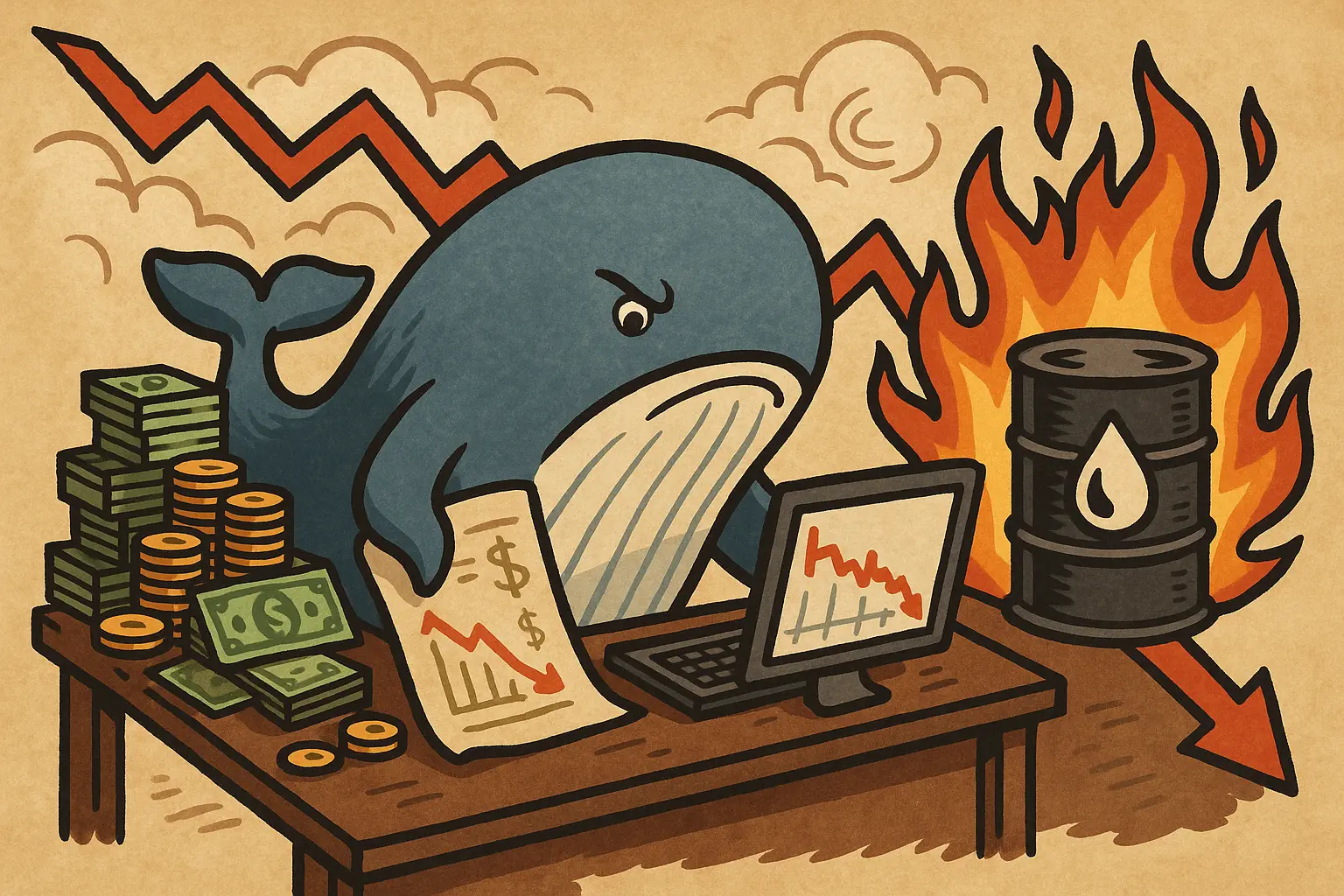
A whale (a large market participant) has established a short position valued at approximately $17 million in the crude oil market, betting that the recent upward trend in oil prices will slow down or even reverse, with a liquidation price set at around $139 per barrel. This contrarian trade occurred against the backdrop of ongoing geopolitical tensions in the Middle East that have significantly driven up oil prices, reflecting a deepening divide in market expectations regarding the future direction of oil prices, with both bulls and bears facing high uncertainty.
Short Position Structure: Liquidation Level of $139 is the Key Risk Boundary
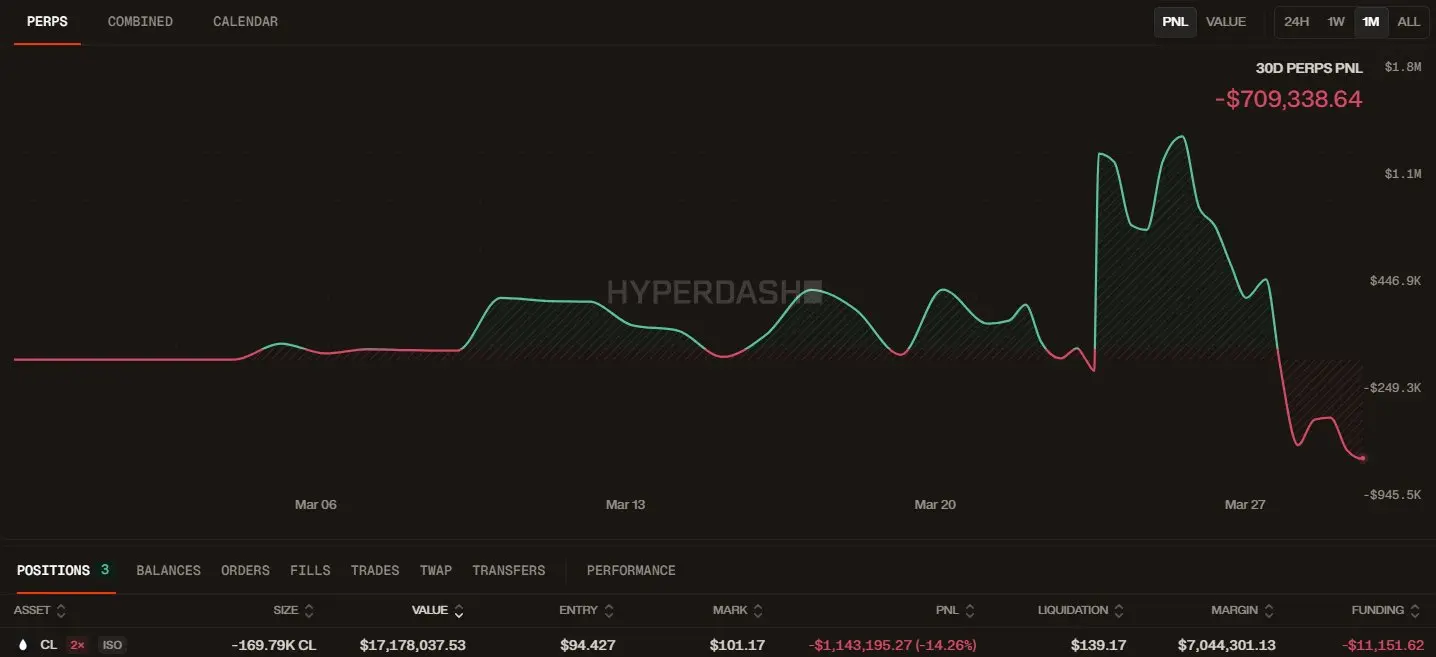 (Source: Hyperdash)
The profit logic of the short position is based on falling oil prices; thus, the holder assesses that the current upward momentum in crude oil is unlikely to last, and the market will experience a mean-reversion style pullback. The liquidation price set at around $139 per barrel is the core risk parameter of this trade—if oil prices continue to be driven by geopolitical shocks and rise to this level, the holder will face forced liquidation, with potential losses that could far exceed the initial margin requirement.
Such a large single-direction position typically reflects a strong conviction on the part of the holder regarding market trends. However, a high concentration of leveraged positions also means that market volatility can have a magnified impact on the holder. If market trends move contrary to expectations, the buying pressure resulting from forced liquidations could further accelerate price increases, creating a chain reaction.
Geopolitical Drivers of Rising Oil Prices
The recent upward trend in the crude oil market is driven by several mutually reinforcing risk factors:
Ongoing U.S.-Iran Military Conflict: Since the initiation of the U.S. “Epic Fury” operation, tensions in the Middle East have remained high, with the Strait of Hormuz, the world’s most important oil transportation route, facing supply disruption risks that directly impact market pricing.
Disruption in Red Sea Shipping: Houthi forces continue to attack commercial vessels in the Red Sea, forcing some oil tankers to reroute, leading to increases in both transportation time and costs.
Tightening Supply Expectations: Concerns over potential further restrictions on Iranian oil exports have prompted an early expansion of spot demand.
The oil market reacts extremely quickly to geopolitical signals; even slight changes in supply expectations can trigger significant price fluctuations in a short time.
Market Divergence: Both Bulls and Bears Have Support for Their Arguments
Faced with the same set of geopolitical data, the market has shown a clear divergence in judgment regarding future trends. Bulls believe that if the conflict escalates, the Strait of Hormuz faces closure risks, and oil prices still have further upward potential, while existing short positions could be targeted; bears, however, argue that the market has “overpriced” some risks—U.S. officials indicate that military objectives are largely achieved, and if meaningful progress is made in ceasefire negotiations, the geopolitical risk premium will quickly dissipate, leading to a rapid correction in oil prices.
The existence of large short positions itself is also a factor contributing to market instability. If oil prices approach the $139 liquidation level, the buying orders triggered by forced liquidations could accelerate upward; conversely, if prices fall back, short covering could also accelerate the decline, creating a bidirectional price amplification effect.
Frequently Asked Questions
What is the logic behind the whale betting on falling oil prices?
The core judgment of the short position holders is that the current oil prices have already reflected too much geopolitical premium. If ceasefire negotiations in the Middle East make progress or the intensity of the U.S.-Iran conflict decreases, this portion of risk premium will quickly detach from oil prices, creating considerable room for correction, which forms the basic profit condition for the $17 million short position.
What does a liquidation price of $139 imply in terms of risk exposure?
The liquidation level represents the critical point at which the short position would be forcibly liquidated. If oil prices continue to be driven by geopolitical shocks and consistently breach and maintain above $139, the holder will incur the full loss of their margin. Large leveraged short positions theoretically face unlimited losses in a trending upward market; therefore, the setting of the liquidation level directly determines the maximum acceptable loss boundary for the holder.
What impact does this $17 million short position have on the overall trend of oil prices?
While a single trade cannot dictate market direction, such a sizable position can serve as a sentiment indicator, reflecting institutional expectations for a correction in oil prices. If large-scale shorts simultaneously accumulate, it could accelerate downward movements when market correction signals appear; conversely, if shorts are liquidated, forced buying could temporarily amplify upward momentum, creating a bidirectional volatility amplification effect.
Disclaimer: The information on this page may come from third parties and does not represent the views or opinions of Gate. The content displayed on this page is for reference only and does not constitute any financial, investment, or legal advice. Gate does not guarantee the accuracy or completeness of the information and shall not be liable for any losses arising from the use of this information. Virtual asset investments carry high risks and are subject to significant price volatility. You may lose all of your invested principal. Please fully understand the relevant risks and make prudent decisions based on your own financial situation and risk tolerance. For details, please refer to
Disclaimer.


