
Webtoon Canvas introduces AI translation support for Traditional Chinese and six other languages. Japanese publishers are also investing in AI translation, while DLsite adopts a fan revenue-sharing model to address labor shortages and time differences, accelerating overseas expansion and combating piracy.
Webtoon Canvas introduces AI translation, supporting Traditional Chinese and six other languages
Korean webtoon giant Webtoon announced yesterday (3/26) that it will integrate user-generated content platforms (UGC) across regions this spring, launching an international version of Webtoon Canvas with AI translation functionality, allowing creators to automatically translate their works into seven languages, including Traditional Chinese, English, Spanish, French, Indonesian, Thai, and German.
This translation system combines Webtoon’s proprietary AI model with third-party large language models (LLMs).
Addressing creators’ concerns about their comics being taken by AI models, Webtoon Entertainment President Yongsoo Kim stated that the system only processes text elements within comic pages and does not capture image data, with a dedicated glossary feature to help AI understand narrative context and maintain translation consistency. The platform will not require mandatory participation; the AI translation feature is voluntary, allowing creators to retain full control over their works.
Webtoon Canvas will initially test eligible English-speaking creators, with plans to expand to other overseas markets.

Image source: Webtoon Canvas Webtoon Canvas introduces AI translation, supporting Traditional Chinese and six other languages
Japanese manga publishers are also laying out their strategies, investing in AI startups and integrating tools
As more and more anime works enter the mainstream, the global online comic and physical comic markets are gradually expanding.
To meet the massive localization translation demands, major Japanese publishers are accelerating their embrace of AI translation technology.
In 2024, the startup Mantra, focused on AI translation technology for comics, has secured a total investment of 780 million yen from major publishing giants such as Shueisha, Shogakukan, KADOKAWA, and Square Enix.
The translation tool under Mantra combines comic image recognition technology with large language models, able to understand characters and story backgrounds, compressing traditional translation workflow time to less than half; it is currently used for simultaneous multi-language releases of well-known works like “One Piece” and “Spy x Family.”
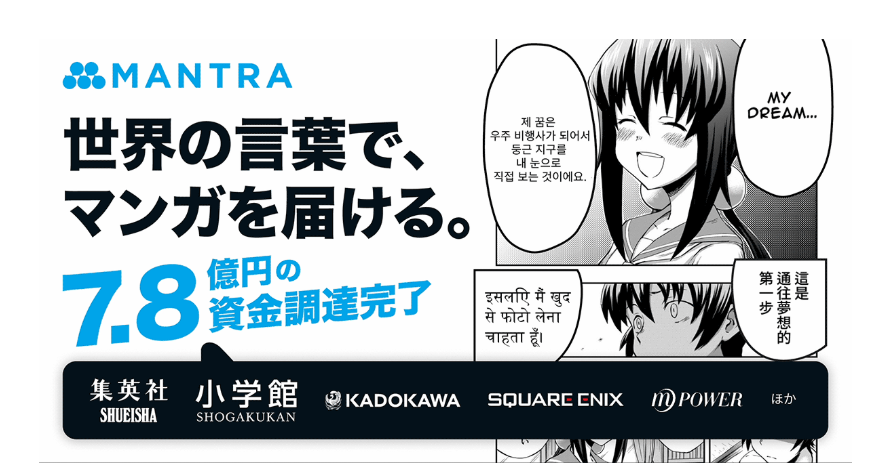
Image source: Mantra The startup Mantra, focused on AI translation technology for comics, has secured a total investment of 780 million yen from major publishing giants such as Shueisha, Shogakukan, KADOKAWA, and Square Enix.
While operating the global comic community service MANGA Plus Universe, Shueisha also announced the introduction of the AI Schliemann translation tool.
Shueisha adopts a dual-track parallel strategy, having professional human translators handle important interfaces and user agreements, while a large volume of comments that require immediate processing in the community discussion area is translated rapidly into nine languages by an AI system capable of learning brand tone.
DLsite takes a different approach, solving translation issues through a doujin model
However, in the crowded Japanese doujin market, which is filled with derivative works and original creations shared with like-minded individuals, a doujin translation mechanism has already been explored.
The well-known doujin work sales platform DLsite launched the “Let’s Translate” project back in 2021, recruiting over 25,000 enthusiastic fan volunteer translators to support the localization of doujin works and general commercial manga in as many as 13 languages. Creators can set their own profit-sharing ratios, while translators can freely choose whether to receive a share of the profits.
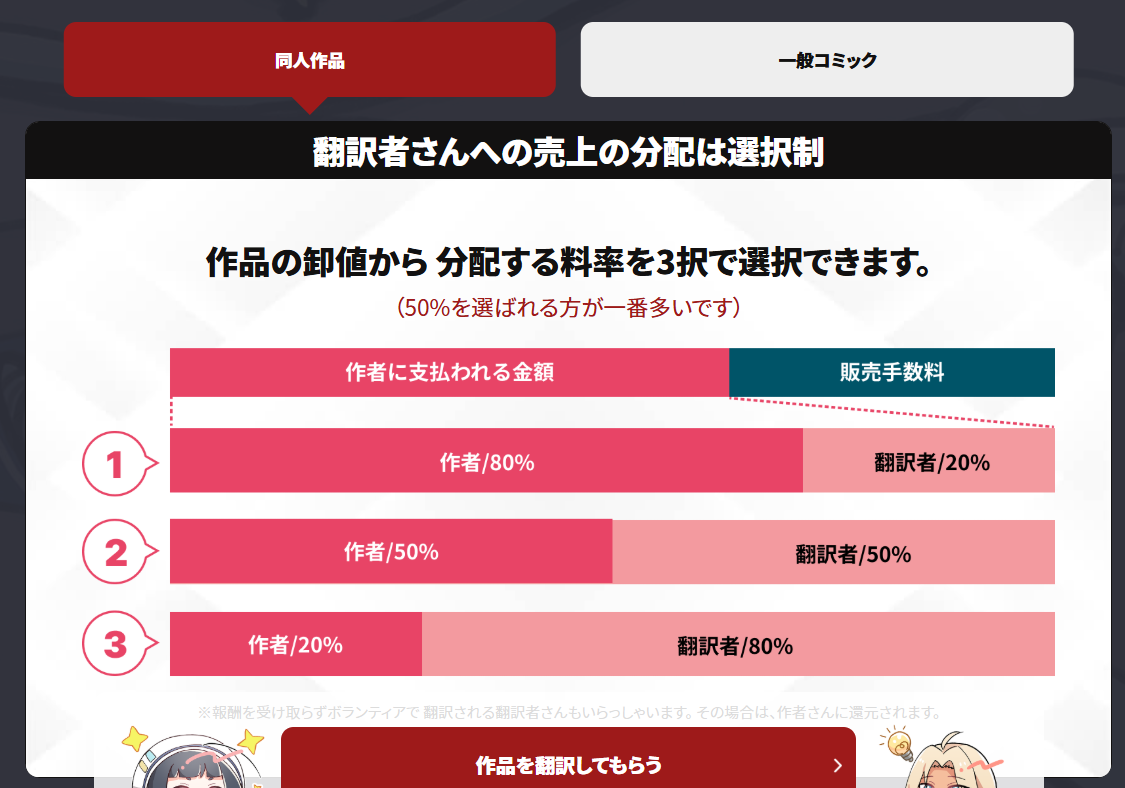
Image source: DLsite website screenshot The well-known doujin work sales platform DLsite launched the “Let’s Translate” project back in 2021.
Participants who want to join DLsite must first register for a platform and translator account, then select works that have already received author translation permission.
Translators can use the online translation tool provided by Mantra Engine, entering translations directly on the webpage, adjusting text layout, and overlaying text. After completion, the work is submitted for review by official staff, and once listed for sale, the translator can receive corresponding profit shares.

Image source: DLsite website screenshot The well-known doujin work sales platform DLsite launched the “Let’s Translate” project back in 2021.
This mechanism has produced over 15,000 translated works within a year, generating a total sales volume of 2.5 billion yen from legitimate translated works, successfully establishing a mutually beneficial business model for creators and translators.
Addressing labor shortages and piracy issues, AI becomes a tool for accelerating overseas expansion
Whether AI translation or doujin translation, comic platforms and publishers are actively adopting these technologies primarily to address various pain points faced by traditional translation processes.
Webtoon has pointed out that the company cannot provide enough human translators to meet the needs of all independent creators who wish to take their works overseas, making AI translation a technological solution to the shortage of human resources.
Yongsoo Kim also explained to The Verge that language barriers and challenges in traditional distribution channels have long limited creators’ reach, and new tools can effectively help creators build global fanbases.
Translation speed is also a key factor in combating piracy. DLsite noted that traditional translation processes require a considerable amount of time, often failing to meet the growing demands of global readers, and this time lag is one of the main reasons for rampant piracy in comics.
By accelerating the output of officially licensed translations through technology or community power, Webtoon, Japanese publishers, and the doujin market hope to attract overseas readers who might hesitate due to language barriers, aiming to effectively curb the spread of piracy.
Further reading:
Shueisha’s new manga award work allegedly generated by AI! Japanese netizens erupt: Can’t the judges tell the difference?


