
OpenAI announced on March 18th the release of GPT-5.4 Mini and GPT-5.4 Nano, two lightweight models designed for high-capacity AI workloads, iterating less than two weeks after the launch of the GPT-5.4 flagship version. GPT-5.4 Mini is twice as fast as the previous GPT-5 Mini, while GPT-5.4 Nano is optimized for real-time conversations at a lower cost.
Core Logic of Small Models: Accuracy Is Not Always the Bottleneck
OpenAI positions GPT-5.4 Mini and Nano as “the most powerful small models to date,” but they are not just scaled-down versions of the flagship. They are designed based on different priorities: when the actual bottleneck is speed and cost rather than reasoning depth, smaller models often prove more practical.
For example, in customer service: if answering 200 fixed questions daily, the marginal benefit of doctoral-level reasoning is nearly zero, and the key to scaling the system is response times under one second and response costs of just a fraction of a cent per reply.
A relatively efficient workflow currently involves: the flagship model (like GPT-5.4) handles task planning and coordination, while Mini or Nano processes large volumes of repetitive sub-tasks—such as codebase searches, document reading, or form processing. Jerry Ma, Vice President of Technology at Perplexity, stated after testing: “Mini models have strong reasoning capabilities, and Nano models respond quickly and efficiently, suitable for real-time conversation workflows.”
Benchmark Data: Mini Has Surpassed Human Computer Operation Standards
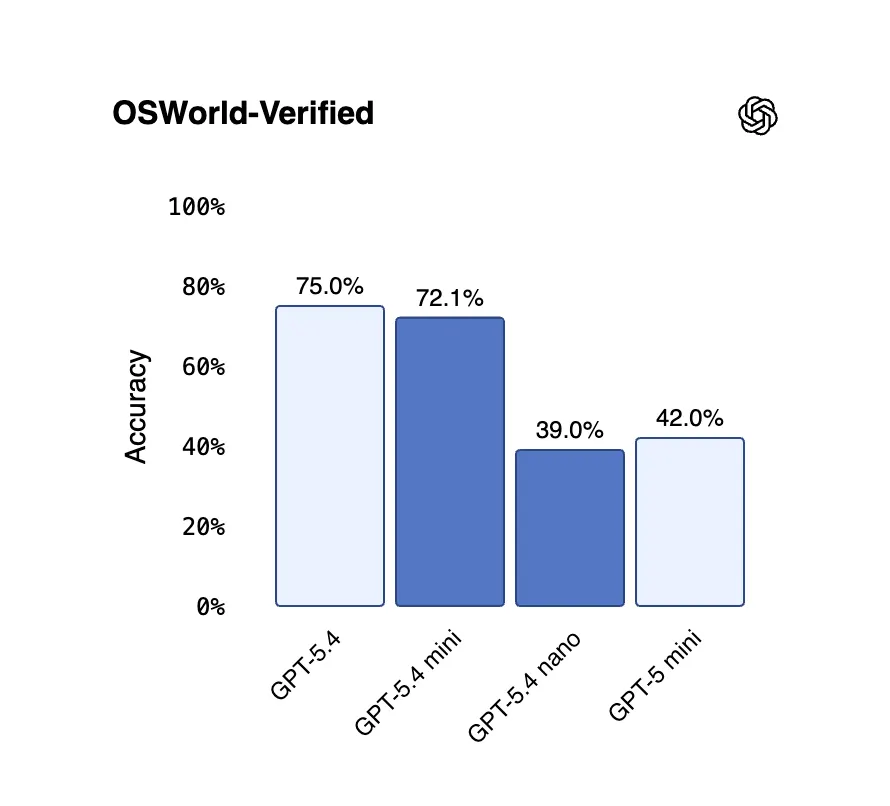 (Source: OpenAI)
Based on public benchmark data, GPT-5.4 Mini’s performance is already quite close to the flagship:
SWE-Bench Pro (assessing ability to fix real GitHub code issues): GPT-5.4 Mini scored 54.4%; older GPT-5 Mini scored 45.7%; GPT-5.4 flagship scored 57.7%.
OSWorld-Verified (evaluating actual desktop operations via screenshots): Mini scored 72.1%; GPT-5.4 flagship scored 75.0%; human benchmark is 72.4%—Mini has surpassed human standards.
GPT-5.4 Nano: SWE-Bench Pro 52.4%, OSWorld-Verified 39.0%, lower than Mini but still a significant improvement over previous Nano series.
This data indicates that in scenarios requiring desktop operations or code handling, Mini performs nearly on par with the flagship; Nano, while less accurate, offers unique cost advantages in high real-time demand scenarios.
Pricing Structure and Availability: Developer vs. General Users
API Pricing: GPT-5.4 Mini costs $0.75 per million input tokens and $4.50 per million output tokens; GPT-5.4 Nano costs $0.20 per million input tokens and $1.25 per million output tokens—input pricing for Nano is about a quarter of Mini.
User Accessibility: GPT-5.4 Mini is available to ChatGPT Free and ChatGPT Plus users via the “+” menu under the “Thinking” option; when paid users reach their GPT-5.4 usage limit, the system automatically switches to Mini. GPT-5.4 Nano is currently only accessible via API, targeting developers and not directly available to consumers.
Frequently Asked Questions
What are the main differences between GPT-5.4 Mini and GPT-5.4 flagship?
GPT-5.4 Mini is over twice as fast as the previous GPT-5 Mini, scoring 72.1% on OSWorld-Verified, surpassing the human benchmark of 72.4%, and just slightly below the 75.0% of the flagship. The main differences lie in reasoning depth and handling complex tasks, while Mini’s speed and cost advantages make it more practical for large-scale repetitive tasks.
What are the best use cases for GPT-5.4 Nano?
GPT-5.4 Nano is positioned as a developer tool, ideal for lightweight real-time conversation workflows such as instant customer service or large-scale daily automation queries. Its input cost of only $0.20 per million tokens makes large-scale deployment economically feasible for startups.
How to use GPT-5.4 Mini in ChatGPT?
GPT-5.4 Mini is currently available to ChatGPT Free and Plus users via the “+” menu under the “Thinking” option. Paid users will automatically switch to Mini when reaching their GPT-5.4 usage limits.
Disclaimer: The information on this page may come from third parties and does not represent the views or opinions of Gate. The content displayed on this page is for reference only and does not constitute any financial, investment, or legal advice. Gate does not guarantee the accuracy or completeness of the information and shall not be liable for any losses arising from the use of this information. Virtual asset investments carry high risks and are subject to significant price volatility. You may lose all of your invested principal. Please fully understand the relevant risks and make prudent decisions based on your own financial situation and risk tolerance. For details, please refer to
Disclaimer.


