
Writing by: Bitget Wallet
War reveals ruins to the world, but capital only cares about prices.
As the Middle East reignites with conflict, colleagues in Dubai send reports of bombings and air raid sirens. Missiles tear through the sky, symbolizing humanity’s wait for an uncertain fate.
Meanwhile, on an invisible timeline, global financial markets have begun recalculating: Where should oil prices go? Will gold continue to surge? When will the stock market bottom out and rebound?
Capital shows no sympathy, nor does it anger. It simply does one thing—price uncertainty. To most people, it’s invisible, intangible, coldly logical, and ruthlessly paced.
But in turbulent times, understanding the logic of capital operations and risk pricing might be the last line of defense between ordinary people and the tide of history. Looking back at human geopolitical conflicts and financial history, you’ll find an almost unchanging rule: In the face of war, capital markets always repeat the same script. Over the past 36 years, this script has been played out four times in full.
What capital fears most isn’t conflict, but “waiting”
From the Gulf War in 1991, the Iraq War in 2003, to the Russia-Ukraine conflict in 2022, the script is always eerily similar. These three major geopolitical crises illustrate the pricing pattern of capital markets during the “incubation—eruption—clarification” phases.
Financial markets are essentially a discounting machine for expectations. During the incubation period of conflict, fears of supply disruptions push oil and gold prices to sky-high levels, while global stocks plummet sharply. However, Wall Street has a brutal rule: “Buy to the sound of cannons.”
Once the first shot is fired (or the situation clarifies), the greatest uncertainty is cleared. Safe-haven assets often peak and then fall back quickly, while stocks perform a deep V-shaped reversal at despair’s nadir. The war may still be ongoing, but the panic in capital markets has subsided.
Here is an in-depth analysis of how capital markets changed during these three historical events:
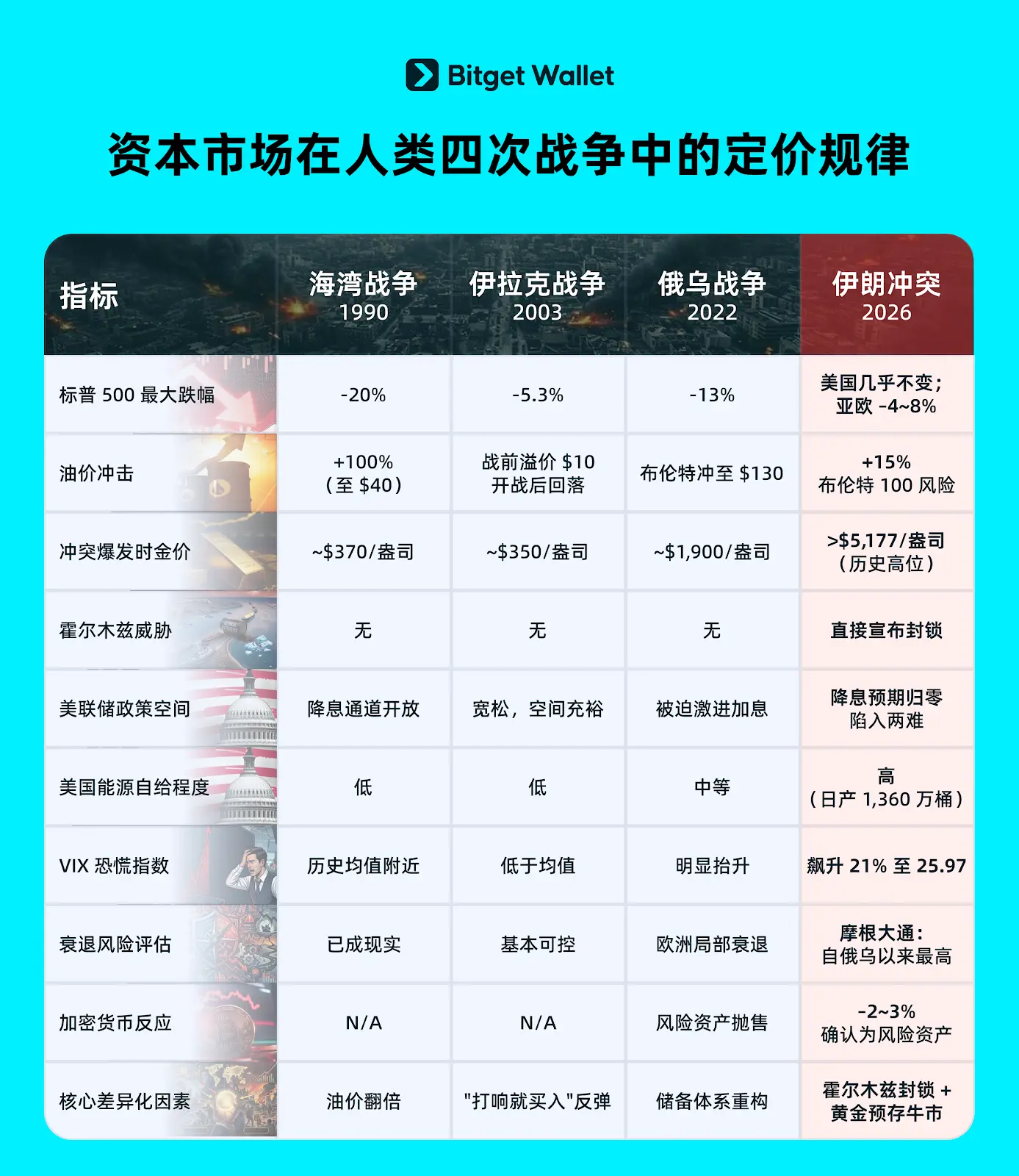
1. 1990-1991 Gulf War: Classic “V-shaped Reversal” and Oil Shock
This war is a textbook case in modern financial history for studying geopolitical shocks, perfectly illustrating “buy expectations, sell facts.”
- Incubation phase (August 1990 - January 1991): Panic and safe-haven buying
- Oil prices soared: After Iraq invaded Kuwait, markets feared supply disruptions in the Middle East. In just two months, international oil prices jumped from around $20 to over $40 per barrel, an increase of over 100%.
- Stock markets plunged: Due to rising oil prices and war clouds, the S&P 500 fell nearly 20% from July to October 1990.
- The decisive moment (January 17, 1991): An unexpectedly dramatic market shift
- On the first day of the U.S.-led “Desert Storm” operation, markets reacted counterintuitively: because the war’s momentum was overwhelming, “uncertainty” was instantly eliminated.
- Oil prices plummeted: On the day war broke out, oil prices experienced one of the largest single-day drops in history (over 30%).
- Stock market rally: The S&P 500 surged that day, then launched a fierce V-shaped rebound, recovering all losses within six months and reaching new highs.
2. 2003 Iraq War: Long Downtrend Followed by “Relief”
The 2003 Iraq War, combined with the aftershocks of the dot-com bubble burst and post-9/11 security fears, reflected a market response more like “short-term relief from long-term pain.”
- Incubation phase (late 2002 - March 2003): Dull pain
- During months of diplomatic stalemate and war preparations, markets were jittery. The S&P 500 continued to decline, and global capital flooded into gold and U.S. Treasuries as safe havens.
- Oil prices gradually rose from $25 to nearly $40, driven by war expectations and factors like Venezuelan strikes.
- The decisive moment (March 20, 2003): Bad news becomes good news
- Ironically, the absolute bottom of U.S. stocks appeared about a week before the war started (around March 11, 2003).
- When missiles hit Baghdad, the market viewed it as “bad news fully priced in.” Stocks then rapidly surged, beginning a four-year bull market. Safe-haven assets like gold cooled down as the war progressed smoothly.
3. 2022 Russia-Ukraine Conflict: “Super Stagflation” Triggered by Supply Chain Disruptions
Unlike the Middle East wars (where the U.S. quickly achieved overwhelming victory without long-term damage to global supply chains), the Russia-Ukraine conflict has had a deeper, more lasting impact, fundamentally changing macroeconomic logic.
- Outbreak (February 2022): Epic commodities storm
- Russia is a giant in energy and industrial metals; Ukraine is Europe’s granary. After the conflict erupted, Brent crude surged past $130 per barrel; European natural gas prices skyrocketed; wheat, nickel, and other commodities hit record highs.
- Ongoing effects: Inflation rebound and “double whammy” of monetary tightening
- Stocks and bonds both fell: The most damaging market impact was the shattering of the fragile global supply chain post-pandemic, igniting the worst inflation in 40 years in Europe and America.
- To combat this “imported inflation” driven by geopolitical war, the Fed launched the most aggressive rate hike cycle in history. The result was a rare “stock-bond double decline” in 2022, with the Nasdaq dropping over 30%.
Deadly Illusion: Never try to profit from “war”
Let’s bring the timeline back to reality.
The current escalation in the Middle East again pushes global capital markets into a period of “stress testing” filled with uncertainty.
From a macroeconomic perspective, the core threat of the Middle East conflict to capital markets is: “Physical supply chain disruption → Energy prices soar → Global inflation rebounds → Central banks forced to tighten → Risk assets plummet.”
Chain reaction analysis of capital markets
- International crude oil: The epicenter of the storm
Chain reaction: The Middle East controls the global oil lifeline (especially key waterways like the Strait of Hormuz). If conflict escalates or risks involving major oil producers, markets will immediately price in “geopolitical risk premiums.” This causes Brent and WTI crude to spike sharply in the short term.
Deeper impact: Oil is the mother of all industries. Rising oil prices not only increase costs for airlines, logistics, and chemicals but also threaten the recently stabilized consumer price index (CPI) through “imported inflation.”
- Precious metals (gold/silver): Traditional safe havens
Chain reaction: During war, geopolitical turmoil, and potential hyperinflation, funds instinctively flock to gold. Gold prices often gap higher before and during the early stages of conflict, reaching new highs; silver, with industrial uses, tends to be more volatile.
Deeper impact: Be aware that gold’s surge is often emotion-driven. Once the situation clarifies (even if conflict continues), safe-haven sentiment wanes, and gold prices tend to retreat, returning to the pricing logic dominated by the U.S. dollar’s real interest rates.
- U.S. stock market: Inflation ghost and “valuation killing”
Chain reaction: War generally is bearish for U.S. stocks. The VIX (volatility index) spikes rapidly, and funds withdraw from high-valuation tech stocks (like AI and semiconductors), shifting into defense, traditional energy, and utilities.
Deeper impact: What U.S. stocks fear most isn’t the artillery fire itself but the inflationary rebound it triggers. If oil prices surge and keep CPI high, the Fed may delay or reverse rate cuts. This macro tightening hits tech stocks’ valuations hard, especially those represented by the Nasdaq.
- Crypto markets: Liquidity drain from high-risk assets
Chain reaction: Despite Bitcoin’s narrative as “digital gold,” during past geopolitical crises (like initial Russia-Ukraine escalation or Middle East tensions), crypto markets behaved more like “highly elastic Nasdaq.”
Deeper impact: In war panic, Wall Street institutions tend to sell the most liquid, riskiest assets first—crypto included—leading to declines. Altcoins face liquidity shortages. However, if conflicts cause local fiat currencies to collapse or traditional banking systems to be obstructed, crypto’s “censorship resistance and borderless transfer” attributes may attract some safe-haven capital.
From historical geopolitical conflicts, we can distill core rules for ordinary people to respond:
- “Uncertainty” is the greatest killer: The most severe stock declines almost always occur during the war’s incubation and bargaining phases. Once the war actually starts (especially when the situation becomes predictable), markets tend to bottom and rebound. This echoes Wall Street’s adage: “Buy when cannons roar.”
- Commodity “trap”: Before and at the start of war, oil and gold are often driven to incredible highs by panic. But if the conflict doesn’t cause long-term physical supply disruptions (like Gulf or Iraq wars), prices tend to halve after the fighting begins. Blindly chasing high commodities can make institutions the “bagholders.”
- Distinguish “emotional shocks” from “fundamental damage”: If war is merely an emotional shock (localized, with overwhelming disparity of strength), markets usually fall temporarily and then recover quickly. But if the conflict causes long-term disruption of core supply chains (like energy or food crises from Russia-Ukraine), it will alter global funding through “inflation and rate hikes,” leading to a prolonged pain period.
History doesn’t simply repeat, but it always rhymes. When observing current capital movements, we must calmly judge: Is this conflict a temporary emotional panic, or a black swan that will reshape global inflation and interest rate cycles?
Geopolitical games are unpredictable; a late-night ceasefire can instantly wipe out highly leveraged long positions. In crises, the primary rule is always to preserve capital.
Defensive strategies in turbulent times: How can ordinary people position themselves?
Under the shadow of war and inflation, the core goal for ordinary investors must shift from “pursuing high returns” to “protecting principal, defending against inflation, and hedging tail risks.” Consider restructuring your assets with these “defensive counterattack” tactics:
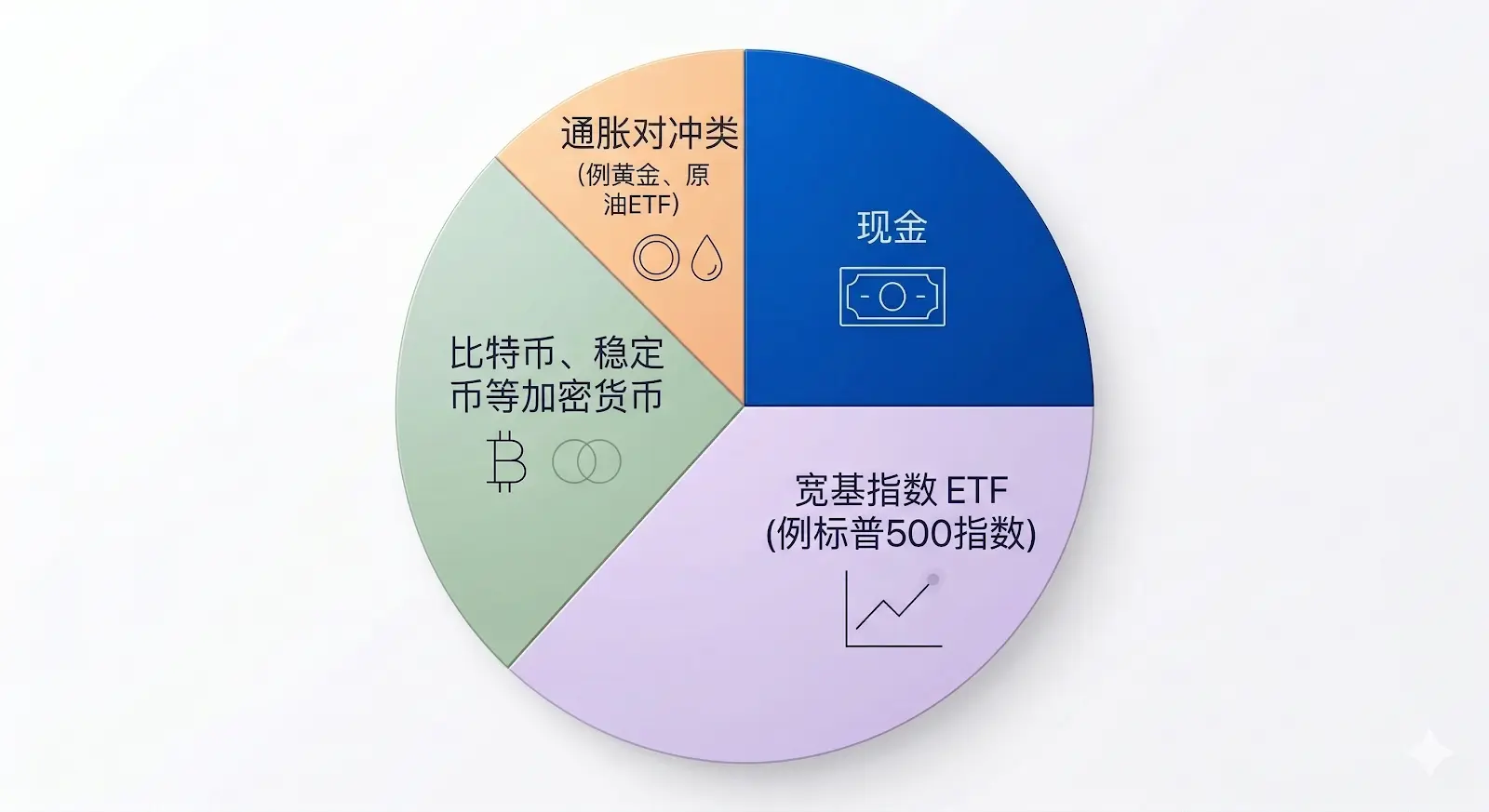
Strategy 1: Build a high cash buffer (20%-30%)
- Approach: Increase holdings of cash and cash equivalents (high-yield USD deposits, short-term Treasuries, money market funds).
- Logic: In crises, liquidity is life. Having ample cash ensures your family’s survival in extreme conditions, prevents losses from soaring prices, and provides ammunition to buy quality assets at lows.
Strategy 2: Buy “insurance” against inflation (10%-15%)
- Approach: Allocate to gold ETFs, physical gold, or some broad energy ETFs.
- Logic: This isn’t about making big money but hedging. If war causes oil supply cuts and prices soar, your increased living costs can be offset by gains in gold and energy sectors. Remember: don’t chase high on headlines.
Strategy 3: Narrow your focus, hold core equities (30%-40%)
- Approach: Sell high-debt, unprofitable marginal stocks, and concentrate funds into broad index ETFs (like S&P 500) or cash-flow strong giants.
- Logic: During war, individual stocks face huge black swan risks (like supply chain failures). Embracing broad indices leverages the resilience of the entire economy. Stick to dollar-cost averaging, ignore short-term losses, and long-term opportunities will emerge.
Strategy 4: De-risk crypto (for Web3 users)
- Approach: Reduce holdings of highly volatile altcoins and meme tokens; allocate to Bitcoin (BTC) as a long-term core; or convert to stablecoins (USDC/USDT) and earn yield on reputable platforms. When geopolitical risks are perceived as manageable, re-enter meme coins for alpha opportunities.
- Logic: Liquidity crises from war hit small-cap tokens hardest. Stablecoins can serve as safe liquidity reserves and hedges during turmoil, especially if local currencies collapse or banking is obstructed.
Absolute red lines:
- No leverage: Geopolitical events are unpredictable. A ceasefire can wipe out 10% of oil prices overnight. Leveraged positions may blow up before long-term wins.
- Avoid “war profiteering” psychology: The information gap in markets is brutal. When you see escalation and decide to go long certain assets, quant funds are already taking profits and selling into your move.
In macro shocks, the strongest weapon for ordinary people isn’t precise prediction but common sense, patience, and a healthy balance sheet.
War will end, and order will be restored from ruins.
In moments of extreme panic, the most un-human action is to stay rational; the most dangerous is panic selling. Remember the oldest adage in investing: never bet on the end of the world—because even if you win, no one will pay you.
Our greatest hope remains: conflict ends, families reunite, and peace returns to the world.


