What Is GOAT Network?
(Source: GOATRollup)
GOAT Network is redefining Bitcoin scalability among Layer 2 solutions. Unlike conventional zkRollups or bridge protocols, GOAT Network leverages the BitVM2 protocol and zkMIPS technology to build a decentralized Layer 2 architecture. Its goal is to position Bitcoin Layer 1 as the genuine settlement and verification layer, enabling zero-knowledge proofs and trustless cross-chain operations.
GOAT Network’s core innovation addresses real-world challenges in BitVM2 deployments, such as Operator double-spending attacks, inefficient challenge mechanisms, and insufficient incentives. Using multi-round randomized challenges, a Decentralized Sequencer Commitment Scheme, and the Universal Operator model, GOAT Network delivers a more secure, efficient, and incentive-driven Bitcoin zkRollup ecosystem.
BitVM2: Expansion and Redesign
BitVM2, created by Robin Linus, enables trust-minimized cross-chain bridges without changes to the Bitcoin protocol. Building on this foundation, GOAT Network introduces GOAT BitVM2, which reimagines the logic and economic structure of Bitcoin Layer 2:
1. zkMIPS: Rapid Generation and Aggregation of Zero-Knowledge Proofs
GOAT Network uses zkMIPS as its proof engine, generating L2 block proofs in roughly 40 seconds and dramatically reducing Operator computational load. With advanced pipelining and hardware acceleration, zkMIPS makes zkRollup on Bitcoin feasible.
2. Universal Operator Model
BitVM2 traditionally separates Operator, Challenger, Committee, and Sequencer roles. GOAT Network combines these into a Universal Operator, allowing nodes to rotate through roles, sharing both risks and rewards. This design upholds system vitality and guarantees fair incentive allocation.
3. Multi-Round Randomized Challenge Mechanism
GOAT introduces a multi-round randomized challenge, selecting Challengers via verifiable random functions (VRF).
If a Challenger fails to act, their stake is slashed and awarded to the next honest Challenger. This process shortens the challenge cycle to less than one day, greatly enhancing real-time fraud prevention.
4. Decentralized Sequencer Commitment
GOAT uses a Bitcoin light client to submit the Sequencer public key set to the mainnet, ensuring every L2 state and transaction is traceable and verifiable on L1. This design enables trustless Sequencer consensus.
Architecture Features
GOAT Network’s architecture is built around three core principles: Liveness, Security, and Effectiveness.
1. Liveness:
The system does not depend on a single Operator; as long as any single node is honest, on-chain activity continues.
2. Security:
Zero-knowledge verification via zkMIPS and a multi-layer challenge mechanism ensure that all cross-chain actions are verifiable at the Bitcoin layer.
3. Effectiveness:
GOAT Network reduces the challenge cycle from BitVM2’s two weeks to under 24 hours and uses incentives and penalties to guarantee honest node participation at every stage.
These features enable GOAT Network to deliver a trustless, secure, and high-performance Layer 2 experience.
Economic Model & Role Incentives
GOAT’s economic model centers on staking and role rotation. All participants—including Sequencers, Challengers, and Operators—must stake GOATED tokens and rotate through roles each round, ensuring long-term stability and balanced rewards.
Balanced Incentives
High-cost roles (e.g., Operator) in one round are followed by higher-reward roles (e.g., Sequencer) in the next.
This rotation ensures overall profit/loss balance and lowers centralization risk.
Randomized Penalties & Rewards
Negligent Challengers have their stake slashed, while honest Challengers claim the reward.
This mechanism guarantees a steady pool of honest Challengers.
Application Scenarios
GOAT Network is more than a protocol: it’s the infrastructure layer for Bitcoin applications. Supported use cases include:
Bitcoin zkRollup ecosystem: Secure, trustless Layer 2 transaction settlement.
Cross-chain bridges and atomic swaps: Trustless BTC ↔ GOAT asset exchange via HTLC.
DeFi & dApp deployment: Verifiable L2 state and zk validation, enabling multi-chain interoperability.
Decentralized challenge mechanism: Any node can participate in verification, establishing a public audit layer.
Tokenomics
GOAT Network’s native token, $GOATED, is the ecosystem’s engine—used for governance, staking, incentives, and liquidity. The total supply is 1 billion GOATED (fixed).
Token Distribution
GOAT Network adopts a long-term allocation model, balancing mining pool incentives, community growth, and team development:
- Mining Pool Rewards — 39.42%
Participants receive rewards for multi-role activities, including Sequencer, Prover, Challenger, and node operations.
Rewards early supporters, driving participation and consensus.
- Treasury & Ecosystem — 15%
Funds developer grants, partnerships, and liquidity incentives for sustained network growth.
- Early Supporters — 15.58%
Provides initial capital and technical contributions from investors and strategic partners.
Vested release for long-term incentives, supporting governance and technical advancement.
Token Utility
Governance: Token holders can vote on protocol parameters and funding allocation.
Staking & Rewards: Boosts returns and sequencing rights.
Node Power: Required collateral for Sequencer, Operator, or Challenger participation.
Ecosystem Growth: Supports developer and community initiatives.
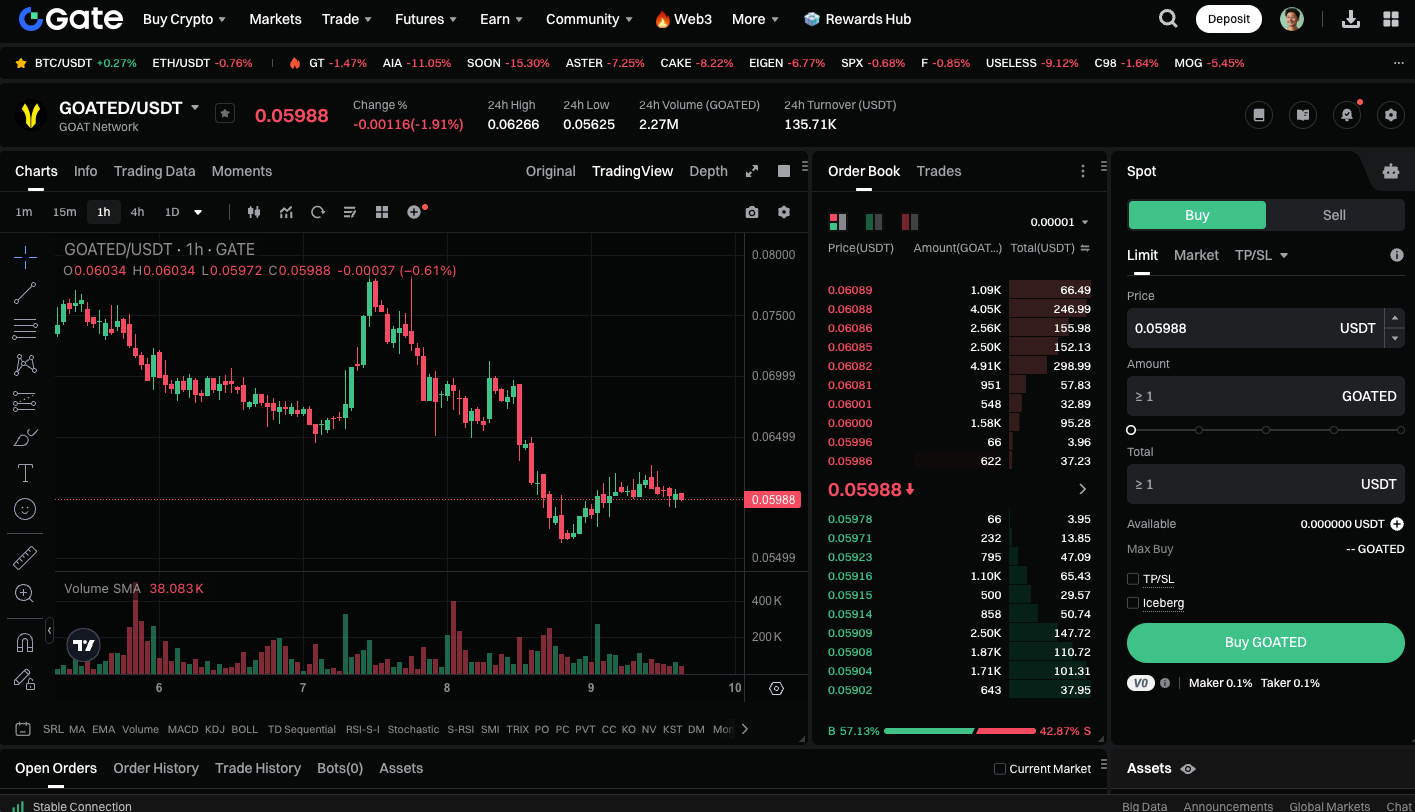
GOATED spot trading is available at: https://www.gate.com/trade/GOATED_USDT
Conclusion
GOAT Network is more than just another chain or bridge; it’s the real-world evolution of Bitcoin scalability. By integrating BitVM2, zkMIPS, and Universal Operator, GOAT Network revives Bitcoin Layer 2, creating a fair, transparent, and incentive-rich ecosystem that sustains itself. In a crypto landscape filled with experimentation and speculation, GOAT Network is driven by technology. Its mission isn’t to replace other blockchains, but to empower Bitcoin with a verifiable, participatory, and sustainable Layer 2 economy.







