As AI applications and AI agents continue to develop rapidly, more systems are adopting multi model AI architectures. Different AI models vary significantly in reasoning capability, response speed, and cost structure. If all tasks are handled by a single model, it can often result in higher costs or lower efficiency. For this reason, AI model routing is becoming an important component of modern AI infrastructure.
Through an AI router, applications can intelligently distribute tasks across multiple models. This allows AI systems to achieve greater flexibility, scalability, and stability. Such multi-model collaboration is increasingly becoming a core architecture for AI SaaS platforms, AI agents, and automated AI applications.
What Is AI Model Routing?
AI model routing is a technical mechanism used to manage requests across multiple AI models. Its core objective is to select the most suitable model to process a request based on the specific requirements of the task.
In traditional AI applications, a system typically connects to only one model. For example, a chatbot might rely on a single large language model API. However, different tasks require different levels of model capability. For instance:
-
Text summarization or simple question answering often does not require advanced reasoning capabilities.
-
Complex logical analysis or code generation may require more powerful models.
-
Multilingual translation may benefit from models optimized for language processing.
If all tasks are processed by the same high performance model, operational costs can increase significantly. On the other hand, using simpler models for complex tasks may reduce the quality of the results.
AI model routing addresses this challenge by analyzing the request and dynamically assigning the task to the most appropriate model, helping balance performance and cost.
Why Do AI Applications Need Multiple Models?
As AI technologies continue to evolve, different AI models have developed distinct strengths and application scenarios. As a result, more AI systems are adopting multi model AI architectures.
First, models differ in their capabilities. Some models perform better at complex reasoning tasks, while others offer advantages in response speed or operational cost. By combining multiple models, a system can select the most suitable one depending on the task.
Second, multi-model architecture can significantly reduce operational costs. For simpler tasks, the system can use lower cost models, while more complex tasks can be assigned to more powerful models. This strategy helps optimize the overall cost of running AI systems.
In addition, multi model architectures improve system reliability. If one model becomes unavailable or experiences service issues, requests can be routed to other models, allowing the system to maintain service continuity.
How Does AI Model Routing Work?
AI model routing systems typically rely on a routing engine to determine which model should process a request. This engine evaluates several factors when making a decision, including:
Task complexity: The system analyzes the request content, such as prompt length or task type, to determine whether a more advanced model is required.
Model capability: Different AI models perform better on different tasks, such as code generation models or multimodal models.
Response speed: For real time applications such as chatbots or AI agents, response latency is an important consideration.
Operational cost: AI model APIs often have different pricing structures, so cost becomes an important factor in routing decisions.
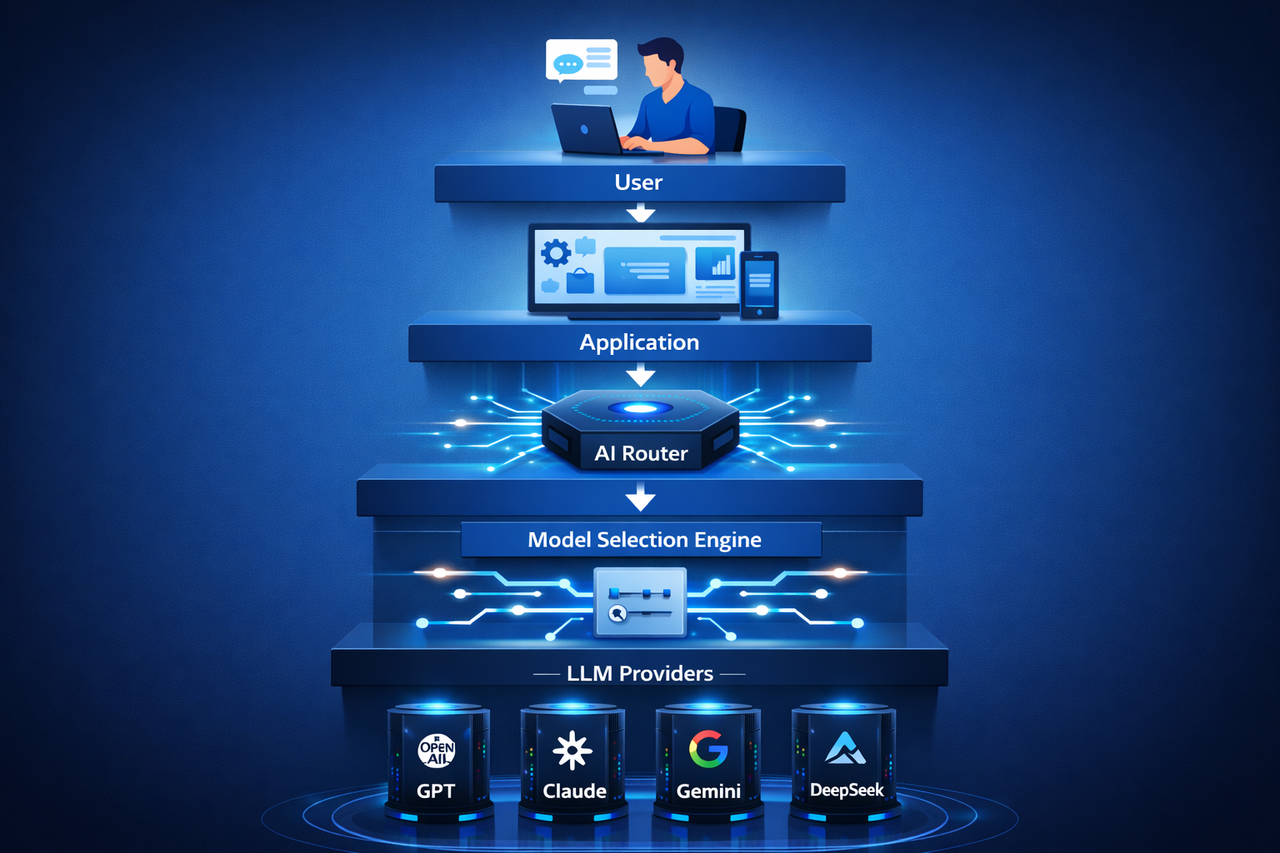
When a user or AI agent sends a request, the AI router first analyzes the task, selects the most suitable model, and then returns the result to the application.
Comparison of Common AI Routing Strategies
In practical AI infrastructure, model routing systems often adopt different strategies to optimize overall system performance.
Cost First Strategy: The system prioritizes lower cost models for handling requests and only calls higher performance models when complex tasks arise.
Performance First Strategy: This strategy focuses more on output quality. The system typically prioritizes the most capable model, even if the operational cost is higher.
Hybrid Strategy: Many modern AI routers use hybrid strategies that consider cost, performance, and response speed at the same time, balancing these factors depending on the task.
Task Specific Strategy: Some systems route requests to models optimized for specific tasks, such as code generation models or multimodal models.
Different strategies are suitable for different types of AI applications, so routing systems are usually adjusted based on practical requirements.
AI Model Routing vs AI API Gateway
AI model routing and traditional API gateways differ significantly in their roles.
AI API Gateway: An API gateway primarily manages API requests, including authentication, traffic management, and security control. It usually does not decide which AI model should process a request.
AI Model Router: An AI router focuses on selecting the most appropriate AI model based on the request content and routing the request to the corresponding model service.
In practice, developers often combine both components. The API gateway manages requests, while the AI router determines which model should handle them.
Typical Application Scenarios for AI Model Routing
As the AI application ecosystem expands, AI model routing is increasingly used across various scenarios where multiple models collaborate to improve overall efficiency.
AI Agents: AI agents often need to call different models to complete complex tasks such as information retrieval, analysis, and content generation. Model routing allows agents to automatically select the most appropriate model.
AI SaaS Platforms: Many AI SaaS platforms provide access to multiple AI models, including different large language models. AI routers can manage these model APIs through a unified interface.
AI Data Analysis: In data analysis environments, different models may handle separate stages of the workflow, such as data interpretation, logical reasoning, and result generation.
Typical Architecture of AI Router Infrastructure
A complete AI router system usually consists of several components.
API Access Layer: This layer receives requests from applications or AI agents and forwards them to the routing system.
Routing Decision Layer: This layer analyzes the request content and determines which AI model should be used to process the task.
Model Execution Layer: This layer connects to multiple model providers, such as different large language model services, and executes the selected model request.
Monitoring and Optimization System: This component monitors model performance, response latency, and operational costs, and continuously adjusts routing strategies to improve efficiency.
This architecture allows AI routers to distribute tasks efficiently across multiple models, helping build more flexible AI infrastructure.
The Role of GateRouter in the AI Router Ecosystem
As multi model AI applications continue to grow, specialized AI router platforms are emerging to help developers manage multiple AI models.
Some AI infrastructure providers now offer unified model access interfaces. One example is the AI model routing platform GateRouter, which is designed to manage multiple large language model services through a single interface.
Compared with traditional AI API gateways, GateRouter places greater emphasis on automated AI application scenarios. It enables AI agents to access different models, supports automated model calls, and helps coordinate task execution across multiple AI services. In addition, GateRouter integrates the x402 automated API payment protocol, allowing machines to automatically complete payments when calling services.
Conclusion
AI model routing is a key technology within multi model AI architectures. By dynamically distributing tasks across different AI models, AI routers help applications balance performance, cost, and response speed.
As AI agents and automated AI applications continue to expand, multi-model architectures are becoming an important trend in AI system design. AI model routing can improve system efficiency while also enhancing stability and flexibility.
Within this context, AI router platforms are emerging as important infrastructure that connects AI models, developers, and automated applications.
FAQs
What Is AI Model Routing?
AI model routing is a technical mechanism that dynamically selects the most appropriate AI model from multiple available models to process a request.
What Is the Difference Between an AI Router and an LLM Router?
An LLM router typically refers specifically to routing systems designed for large language models. An AI router has a broader scope and can manage multiple types of AI models.
Why Do AI Applications Need Multi Model Architectures?
Different AI models vary in capability, cost, and response speed. A multi-model architecture allows systems to select the most suitable model based on the requirements of each task.
How Does AI Model Routing Reduce Costs?
Model routing can assign simple tasks to lower cost models while reserving high performance models for complex tasks, helping reduce overall operational expenses.