As cryptocurrency markets evolved, different exposure models emerged to meet varying needs. BTC represents direct ownership, offering a simple and linear relationship between price and value. BTC3L, by contrast, provides amplified exposure targeting about three times Bitcoin’s daily return through derivatives and automated rebalancing. By embedding leverage, costs, and adjustments into its NAV, BTC3L behaves differently from spot Bitcoin, with performance shaped by volatility and time. This distinction defines their roles: BTC is used for long-term holding, while BTC3L is designed for short-term leveraged trading.
BTC3L and BTC structural overview and exposure models
BTC provides direct exposure to Bitcoin through ownership, meaning its value changes in a simple and proportional way with market price. There are no internal mechanisms altering this relationship. What happens in the market is directly reflected in the value of the asset. This makes BTC a linear and transparent instrument, where performance depends solely on price movement.
BTC3L, by contrast, provides leveraged exposure through a tokenized derivatives structure. Instead of holding Bitcoin directly, it manages positions in instruments such as perpetual futures to target approximately three times Bitcoin’s daily return. This exposure is not static; it is actively maintained through internal mechanisms designed to keep leverage aligned with its daily objective.
Key structural characteristics highlight this difference:
-
BTC is a spot asset with linear price tracking and no internal adjustments
-
BTC3L is a leveraged token designed to amplify daily returns
-
BTC has no rebalancing mechanism, so exposure remains constant over time
-
BTC3L relies on continuous rebalancing, adjusting positions as the market moves
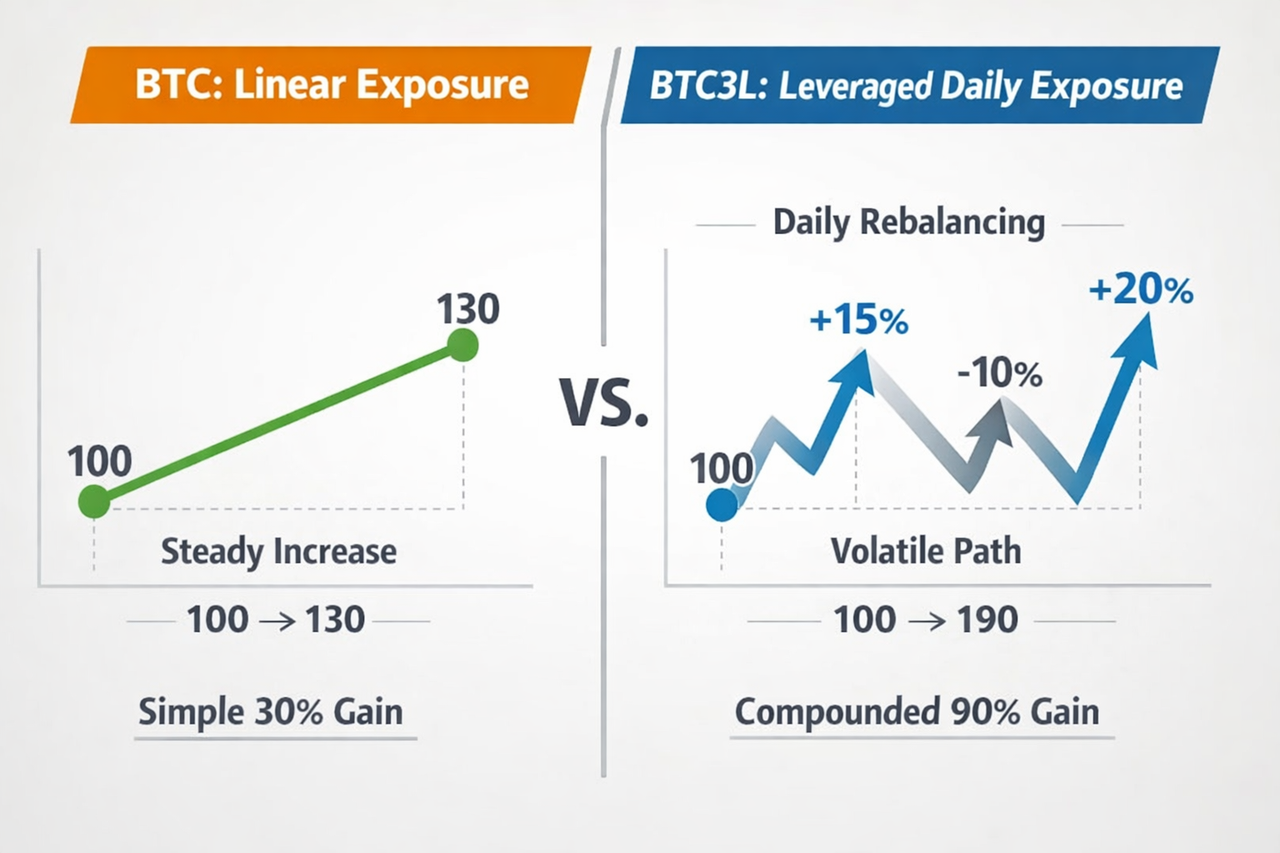
Because of these structural differences, BTC behaves as a direct reflection of market movement, while BTC3L behaves as a managed system that filters market movement through leverage, rebalancing, and internal adjustments.
Key differences between BTC3L leveraged tokens and BTC spot holding
The distinction between BTC and BTC3L becomes clearer when their core features are compared side by side, as each represents a fundamentally different approach to market exposure.
| Feature |
BTC (Spot) |
BTC3L |
| Exposure |
1:1 linear exposure; value moves directly with price. |
~3x daily exposure; amplified but can diverge over time. |
| Ownership |
Direct ownership of Bitcoin. |
Derivative-based exposure, no direct ownership. |
| Leverage |
No leverage. |
Built-in leverage amplifies gains and losses. |
| Cost structure |
Minimal, mostly trading fees. |
Embedded costs (fees, funding, execution) reduce value over time. |
| Holding style |
Suitable for long-term holding. |
More suited for short-term trading. |
| Liquidation |
No liquidation risk. |
No direct liquidation, but NAV can drop significantly. |
BTC is simple and predictable, with value driven entirely by price changes. BTC3L, however, introduces leverage and internal mechanics, such as rebalancing and embedded costs that influence performance beyond price movement alone.
Architecture comparison of leveraged token mechanisms and spot asset ownership
The difference between BTC and BTC3L becomes clear when looking at how each is built. Their structure does not just define how exposure is created, it determines how value behaves over time.
BTC operates on a simple ownership model. Once acquired, its value moves directly with the market, without any internal adjustments, leverage mechanisms, or embedded costs. Exposure remains constant unless the holder actively changes their position, making BTC straightforward, transparent, and easy to track.
BTC3L, in contrast, is built as a managed system rather than a static asset. Leverage is created through derivatives, continuously adjusted through rebalancing, and shaped by ongoing costs such as fees and funding. Its value is reflected through NAV, which updates as these internal processes evolve.
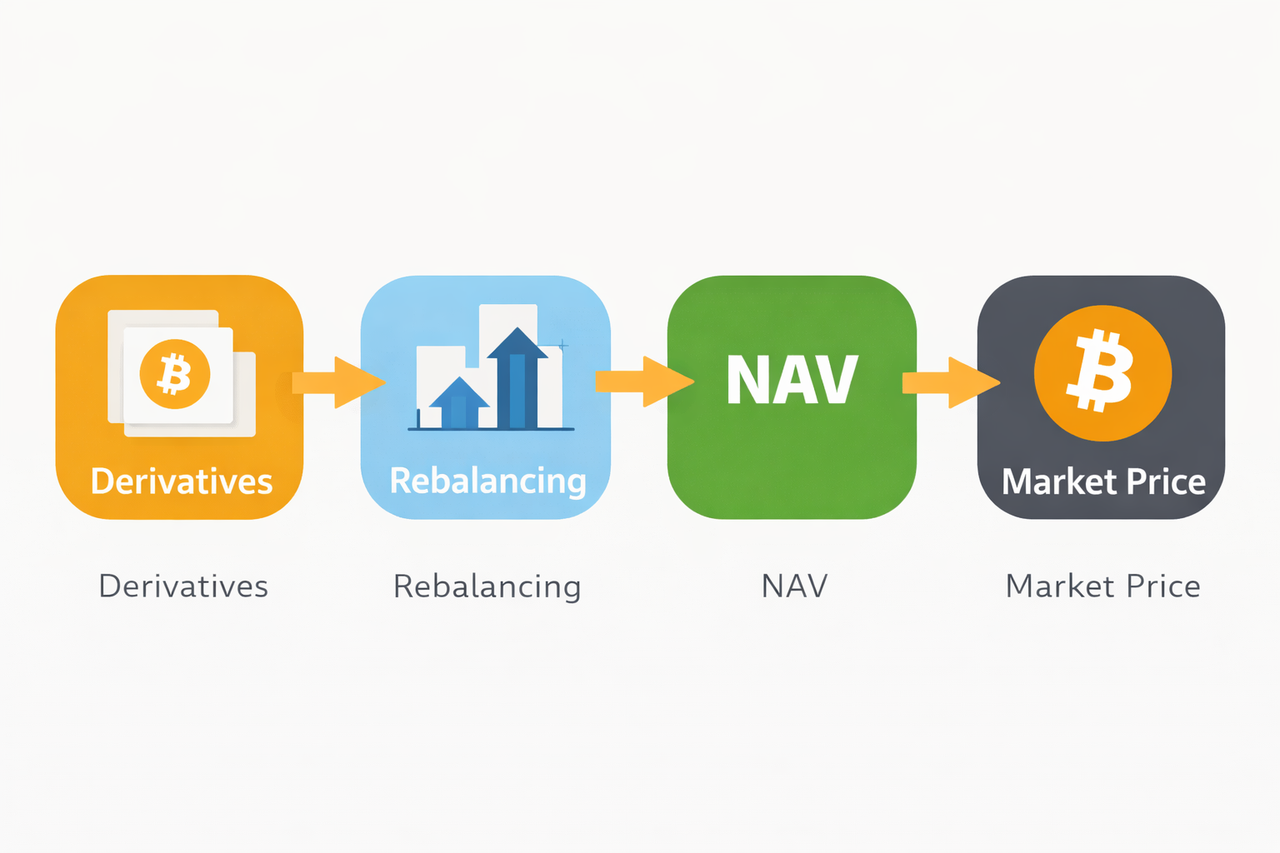
This creates a fundamental distinction: BTC provides static exposure that mirrors the market, while BTC3L delivers dynamically managed exposure that is constantly recalibrated. As a result, BTC3L behaves less like a passive asset and more like a structured financial mechanism, where performance depends not only on price movement but also on how its internal system responds over time.
BTC follows a simple and intuitive performance model: its returns are linear and depend only on the change in price between entry and exit. Regardless of how the market moves in between, the final outcome is determined solely by where Bitcoin starts and ends.
BTC3L operates differently. Its performance is non-linear and shaped not just by direction, but by how the market evolves over time. Price trends, volatility, and the sequence of movements all interact to influence results, making its behavior more complex and less predictable.
In strong, consistent trends, BTC3L can outperform a simple 3x expectation. Gains are continuously applied to a growing base, allowing compounding to enhance returns as exposure scales with the market. This makes BTC3L particularly effective in sustained directional environments.
However, in sideways or volatile markets, this same mechanism works against performance. Frequent price reversals trigger repeated rebalancing, introducing inefficiencies and causing gains and losses to offset each other. Over time, this can lead to gradual value erosion—even when Bitcoin ends at roughly the same price.
This leads to the key concept of path dependency. BTC3L outcomes depend not only on where the price ends, but on how it gets there. Two identical starting and ending prices can produce very different results depending on the sequence and volatility of movements.
BTC reflects the final price change, while BTC3L reflects both the price change and the path taken to reach it.
Risks and trade-offs between leveraged exposure and spot exposure
The difference between BTC and BTC3L is not only about returns, it is also about the type and intensity of risk each introduces.
BTC carries pure market risk. Its value rises and falls directly with Bitcoin’s price, without any additional structural influence. The main considerations are price volatility and, depending on how it is held, custody and security. While prices can fluctuate significantly, the mechanism itself remains simple and transparent, making BTC relatively easy to understand and manage over time.
BTC3L introduces an additional layer of complexity. Because it is leveraged, both gains and losses are amplified, meaning market movements have a stronger and faster impact on value. Beyond this, its structure brings in internal dynamics that affect performance independently of price. Rebalancing can gradually erode value in unstable markets, embedded costs such as fees and funding accumulate over time, and outcomes become sensitive to volatility and timing rather than just direction.
This creates a clear trade-off between the two:
-
BTC offers simplicity, transparency, and consistency, making it more suitable for long-term holding
-
BTC3L offers amplified exposure, but with added structural complexity and less predictable outcomes
In essence, BTC reflects only what the market does. BTC3L reflects both what the market does and how its internal system responds. As a result, BTC carries price risk, while BTC3L carries both price risk and structural risk that evolves over time.
Use cases for BTC3L and BTC in different market conditions
The effectiveness of BTC and BTC3L depends heavily on market conditions, as each is designed to perform differently under varying price behaviors.
In a strong bullish trend, BTC3L becomes more effective. Because it amplifies daily price movements, consistent upward momentum allows gains to compound over time. This makes it suitable for short-term directional trades where there is clear conviction about market direction. BTC also benefits in such conditions, but without leverage, its returns remain proportional rather than amplified.
In sideways or choppy markets, BTC generally performs more efficiently. Since its value depends only on price, it remains stable relative to market movement. BTC3L, however, becomes less efficient in these conditions. Frequent price reversals trigger repeated internal adjustments, which can reduce value over time even if Bitcoin ends at a similar level.
For long-term holding, BTC is typically more appropriate. Its simple structure and lack of embedded costs make it more stable over extended periods. BTC3L, by contrast, tends to become less efficient over time due to ongoing cost accumulation and the effects of rebalancing, especially in volatile environments.
In short-term trading scenarios, BTC3L provides a specific advantage. It allows traders to gain leveraged exposure without directly managing margin, collateral, or liquidation risk. This makes it useful for tactical positioning, particularly when timing short-term market movements.
Overall, BTC is generally used as a holding asset for long-term exposure, while BTC3L is used as a tactical tool for short-term trading where amplified returns are desired.
Summary
BTC and BTC3L represent two fundamentally different ways of gaining exposure to Bitcoin, each defined by how value is created and maintained over time.
BTC provides direct, linear, and transparent exposure. Its performance is entirely driven by market price, making it straightforward to understand and well-suited for long-term holding. There are no internal mechanisms altering its behavior, so outcomes depend solely on where the price starts and ends.
BTC3L, in contrast, provides leveraged and dynamic exposure through a managed structure that includes derivatives, rebalancing, and embedded costs. Its value is not only influenced by price direction, but also by how the market moves, how often adjustments occur, and how costs accumulate over time.
The key distinction lies in how value is generated: BTC reflects price movement directly, while BTC3L reflects price after it has been amplified and reshaped by leverage and internal mechanisms such as rebalancing and cost adjustments.
FAQs
Is BTC3L the same as holding BTC with leverage?
No. BTC3L is not a fixed leveraged position. It targets daily leverage and relies on continuous rebalancing and internal adjustments, which means its performance over time can differ significantly from simply holding BTC with constant leverage.
Does BTC3L always deliver 3x returns?
No. BTC3L is designed to target approximately three times Bitcoin’s daily performance, not its long-term return. Over multiple days, compounding effects, costs, and market conditions can cause results to diverge from a simple 3x expectation.
Why does BTC3L lose value in sideways markets?
Because repeated price fluctuations trigger ongoing rebalancing and cost accumulation. Even if Bitcoin ends at a similar price, these internal adjustments can gradually reduce BTC3L’s value.
Which is safer: BTC or BTC3L?
BTC is generally simpler and carries fewer structural risks. BTC3L introduces additional layers such as leverage, rebalancing, and embedded costs, making its behavior more complex and potentially more volatile.
When should BTC3L be used?
BTC3L is typically used for short-term, high-conviction directional trades where traders want amplified exposure without directly managing margin or derivatives positions.