Ahead of the Fed Decision, Bitcoin Nears $92,500: Hype, Uncertainty, or Opportunity?
Federal Reserve Rate Decision Nears, Market Sentiment Intensifies
As the Federal Reserve prepares to announce its latest interest rate decision on December 10 (New York time), global financial markets are on high alert. Many institutions anticipate a 25 basis point rate cut. Investors are adjusting their positions in anticipation of a potential shift in monetary policy. This has led to noticeable changes in capital allocation, spanning from traditional finance to crypto assets.
In this environment, Bitcoin has emerged as a key market focus. Expectations in the crypto market for “zero-yield assets, accommodative monetary policy, and inflation hedging” have reignited strong interest in Bitcoin.
Recent Bitcoin Price Trends
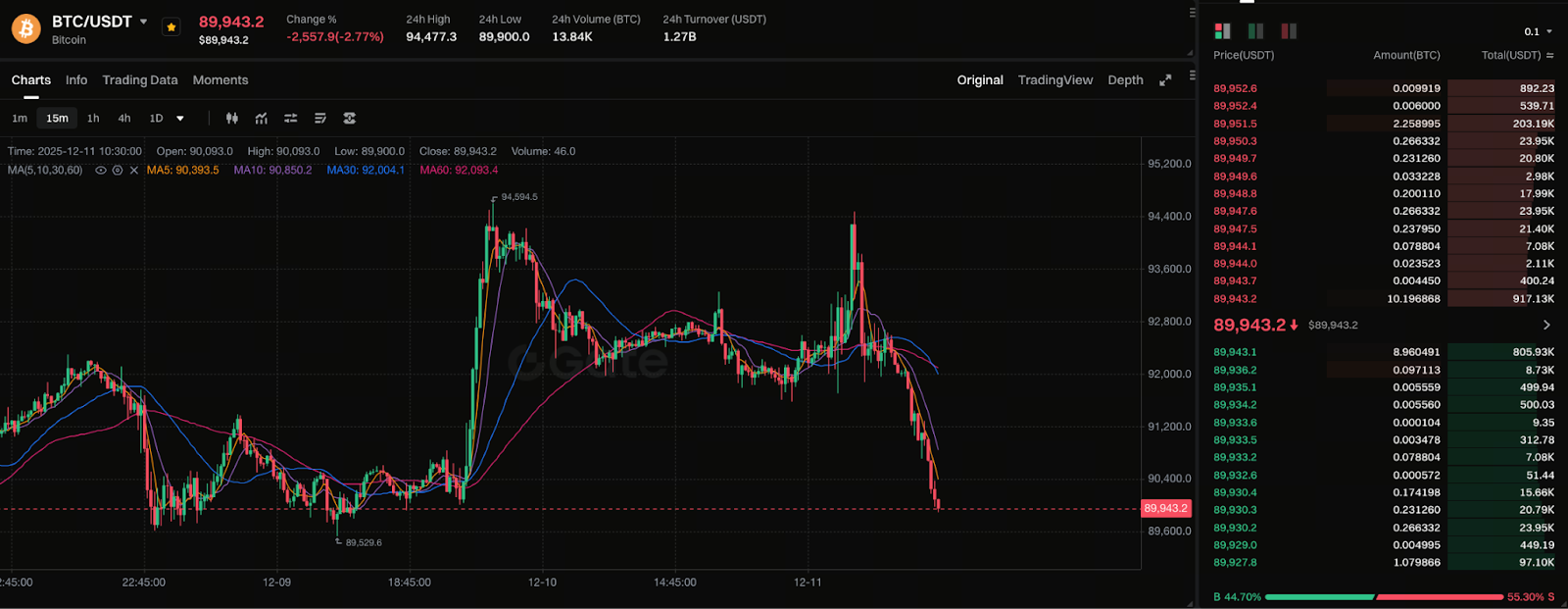
Chart: https://www.gate.com/trade/BTC_USDT
Recent data shows that Bitcoin’s price has been highly volatile over the past several days. It briefly surpassed $94,000 before retreating to around $92,500.
Specifically, one report highlighted that Bitcoin rebounded sharply from a late November low near $83,800. Daily-level technical indicators improved, pointing to a potential recovery in bullish sentiment. However, some analysts note that Bitcoin is oscillating between $92,800 and $88,100, suggesting the market may be entering a consolidation phase.
Why Do Rate Cut Expectations Lift Crypto Assets?
First, lower interest rates mean declining yields on traditional bonds, reducing the opportunity cost of holding non-yielding assets such as Bitcoin and gold. This makes crypto assets more attractive compared to cash or low-yield bonds.
Second, an accommodative monetary policy usually signals future economic stimulus and increased liquidity. In this environment, risk assets—including cryptocurrencies—tend to benefit. Several market research firms have indicated that if the Federal Reserve cuts rates, Bitcoin could become a key channel for capital inflows.
Finally, as institutional investors enter the market and retail attention grows, the volatility of crypto assets is increasingly correlated with traditional equities. For those seeking to hedge against inflation or currency depreciation, Bitcoin offers compelling appeal.
Risks and Uncertainties: Why Is BTC Struggling to Break Key Resistance?
Even with strong expectations for rate cuts, Bitcoin is not guaranteed to rally sharply. Some analysts point out that the market may have already priced in “rate cuts and easing.” If the Federal Reserve delivers a hawkish outlook, the price could face a “sell the news” reaction.
Additionally, crypto market research firms warn that Bitcoin is currently in a structurally “fragile zone.” This makes it difficult for the price to break above $100,000, while any selling pressure could trigger a swift pullback.
Furthermore, as institutional players increasingly drive price action, the correlation between traditional equities and cryptocurrencies is strengthening. Volatility in AI, technology stocks, and traditional assets can also move Bitcoin. If overall risk appetite declines, Bitcoin could be dragged lower as well.
How Should Investors Navigate Risks and Opportunities?
If you’re considering positioning in Bitcoin at this stage, maintain caution and flexibility. Consider these points:
- Keep your position sizing reasonable; avoid overconcentration. Given the significant volatility, allocating all assets to Bitcoin carries high risk.
- Monitor official Federal Reserve statements and key fundamentals such as inflation and employment data. Should the Fed signal a hawkish stance on future rate hikes, Bitcoin may retreat quickly.
- Set clear take-profit and stop-loss thresholds. If the price breaks above $95,000 or falls below $88,000, have your exit plan ready in advance.
- Consider a long-term holding strategy. If you are optimistic about the medium- to long-term outlook—such as greater institutional adoption and regulatory improvements in 2026 and beyond—short-term volatility may offer attractive entry points.
Conclusion
On the eve of the Federal Reserve’s rate decision, Bitcoin briefly surged to $92,500 on rate cut expectations, sparking strong market enthusiasm. However, uncertainties—including “priced-in expectations, policy divergence, and structural trading ranges”—have also intensified. For investors, rationality and patience may prove more valuable than aggressive moves. If you’re preparing for a potential rebound, remain vigilant about downside risks.
Share
Content


Related Articles

2025 BTC Price Prediction: BTC Trend Forecast Based on Technical and Macroeconomic Data

Flare Crypto Explained: What Is Flare Network and Why It Matters in 2025

Pi Coin Transaction Guide: How to Transfer to Gate.com

How to Use a Crypto Whale Tracker: Top Tool Recommendation for 2025 to Follow Whale Moves

What is N2: An AI-Driven Layer 2 Solution