


I. What Is a Trailing Grid?
Trailing Grid is Gate's upgraded version of traditional grid trading. While executing automated trades within a preset price range, it dynamically adjusts grid parameters based on market movements. This allows the bot’s price range to automatically shift upward or downward as the market changes, maintaining profitability in volatile conditions.
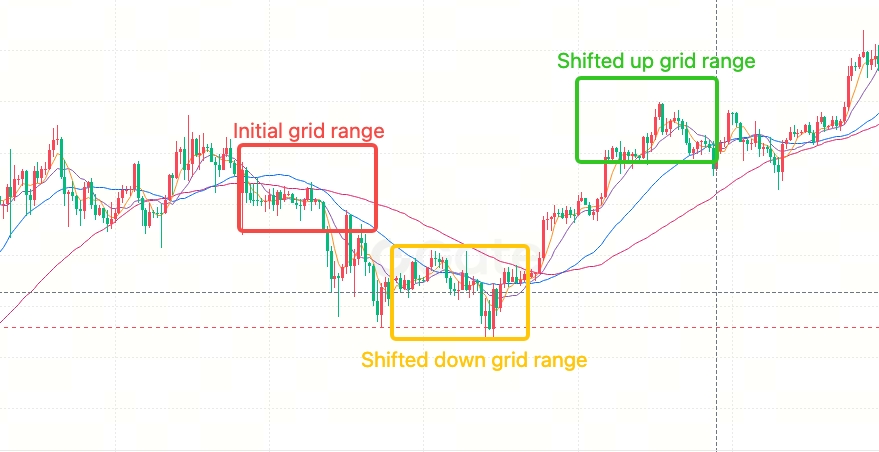
The Trailing Grid feature is an advanced setting of Gate Grid Bots (enabling or disabling it does not affect grid strategy creation). Both Spot Grid and Futures Grid support this function. Compared with traditional fixed-range grids, a Trailing Grid automatically moves its price range with market action, preventing "grid failure" in one-sided trends. After enabling:
Spot Grid: When the market price breaks through the original grid range, the system automatically shifts the entire grid range upward or downward to adapt to the new trend.
Futures Grid: During strategy execution, the price range can be dynamically adjusted. Combined with leverage and profit reinvestment features, this enhances strategy flexibility and profit potential. After the grid shifts, your position’s liquidation price may change. Please be aware of the associated risks.
II. How It Works
1. Core Logic
The Trailing Grid is a dynamic grid-range adjustment mechanism. When market trends break above or below the original range, the system automatically shifts the entire grid range to match the new price environment.
Gate bots use the 720-minute moving average (MA720) as the core trend reference. The grid price range follows MA720's upward or downward movement, ensuring the grid adapts to mid-to-short-term trends while filtering short-term noise.
Mechanism details:
a. Breakout Monitoring: The system continuously monitors market prices. When the price moves outside the current grid range, the trailing mechanism is triggered.
b. Range Adjustment: Based on market direction, the grid range automatically shifts upward or downward to maintain strategy effectiveness. If the market continues rising beyond a certain threshold, the grid shifts upward; if the market continues falling beyond a threshold, the grid shifts downward.
c. Trigger Condition: Whether to shift the grid depends on the percentage change of the 720-minute moving average.
d. Continuous Operation: After a new grid range is set, the bot continues executing buy and sell orders within the new range. For Futures Grid, when the grid shifts, the bot keeps existing open positions unchanged and only updates pending grid orders.
Example: If a Futures Grid was set at 90,000–100,000 and the bot held a 0.05 BTC long position before the shift, after the grid moves downward, the new range becomes 81,000–90,000. The bot still holds the 0.05 BTC long position. Pending orders in the old 90,000–100,000 range are canceled, and new orders are placed within 81,000–90,000.
After the new grid range is set, the bot continues executing buy and sell orders within the new range.
2. Trigger Conditions for the Trailing Grid
Trigger Rule: When the last price moves outside the current grid range and the percentage change of the 720-minute moving average reaches the preset ratio, the Trailing Grid is triggered.
Direction: If MA720 rises, Grid shifts upward; If MA720 falls, Grid shifts downward.
III. How to Enable Trailing Grid
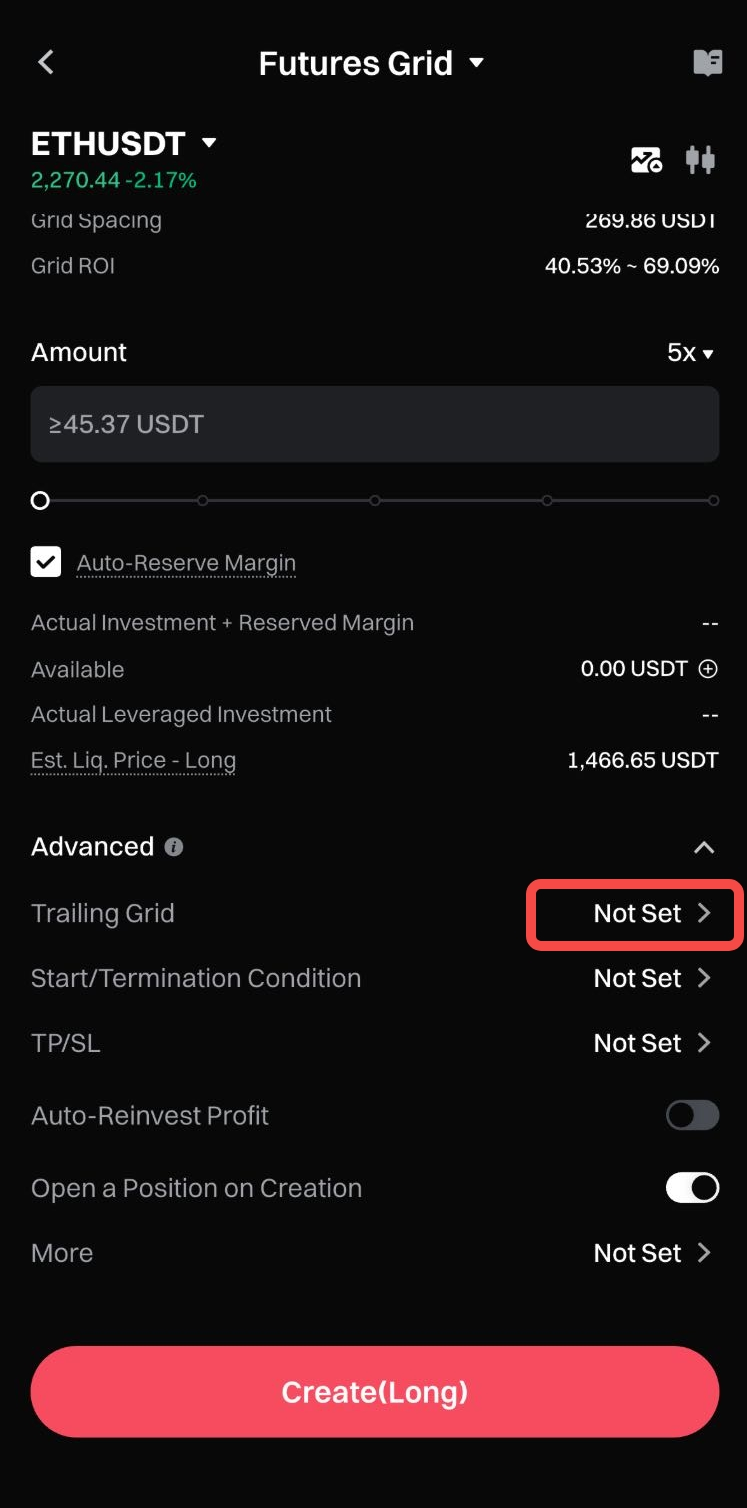
Log in to your Gate account and go to: [Trade] - [Bots] - [Futures Grid] - [Customize]. Fill in leverage, price range, and number of grids. Then scroll down and select: [Trailing Grid] - [Not Set] to enter the Trailing Grid settings page.
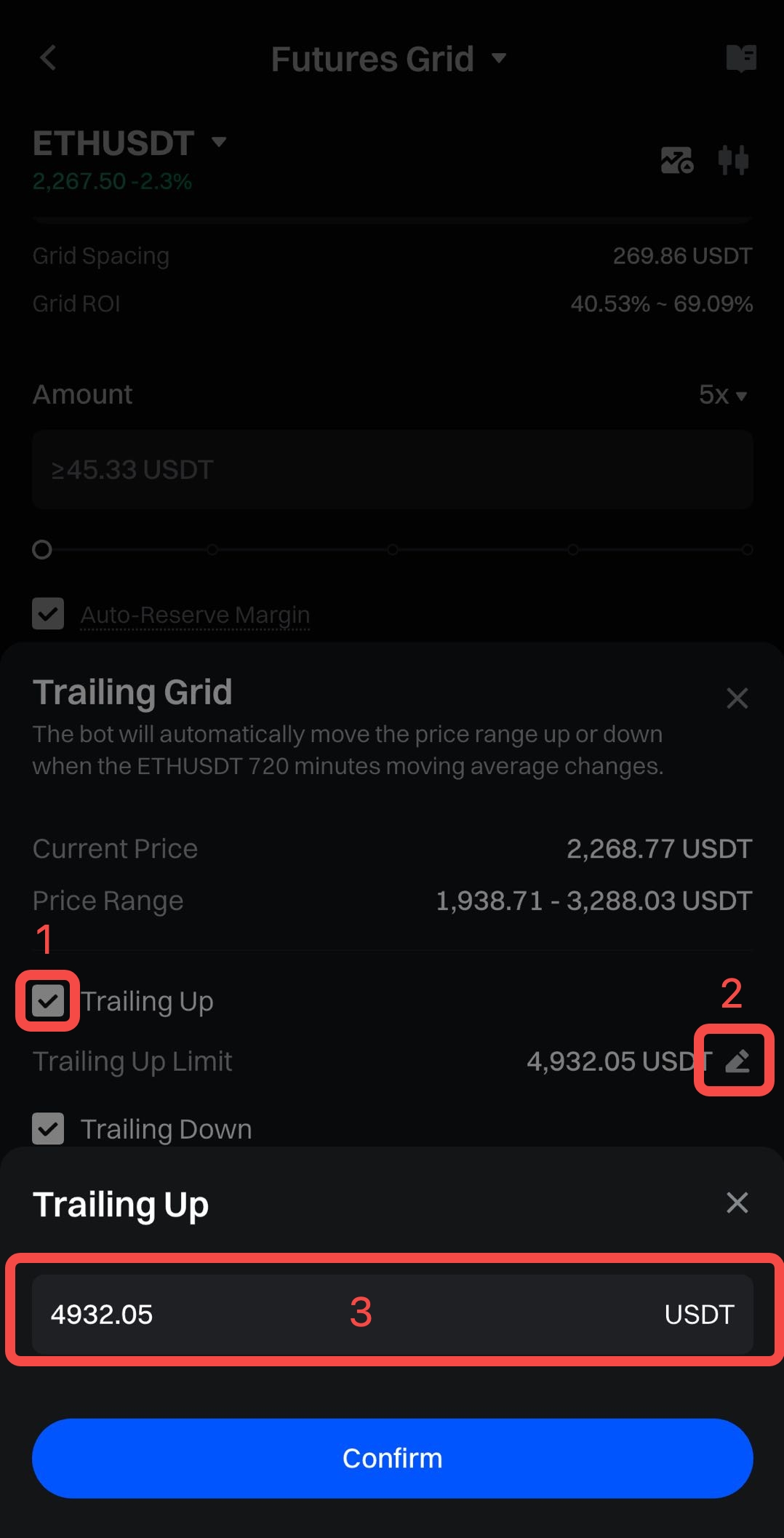 Check [Trailing Up] and/or [Trailing Down] (You may enable one or both. If neither is selected, the Trailing Grid function is disabled.) The system provides a reference price. You may also set a custom price. Choose MA Change % or enter a custom value, then click Confirm.
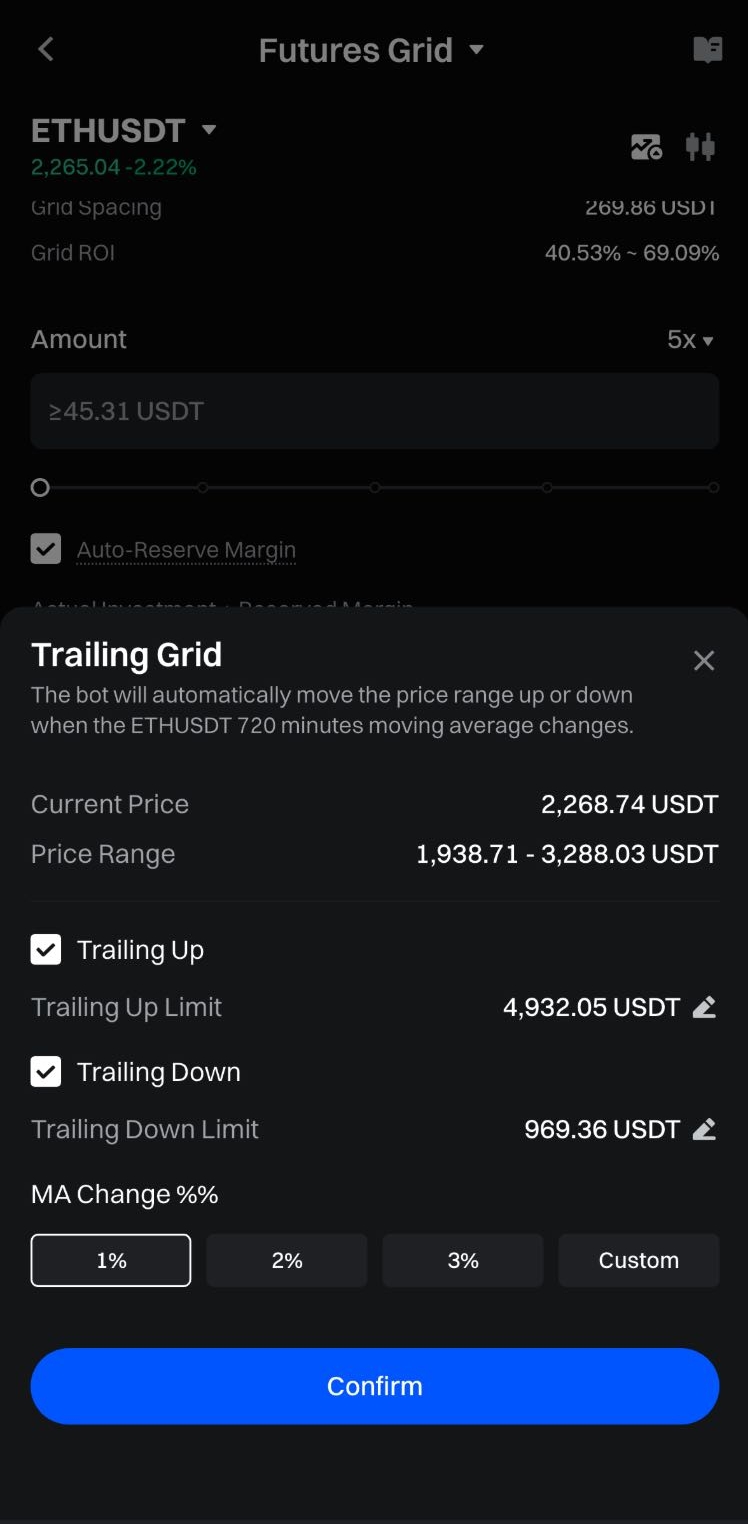
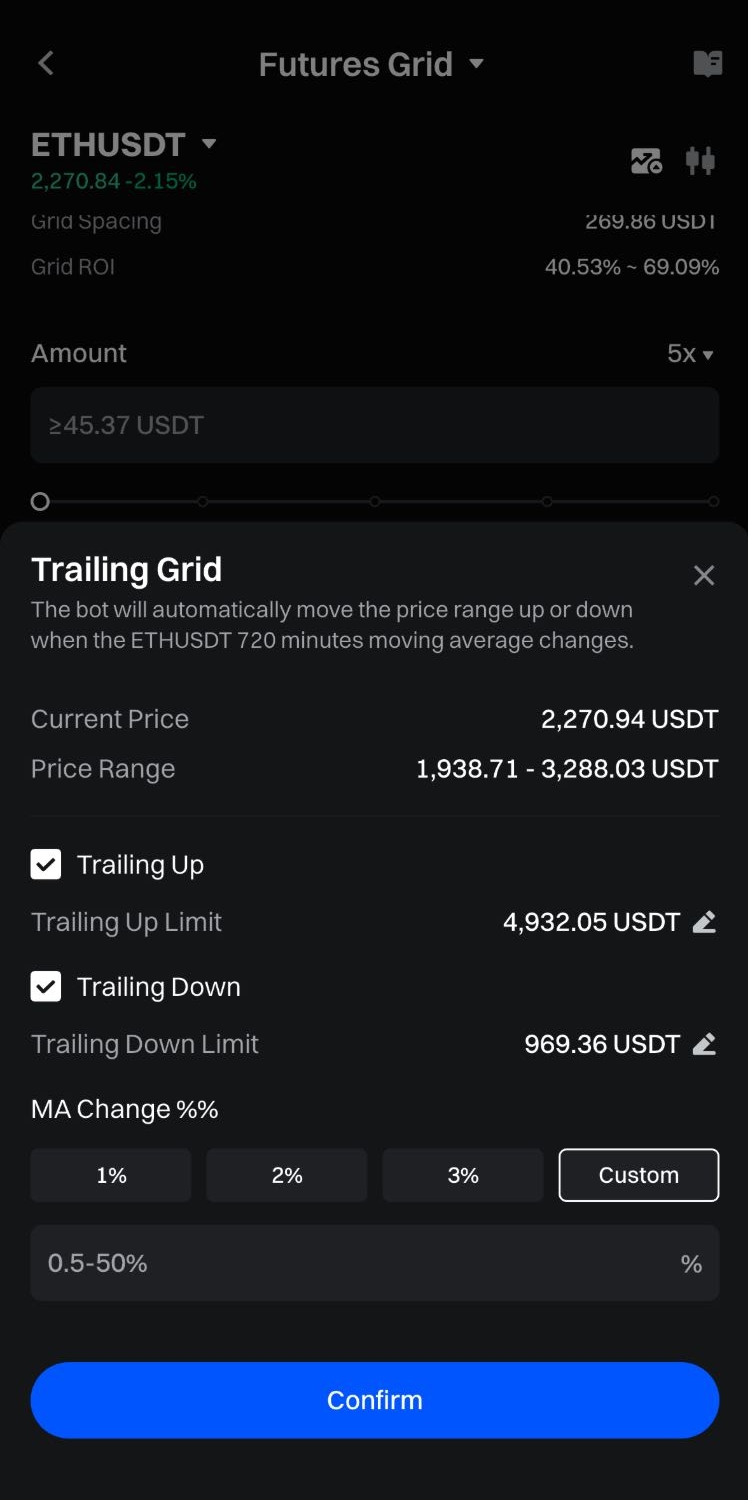
Parameter Settings:
Trailing Up: When the moving average continues rising, the entire grid range shifts upward.
Trailing Down: When the moving average continues falling, the entire grid range shifts downward.
Moving Average Change %: When your bot has an open position, your bot will automatically move the price range up or down whenever the last price is outside the price range and the 720-minute moving average rises or drops by your preset percentage. After the grid is moved, the liquidation price of your position may change, so please be aware of the risk.
Recommended Settings
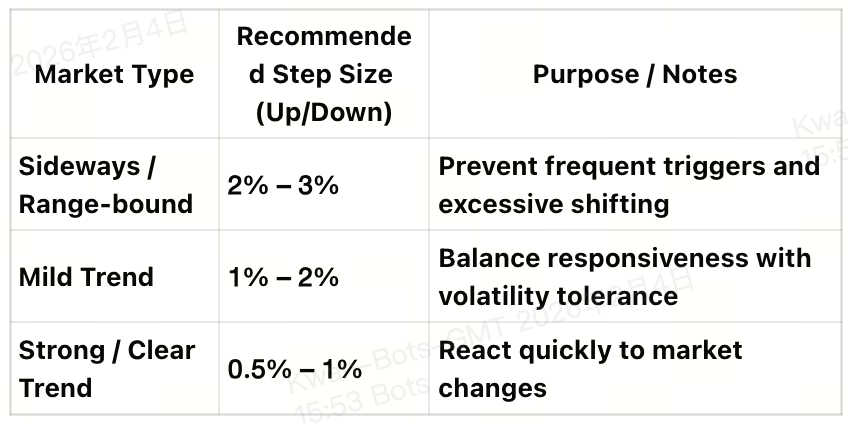
** IV. What Are the Benefits?
- Adapt to market trends, avoid missing opportunities: Automatically adjusts grid ranges to prevent strategy failure when price breaks out of the original range.
- Improve capital efficiency: Captures frequent arbitrage in ranging markets and continues harvesting profits in trending markets through shifted ranges.
- Enhance profit potential: Keeps the strategy active during sustained uptrends or downtrends, capturing more trading opportunities.
- Reduce manual intervention: Automated adjustments minimize the need to manually modify strategy parameters, improving trading efficiency.
V. Suitable Market Conditions and Users
- Suitable Market Scenarios
- Wide-range sideways markets: Trailing Grid captures multiple profit segments within large oscillations.
- Early trend phases: Grid ranges move with trend direction to avoid missing opportunities.
- High-volatility assets: Especially suitable for altcoins or leveraged tokens with sharp price swings.
- Suitable Users
- Conservative investors: Lower risk exposure during strong one-sided trends through dynamic range shifts.
- Time-limited users: No need for frequent manual adjustments; automation improves efficiency.
- Intermediate to advanced traders: Users with market analysis experience who can fine-tune parameters according to market conditions.
VI. Important Notes
- Avoid excessive grid shifts: In persistent one-sided markets, repeated grid movements may cause insufficient funds for new orders.
- Set reasonable leverage (Futures Grid): High leverage combined with Trailing Grid may accelerate liquidation risk. Low leverage is recommended initially.
- Watch liquidity: For some small-cap tokens, orders may fail to fill during extreme market conditions due to insufficient depth.
- Fee considerations: Frequent re-positioning increases transaction costs. For Futures Grid, funding fees must also be considered.
- Regular monitoring: Although automated, strategies should still be reviewed periodically to ensure alignment with current market conditions.
Disclaimer
The content provided herein is for reference and educational purposes only and does not constitute any financial, investment, trading, or legal advice, nor does it constitute an offer or solicitation to buy or sell any digital assets. Gate makes no express or implied representations or warranties regarding the accuracy, completeness, or timeliness of the information contained herein. Product features, interfaces, rules, and fee structures may be updated or adjusted at any time. Please refer to the latest announcements and the actual information displayed on the Gate platform for the most accurate details.
Digital asset investments involve significant risk, and prices may fluctuate substantially. You may lose the entire amount of your investment. Please make decisions cautiously based on your own financial situation and risk tolerance after fully understanding the associated risks. If necessary, you are advised to consult an independent professional financial or legal advisor.
For more information about potential risks, please refer to Gate's Risk Disclosure and User Agreement.
