SAI vs XRP: Comparing Two Blockchain Assets in the Digital Currency Market

Introduction: SAI vs XRP Investment Comparison
In the cryptocurrency market, comparisons between SAI and XRP have always been a topic investors cannot ignore. The two assets not only differ significantly in market capitalization ranking, application scenarios, and price performance, but also represent different positioning within the crypto ecosystem. SAI (SAI): Launched as an AI-powered crypto super-app designed for professional traders, it offers a unified platform for intelligence, investing, and automating digital assets. XRP (XRP): Built on the XRP Ledger since its inception, it was designed specifically for payments—fast (~3 seconds per transaction), cost-effective ($0.0002 per transaction), scalable (1,500+ tps), and carbon-neutral. This article will comprehensively analyze the investment value comparison between SAI and XRP from multiple perspectives including historical price trends, supply mechanisms, market adoption, technical ecosystems, and future outlook, while attempting to answer the question investors care most about:
"Which is the better buy right now?"
I. Price History Comparison and Current Market Status
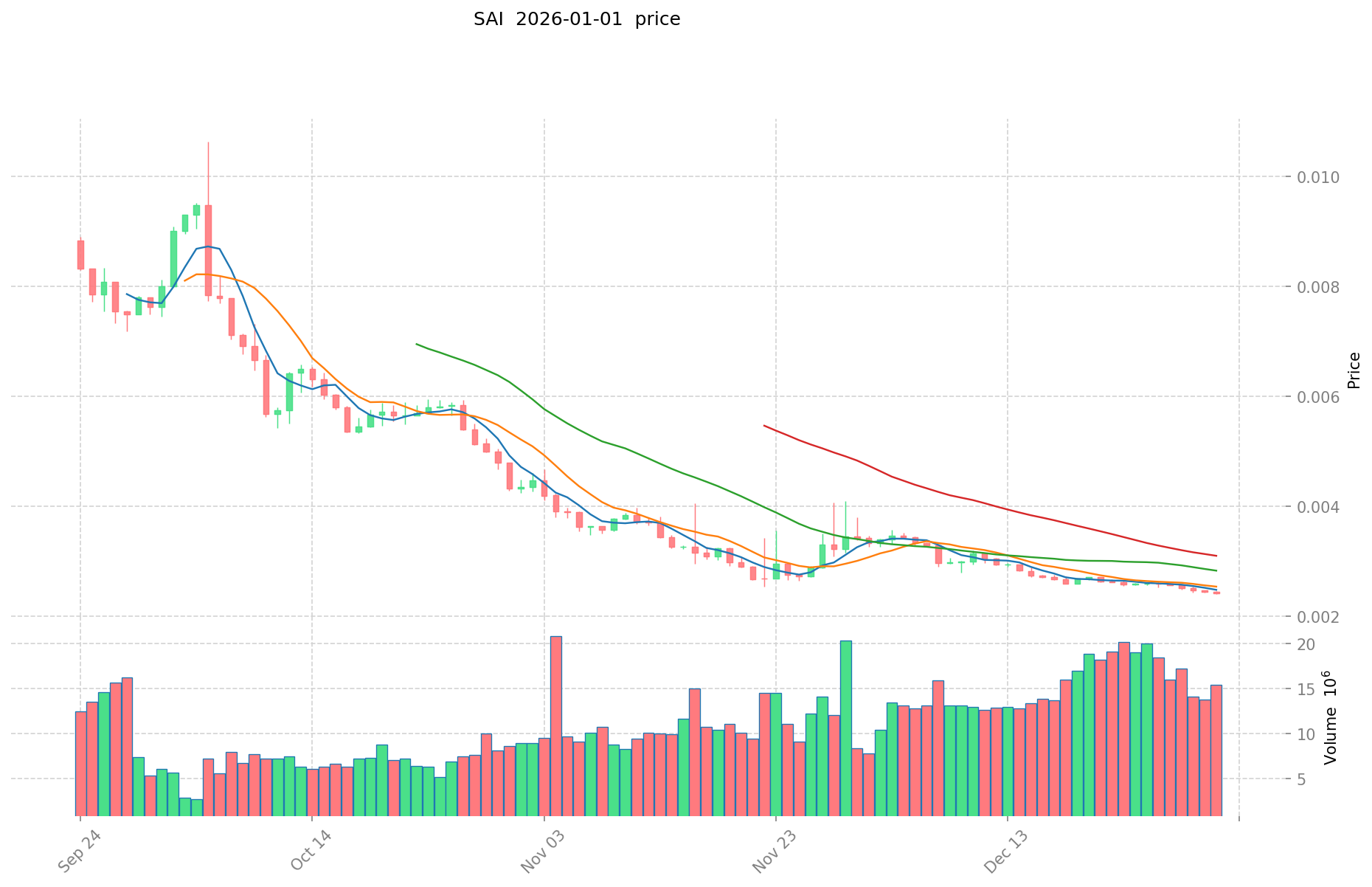
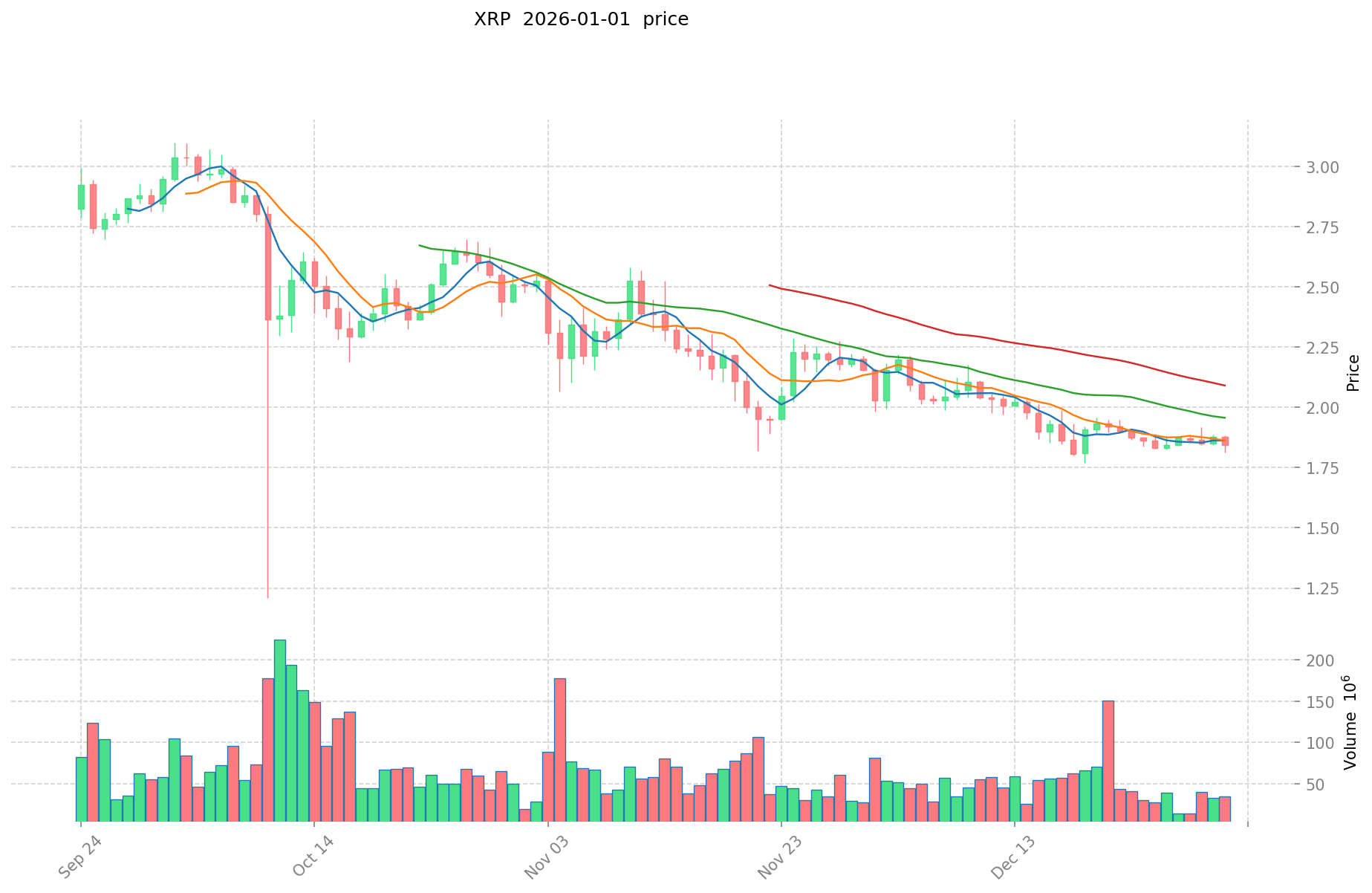
Sharpe AI (SAI) and XRP Price Trends
- 2024: Sharpe AI was launched on August 27, 2024, at a price of $0.02. The token experienced significant volatility, reaching its all-time high of $0.11866 on January 17, 2025, before declining to current levels.
- 2012-2025: XRP was created in 2012 and built specifically for payments on the XRP Ledger. The token reached its all-time high of $3.65 on July 18, 2025, demonstrating sustained market presence over more than a decade.
- Comparative Analysis: In the recent market cycle, SAI declined from $0.11866 to $0.002411, representing a -95.52% decline over one year. XRP, meanwhile, decreased from $3.65 to $1.843, reflecting an -11.59% decline over the same period, demonstrating relatively greater price stability compared to SAI.
Current Market Status (2026-01-01)
- SAI Current Price: $0.002411.
- XRP Current Price: $1.843.
- 24-Hour Trading Volume: SAI $37,429.55 vs XRP $65,142,167.59.
- Market Emotion Index (Fear & Greed Index): 21 (Extreme Fear).
View Real-Time Prices:
- View SAI current price Market Price.
- View XRP current price Market Price.
SAI vs XRP Investment Value Analysis
II. Core Factors Influencing SAI vs XRP Investment Value
Tokenomics and Supply Mechanism
Based on available reference materials, the document references XRP but contains no specific information about SAI's supply mechanism. Therefore, this section regarding SAI tokenomics is omitted per content principles.
-
XRP: XRP operates within Ripple's ecosystem with a fixed maximum supply. The token's value derivation differs from Bitcoin's scarcity model or Ethereum's developer ecosystem approach, instead drawing closely from Ripple's fintech ecosystem integration and multiple favorable developments.
-
📌 Historical Pattern: Supply structure directly influences price cycles. XRP price movements have historically been constrained by Ripple's legal proceedings with the SEC since 2020, which represented the primary obstacle to price appreciation before recent resolution progress.
Institutional Adoption and Market Application
-
Institutional Holdings: XRP benefits from Ripple's partnerships with financial institutions. Ripple-SBI collaboration represents a core institutional adoption pathway, with key figures like Kitao playing central roles since April 2019. Recent data indicates addresses associated with Larsen transferred over $109 million worth of XRP to exchanges in January 2025, reflecting significant institutional movement.
-
Enterprise Adoption: XRP's core logic centers on enabling efficient cross-border payments between banks and financial institutions. Unlike Bitcoin's role as digital asset storage, XRP's technical architecture focuses on real-time transactions between banking and financial entities. The infrastructure design targets solving global interbank cross-border payment bottlenecks.
-
National Policy: XRP's regulatory environment improved significantly following Ripple's multi-year litigation with the SEC, with key legal progress removing major price appreciation obstacles after 2020.
Technology Development and Ecosystem Construction
-
XRP Technology Development: XRP's technical architecture specializes in high-speed interbank settlement. The token can seamlessly adapt to Web3 industry transformation. Unlike traditional cross-border payment markets, Web3's core value lies in decentralization, digital asset liquidity, and smart contract applications—characteristics that position XRP advantageously within evolving industry dynamics.
-
Ecosystem Comparison: XRP connects tightly with Ripple's fintech ecosystem and payment infrastructure development. The ecosystem encompasses real-time settlement solutions, banking partnerships, and international payment networks. Its application scope differs from DeFi-focused ecosystems, concentrating instead on practical financial infrastructure and cross-border transaction facilitation.
Macroeconomic Conditions and Market Cycles
-
Inflation Environment Performance: XRP's value accumulation depends on Ripple's fintech ecosystem association and multiple favorable developments rather than inflation hedging properties like Bitcoin or developer ecosystem dynamics like Ethereum. Its inflation-resistant characteristics remain limited compared to hard-capped supply assets.
-
Macroeconomic Monetary Policy Impact: Interest rate environments and US dollar index movements influence XRP through institutional adoption patterns and cross-border capital flows. Analysts predict Bitcoin may reach $86,000-$111,000 and Ethereum may approach $9,000 in 2026, reflecting broader macro cycle positioning where mature assets benefit from regulatory clarity improvements.
-
Geopolitical Factors: Cross-border transaction demand dynamics directly affect XRP adoption. International trade structure evolution and increasing global digital nomad populations create sustained demand for efficient, low-cost international fund transfers. These geopolitical shifts enhance the value proposition of practical payment infrastructure like XRP represents.
III. 2026-2031 Price Forecast: SAI vs XRP
Short-term Forecast (2026)
- SAI: Conservative $0.001421–$0.002408 | Optimistic $0.003130
- XRP: Conservative $1.418–$1.841 | Optimistic $2.430
Mid-term Forecast (2027-2029)
- SAI may enter consolidation phase, estimated price range $0.001606–$0.003224
- XRP may enter growth phase, estimated price range $1.837–$3.957
- Key drivers: institutional capital inflows, ETF approvals, ecosystem development
Long-term Forecast (2030-2031)
- SAI: Base scenario $0.001752–$0.003129 | Optimistic scenario $0.004412–$0.005505
- XRP: Base scenario $3.193–$3.587 | Optimistic scenario $4.054–$4.967
SAI:
| 年份 | 预测最高价 | 预测平均价格 | 预测最低价 | 涨跌幅 |
|---|---|---|---|---|
| 2026 | 0.0031304 | 0.002408 | 0.00142072 | 0 |
| 2027 | 0.002935352 | 0.0027692 | 0.001606136 | 14 |
| 2028 | 0.00322307188 | 0.002852276 | 0.0025670484 | 18 |
| 2029 | 0.0032199343764 | 0.00303767394 | 0.0029465437218 | 25 |
| 2030 | 0.004411613863062 | 0.0031288041582 | 0.001752130328592 | 29 |
| 2031 | 0.005504505155521 | 0.003770209010631 | 0.001922806595421 | 56 |
XRP:
| 年份 | 预测最高价 | 预测平均价格 | 预测最低价 | 涨跌幅 |
|---|---|---|---|---|
| 2026 | 2.43012 | 1.841 | 1.41757 | 0 |
| 2027 | 3.0538508 | 2.13556 | 1.8365816 | 15 |
| 2028 | 3.840163992 | 2.5947054 | 2.231446644 | 40 |
| 2029 | 3.95744467608 | 3.217434696 | 2.99221426728 | 74 |
| 2030 | 4.0538068452252 | 3.58743968604 | 3.1928213205756 | 94 |
| 2031 | 4.96681024532238 | 3.8206232656326 | 2.063136563441604 | 107 |
IV. Investment Strategy Comparison: SAI vs XRP
Long-term vs Short-term Investment Strategy
- SAI: Suitable for investors focused on emerging AI-powered trading platforms and those seeking exposure to early-stage crypto super-app ecosystems with high growth potential
- XRP: Suitable for investors seeking payment infrastructure exposure, institutional adoption pathways, and assets with established fintech ecosystem integration
Risk Management and Asset Allocation
- Conservative Investors: SAI 5% vs XRP 95%
- Aggressive Investors: SAI 30% vs XRP 70%
- Hedging Tools: Stablecoin positioning, options strategies, cross-asset diversification with Bitcoin and Ethereum exposure
V. Comparative Risk Analysis
Market Risk
- SAI: Extreme price volatility (95.52% decline in one year from $0.11866 to $0.002411), limited trading volume ($37,429.55 daily), and nascent market presence since August 2024 create significant liquidity and price stability concerns
- XRP: Historical regulatory uncertainty from SEC litigation (2020 onwards) previously constrained price appreciation; however, improved regulatory progress reduces this risk factor relative to SAI's nascent stage
Technical Risk
- SAI: Platform stability and performance under scaling conditions remain unproven due to limited operational history; AI algorithm reliability and update risk present ongoing technical concerns
- XRP: XRP Ledger's high-speed transaction architecture (3-second finality, 1,500+ tps) demonstrates proven technical stability; ecosystem maturity reduces technical implementation risk
Regulatory Risk
- Global Regulatory Environment: XRP faced multi-year SEC litigation creating significant regulatory headwinds through 2020, though recent resolution progress has improved clarity. SAI, as an emerging AI platform, faces regulatory uncertainty regarding AI-powered financial services and trading automation across different jurisdictions
- Compliance Requirements: XRP's payment infrastructure focus subjects it to banking regulations and cross-border transaction compliance frameworks. SAI's AI trading functions may face additional scrutiny from financial regulatory bodies regarding algorithmic trading oversight
VI. Conclusion: Which Is the Better Buy?
📌 Investment Value Summary
- SAI Advantages: Emerging AI-powered trading platform with early-stage growth potential; positioned within growing crypto super-app sector; lower entry price point ($0.002411) enables higher quantity acquisition
- XRP Advantages: Established 13-year market presence since 2012; proven institutional adoption through Ripple's fintech partnerships; superior price stability (11.59% decline vs SAI's 95.52% decline); significantly higher trading liquidity ($65.1M daily volume); clear payment infrastructure use case; regulatory progress removes historical obstacles
✅ Investment Recommendations
- Novice Investors: Prioritize XRP due to established ecosystem, institutional backing, proven technology, and lower volatility profile. Consider allocating 95% XRP with 5% SAI for portfolio diversification exposure
- Experienced Investors: Evaluate personal risk tolerance and time horizon. Consider building core XRP position (60-70%) while allocating smaller SAI position (20-30%) for speculative upside exposure, with remaining allocation to stablecoins and other established assets
- Institutional Investors: XRP offers superior institutional adoption pathway through Ripple partnerships, banking relationships, and cross-border payment infrastructure positioning. SAI lacks sufficient track record and institutional integration for material allocations at current stage
⚠️ Risk Disclaimer: The cryptocurrency market exhibits extreme volatility. This analysis is informational only and does not constitute investment advice. Investors must conduct independent research and consult financial advisors before making investment decisions.
FAQ
SAI和XRP分别是什么?它们的基本特性有什么区别?
SAI是MakerDAO生成的去中心化稳定币,与美元锚定。XRP是瑞波网络的原生代币,用于跨境支付结算。SAI侧重稳定性,XRP侧重流动性与交易效率。两者应用场景不同,SAI用于DeFi生态,XRP用于国际汇兑。
SAI和XRP在技术架构和共识机制上有什么不同?
SAI基于以太坊构建,采用抵押机制生成稳定币。XRP使用XRP账本,采用独特的XRP共识算法(XRP Consensus),不依赖传统挖矿,交易确认速度更快,成本更低。
SAI和XRP各自的主要应用场景和使用目的是什么?
SAI主要用于区块链开发和应用构建。XRP专注于跨境支付和金融转账,支持数字身份验证和智能合约应用,力图成为全球支付系统的关键基础设施。
SAI和XRP的价格稳定性如何对比?哪个波动更大?
XRP波动性通常比SAI更大。SAI作为稳定币设计目的是保持价格稳定,而XRP作为加密资产受市场情绪影响较大,价格波动幅度更明显。
投资SAI和XRP的风险分别是什么?哪个风险更高?
SAI和XRP都具有市场波动风险。XRP通过2026年推出的固定收益质押模型,可能提供更低风险和更高回报。相比之下,XRP的风险相对更低。
SAI和XRP的市场流动性和交易深度如何对比?
XRP的市场流动性和交易深度明显更强。XRP日交易额达数十亿美元,市值排名前五,是流动性最强的非稳定币资产之一。相比之下,SAI的流动性和交易深度相对较低。
Share
Content
Introduction: SAI vs XRP Investment Comparison
I. Price History Comparison and Current Market Status
II. Core Factors Influencing SAI vs XRP Investment Value
III. 2026-2031 Price Forecast: SAI vs XRP
IV. Investment Strategy Comparison: SAI vs XRP
V. Comparative Risk Analysis
VI. Conclusion: Which Is the Better Buy?
FAQ
How to Buy Cryptocurrency


Trending Cryptocurrencies


Will XRP hit $1,000 in 2024? Expert analysis on the future price trajectory
XRP Price Projection for 2024: Can It Reach New Heights?
Will XRP Reach $1000? Unveiling Future Predictions
Exploring the Future Prospects and Revival Potential of XRP
Future Prospects: XRP Price Predictions for 2025 and 2026 - Is It a Good Investment?
Can XRP Reach $100? An In-Depth Price Analysis
Fear Market in Cryptocurrency: How to Navigate Extreme Sentiment and Find Opportunities

Coincheck: A Japan-Based Digital Currency Exchange
SEI Price Analysis: Technical Formation Indicating Potential Bullish Breakout

Is Polkadot Legit? A Look at Whether DOT Is Real or a Scam

HBAR Price Analysis: Hedera's Mainnet Upgrade and Enterprise Partnerships Fuel Market Momentum