YALA Protocol: Building Native DeFi Infrastructure for Bitcoin

Beginner
Quick Reads
Last Updated 2026-04-03 16:23:14
Reading Time: 1m
YALA is a native asset liquidity protocol purpose-built for Bitcoin, solving Bitcoin's programmability and cross-chain DeFi challenges to establish a secure and efficient decentralized financial ecosystem.

What Is the YALA Protocol?
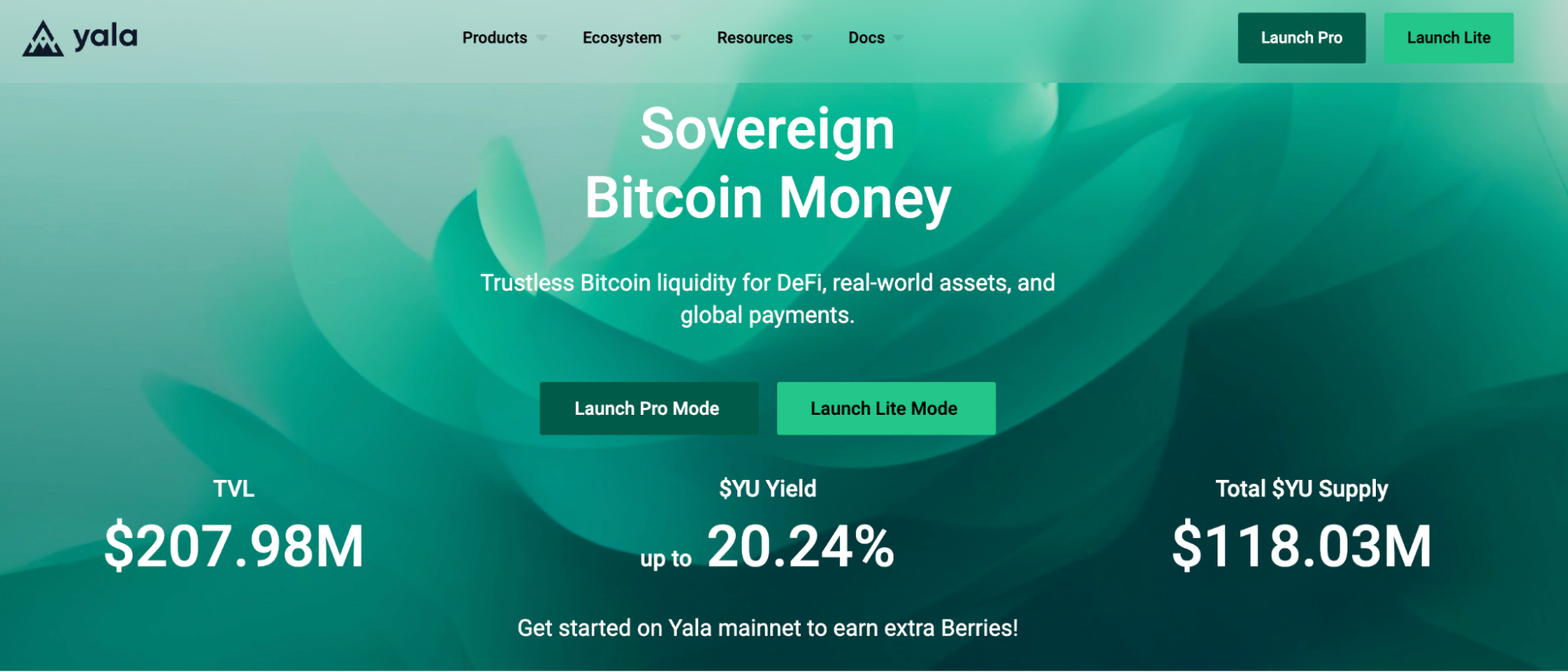

Image: https://yala.org/

YALA is a decentralized finance (DeFi) protocol purpose-built for the Bitcoin network. Its mission is to boost Bitcoin’s asset programmability and liquidity while preserving the network’s core security. Leveraging overcollateralized native BTC assets (such as $YU), atomic swaps, and a modular architecture, YALA acts as a bridge between Bitcoin and other blockchains—transforming BTC from “digital gold” into a vital foundational asset for DeFi applications.

Why Does Bitcoin Need DeFi?

Despite Bitcoin’s market capitalization exceeding $2 trillion and comprising more than 50% of the total crypto market, its share of total value locked (TVL) in DeFi is below 3%. This disparity is largely due to BTC’s lack of Turing-complete smart contract functionality, making it difficult to directly implement sophisticated financial protocols.

YALA aims to overcome this challenge by introducing a BTC-native liquidity protocol, enabling Bitcoin to participate in a wide range of DeFi applications—including lending, restaking, insurance, and more—much like ETH currently does.

A Closer Look at YALA’s Modular Architecture

The YALA protocol features five core layers:

  1. Application Layer: Delivers lending, liquidity issuance, restaking, yield farming, and related services.
  2. Execution Layer: Distributed across the Bitcoin mainnet and target chains. It enables complex logic through UTXO state changes and multi-signature mechanisms.
  3. Consensus & Data Availability (DA) Layer: Synchronizes states using Prover nodes and external data availability networks, such as Nubit.
  4. Settlement Layer: Ensures all final states are securely settled via Bitcoin mainnet UTXOs.
  5. Interoperability Layer: Facilitates cross-chain data and asset exchange with other networks using atomic swaps, DLC protocols, and secure multisig solutions.

Core Features and Highlights

  • BTC-overcollateralized asset $YU: YALA introduces $YU as a liquidity asset, minted exclusively via BTC overcollateralization and managed by the YALA Vault module.
  • Automated Stability Mechanism: Similar to MakerDAO’s stabilization system. YALA employs dual auctions and automated controls to maintain $YU’s peg to BTC.
  • Insurance Mechanism (Takaful): Provides risk-sharing based on Islamic insurance principles, with participant protection managed via the Qard Hasan module.
  • Cross-Chain Mapping & Atomic Swaps: This feature allows for secure asset mapping and seamless flow between BTC and other chains, such as Ethereum and Solana.
  • Data Availability & State Synchronization: The protocol maintains system performance and security through SegWit scripts, UTXO states, and external data availability networks.

Summary

The introduction of the YALA protocol unlocks unprecedented financial extensibility for BTC. YALA not only solves Bitcoin’s long-standing programmability challenges. It also builds a native, efficient, and secure DeFi ecosystem for BTC. As more assets and applications integrate with the protocol, YALA is positioned to become critical infrastructure within the broader Bitcoin ecosystem.
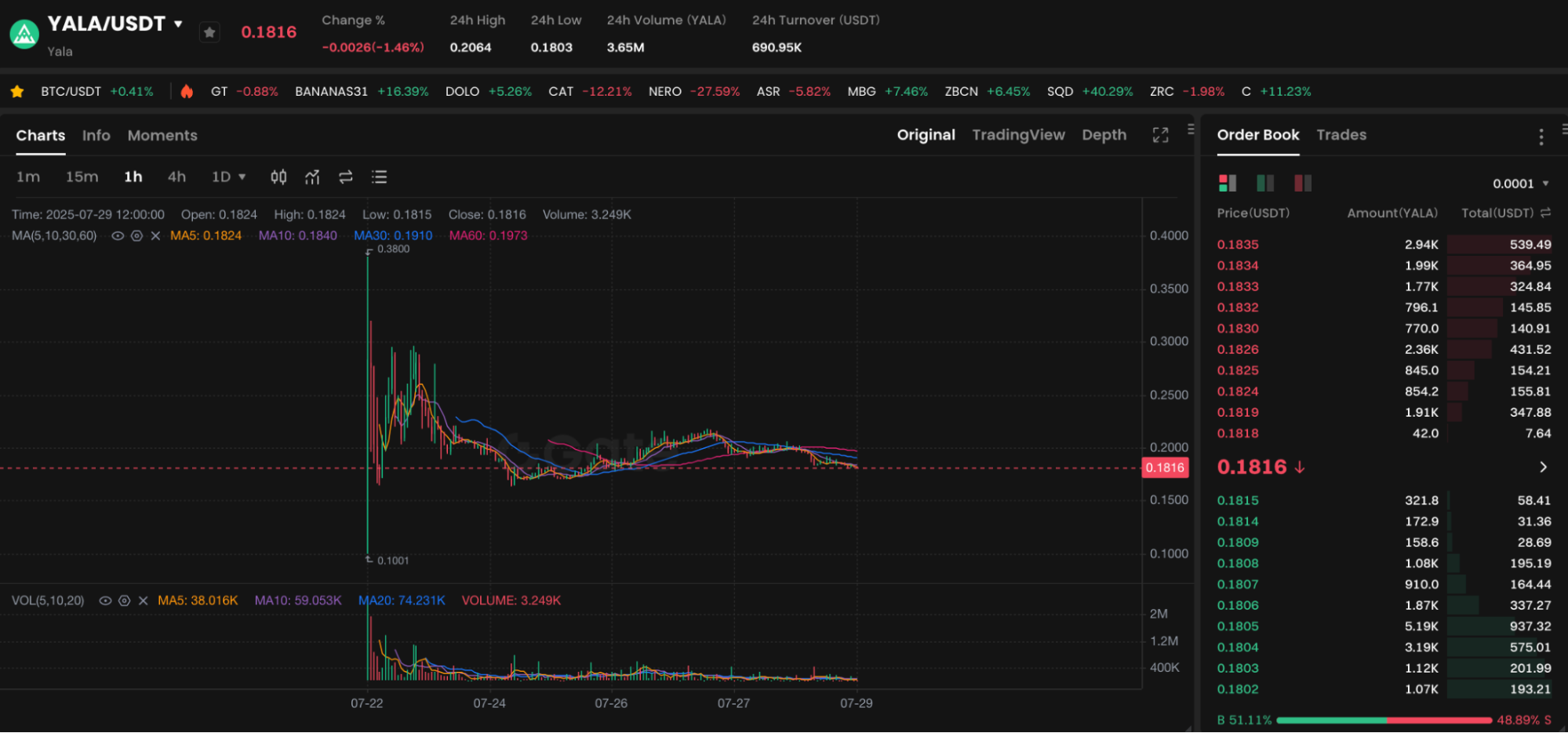

Image: https://www.gate.com/trade/YALA_USDT

YALA has launched on the Gate spot market. As of July 29, 2025, YALA is priced at approximately $0.181. Traders should be aware of recent high volatility and manage risk accordingly.

Author: Max
Disclaimer
* The information is not intended to be and does not constitute financial advice or any other recommendation of any sort offered or endorsed by Gate.
* This article may not be reproduced, transmitted or copied without referencing Gate. Contravention is an infringement of Copyright Act and may be subject to legal action.

Related Articles

What is Fartcoin? All You Need to Know About FARTCOIN
Intermediate

What is Fartcoin? All You Need to Know About FARTCOIN

Fartcoin (FARTCOIN) is a representative meme coin within the Solana ecosystem based on an AI-driven narrative. Its core concept originated from an experiment aimed at exploring the "boundaries between AI Agents and humor." More than just a digital asset with social attributes, the project deeply couples absurd humor culture with on-chain financial logic by integrating autonomous AI interaction models.
2026-04-04 22:01:19
Gold Price Forecast for the Next Five Years: 2026–2030 Trend Outlook and Investment Implications, Could It Reach $6,000?
Beginner

Gold Price Forecast for the Next Five Years: 2026–2030 Trend Outlook and Investment Implications, Could It Reach $6,000?

Analyze current gold price trends alongside authoritative five-year forecasts, integrating an evaluation of market risks and opportunities. This gives investors insight into the potential trajectory of gold prices and the main drivers expected to shape the market over the next five years.
2026-03-25 18:13:30
Aster vs Hyperliquid: Which Perp DEX Will Prevail?
Beginner

Aster vs Hyperliquid: Which Perp DEX Will Prevail?

Aster and Hyperliquid are the two representative protocols of the "purpose-built L1 path" within the current decentralized perpetual exchange (Perp DEX) sector. As a pioneer in the field, Hyperliquid has built a deep liquidity moat through its highly mature order book architecture and strong community consensus. Conversely, Aster, as a rising challenger, seeks to leapfrog the competition in high-performance trading through more aggressive multi-chain aggregation logic, private transaction modules, and an underlying execution environment optimized for 2026 market demands.
2026-03-24 11:58:33
AI-Native Settlement Layers: How United Stables Is Building the Next Financial Rail
Beginner

AI-Native Settlement Layers: How United Stables Is Building the Next Financial Rail

Stablecoins were originally designed as dollar substitutes within exchanges, primarily used for asset pricing and trade settlement. As on-chain financial ecosystems have matured, their role has expanded beyond simple payments to include collateral assets, cross-chain liquidity mediums, and unified settlement units. In particular, as AI systems and automated agents begin to participate directly in economic activity, demand has risen sharply for programmable value units capable of instant settlement. This shift is pushing stablecoins toward the role of foundational financial infrastructure.
2026-03-25 03:16:17
2026 Silver Price Forecast: Bull Market Continuation or High-Level Pullback? In-Depth Analysis of Silver Candlestick Chart
Beginner

2026 Silver Price Forecast: Bull Market Continuation or High-Level Pullback? In-Depth Analysis of Silver Candlestick Chart

2026 Silver Price Forecast: Latest Outlook This article integrates current market trends, silver candlestick chart analysis, and momentum factors to assess the potential key support and resistance levels, upside targets, and pullback risks for silver prices. The goal is to help investors make informed, rational decisions.
2026-03-25 16:08:59
ASTER Tokenomics: Buybacks, Burns, and Staking as the Value Foundation of ASTER in 2026
Beginner

ASTER Tokenomics: Buybacks, Burns, and Staking as the Value Foundation of ASTER in 2026

ASTER is the native equity and governance token of the Aster ecosystem, with its core value built upon a radical "Deflationary Engine." Beyond serving as a governance tool, ASTER integrates multiple utilities including staking rewards, trading fee discounts, and liquidity incentives. Through its deep integration with the upcoming dedicated Layer 1 mainnet, it enables direct value capture from protocol cash flow to token holders.
2026-03-25 07:38:07





