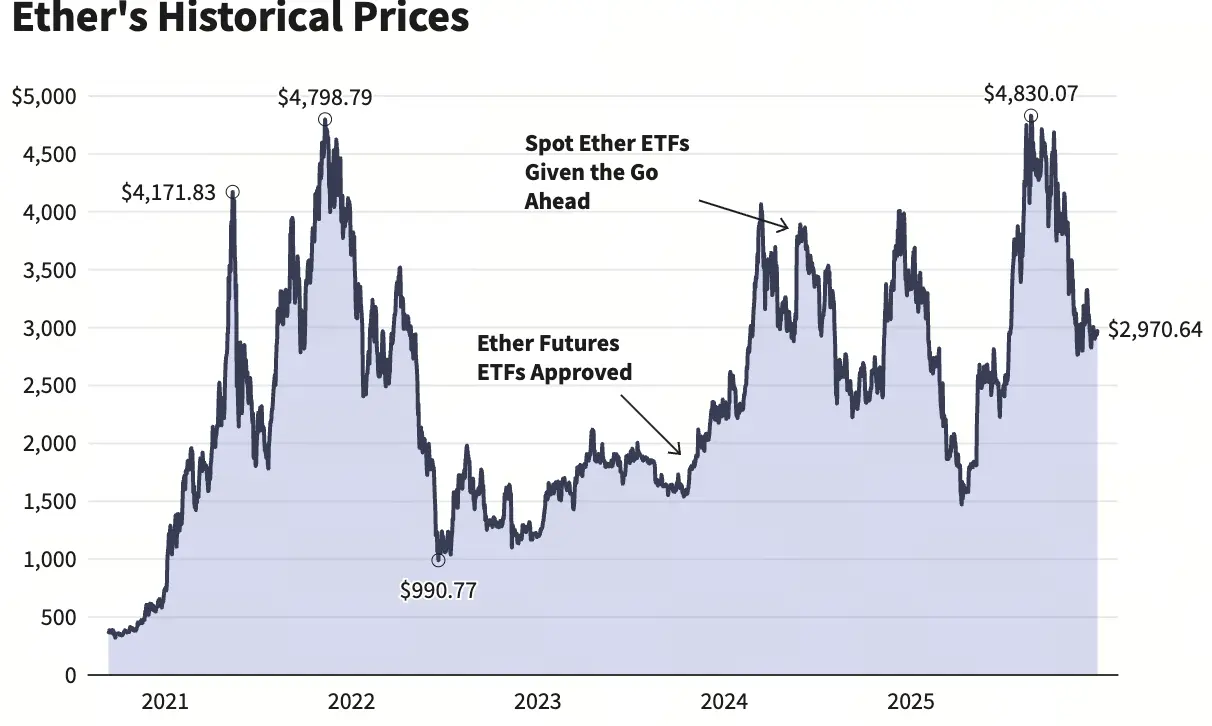
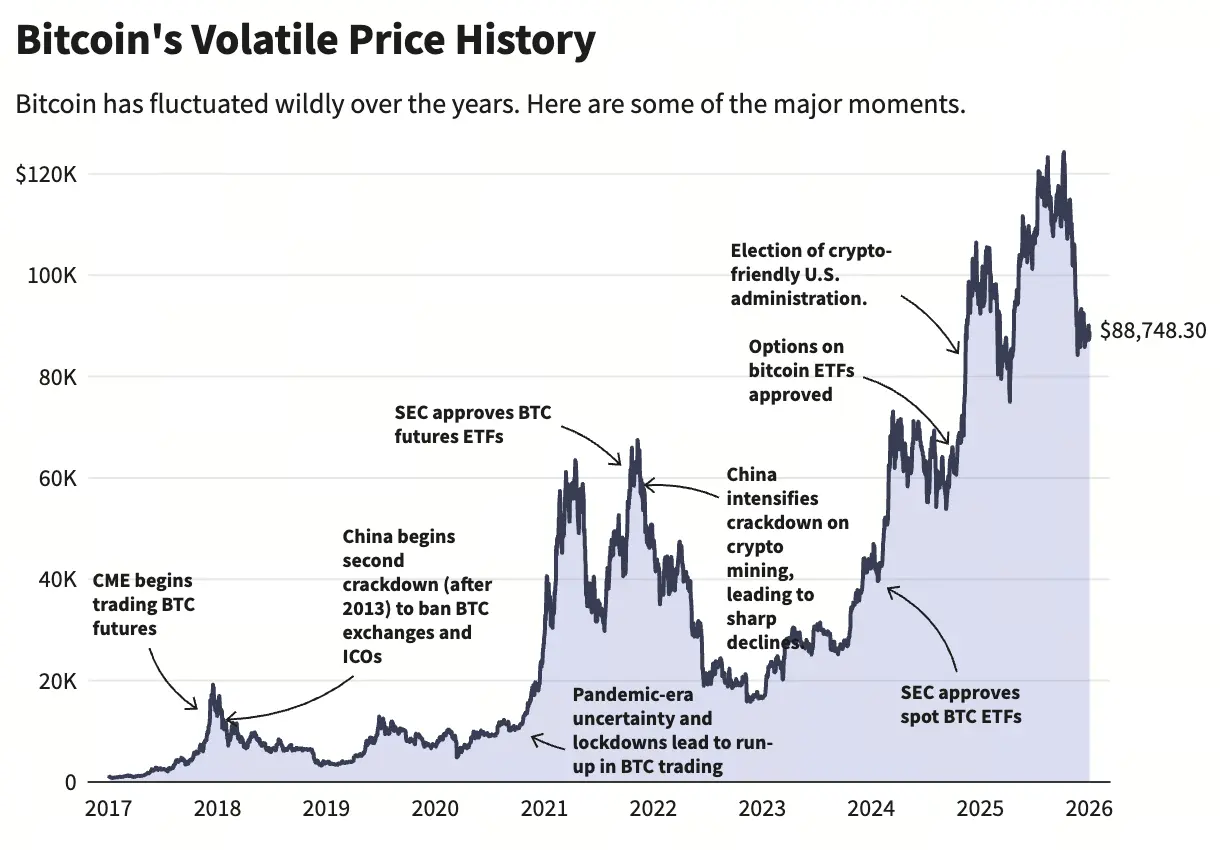
Ethereum has historically been more volatile than Bitcoin—rising harder in bull markets and falling steeper in downturns. In 2025, ETH lost 7.9% YTD through mid-December versus BTC’s 0.8% decline. But does this mean greater long-term potential, or just amplified risk?
Ethereum’s Volatility: Bigger Wins, Bigger Losses
ETH outperformed BTC during the 2020–2021 cycle (+310% vs. BTC’s 303% in 2020; +399% vs. 60% in 2021), fueled by DeFi and NFT booms.
(Sources: TradingView)
In 2023, ETH gained 91% amid lower fees post-proof-of-stake upgrade, though BTC rose 156%.
Recent six months (June 2025 onward): ETH +24% while BTC -12%.
Yet ETH trails BTC significantly from 2021 peaks (-43% vs. BTC’s relative strength), losing nearly two-thirds of its BTC-pair value.
November 2025 alone saw ETH drop 22% (vs. BTC’s 17.5%), dragging total crypto cap below $3 trillion.
Ethereum’s Unique Advantages Over Bitcoin
(Sources: TradingView)
Bitcoin functions as “digital gold”—a store of value with no yield or broader utility.
Ethereum powers a full ecosystem: dApps, NFTs, DeFi lending, and staking for passive income (~3–5% APY historically, dipping below 3% in 2025—comparable to 30-year Treasuries).
~30% of ETH supply is staked, providing network security rewards. Platforms like Lido allow liquid staking (tradeable stTokens), keeping capital flexible.
Layer-2 rollups have slashed fees below $0.30, enhancing scalability.
The Added Risks Ethereum Carries
Ethereum’s expanded utility introduces vulnerabilities Bitcoin largely avoids:
- Hack Risks: DeFi exploits like Yearn Finance’s $9 million drain highlight smart contract dangers.
- Regulatory Uncertainty: ETH’s security status flipped post-2014 ICO; without permanent commodity classification, reclassification remains possible.
- Competition: Solana and others offer cheaper/faster transactions, eroding ETH’s dominance.
These factors amplify ETH’s beta to BTC—greater upside in rallies, sharper downside in corrections.
Outlook: Volatility vs. Sustainable Growth
For short-term traders, ETH’s swings offer more opportunity—both up and down.
Long-term holders may prefer BTC’s relative stability and “digital gold” purity, especially given ETH’s post-2021 underperformance.
ETH’s ecosystem advantages (staking, utility) provide yield and growth levers Bitcoin lacks, but risks like hacks and regulation cap its edge.
In 2026, ETH could reclaim leadership if L2 adoption accelerates and fees stay low—but BTC remains the safer bet for capital preservation amid uncertainty.
Bottom Line: Ethereum has more upside potential in bull runs due to utility and volatility, but Bitcoin edges out for reliability and lower systemic risks. Diversify based on your horizon and risk tolerance.
Disclaimer: The information on this page may come from third parties and does not represent the views or opinions of Gate. The content displayed on this page is for reference only and does not constitute any financial, investment, or legal advice. Gate does not guarantee the accuracy or completeness of the information and shall not be liable for any losses arising from the use of this information. Virtual asset investments carry high risks and are subject to significant price volatility. You may lose all of your invested principal. Please fully understand the relevant risks and make prudent decisions based on your own financial situation and risk tolerance. For details, please refer to
Disclaimer.
Related Articles
Brandt Spotlights 'Ugly' Bitcoin Pattern - U.Today
Peter Brandt advises Bitcoin traders to remain flexible amidst conflicting technical setups: a potential bullish "horn" pattern and a bearish "flag" pattern. He criticizes the dogmatic mindset of some in the crypto community, emphasizing adaptable trading strategies over fixed opinions.
UToday16m ago
Court Reaffirms Bitcoin’s Status as Property but Limits Tort Claims in $172M Case
A United Kingdom High Court’s recent ruling has clarified the legal status of bitcoin, stating that while it is considered property, it cannot be subjected to traditional legal claims applicable to physical goods.
The $172 Million Bitcoin Dispute
In a landmark ruling, the High Court of Justice cl
Coinpedia1h ago
BTC Falls 0.72% in 15 Minutes: On-chain Large Inflows to Exchanges Amplify Decline as Long Positions Liquidate
**March 18, 2026, 18:45-19:00 (UTC)**: BTC recorded a -0.72% return rate within 15 minutes, with price fluctuating between 70,946.6 and 71,615.2 USDT, reaching an amplitude of 0.93%. Market attention increased during this period with active trading volume. Short-term selling pressure dominated the market, causing significant short-term volatility.
The primary driver of this price movement was the concentration of large on-chain BTC inflows into mainstream exchanges. Two large transfers totaling 2,150 BTC were detected flowing into exchanges during the 18:45-19:00 period, and
GateNews1h ago


