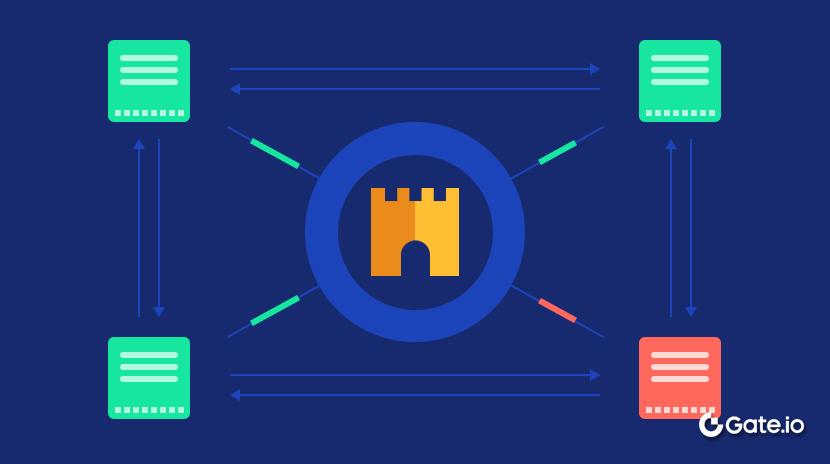
Proof of Work (PoW) is a consensus mechanism that enables a blockchain network to determine who can add new transactions to the blockchain, based on verifiable computational effort. In this system, the amount of provable computation performed serves as voting power.
Participants in PoW are known as miners. Miners group pending transactions into blocks and compete for the right to record them by repeatedly calculating hash values. A hash acts as a “digital fingerprint” for data, producing a completely different output even if the input changes slightly. The miner who first finds a hash that meets predefined criteria earns the right to add the new block and receives a reward.
Proof of Work is essential because it offers a reliable method for updating the blockchain without a central authority, making it resistant to arbitrary changes and double spending.
If anyone could easily alter the ledger, digital currencies would be unusable. PoW ties the right to update the ledger to real-world costs—rewriting history requires massive computing power and electricity, which can be verified by all nodes. This makes cheating economically infeasible. PoW thus provides public blockchains like Bitcoin with a robust security foundation.
Proof of Work operates through a “hash puzzle.” Miners select a random number (nonce) for each block and continuously adjust it until the block’s hash value falls below a network-defined target.
A hash is an irreversible fingerprint function; the target is like a threshold. The lower the threshold, the harder it is to find a valid hash, requiring more attempts. This target is set by the network’s “difficulty,” which is periodically adjusted according to total network computational power to keep block times stable (e.g., around 10 minutes for Bitcoin). When a miner finds a solution meeting the difficulty requirement, they broadcast the block to the network. Other nodes quickly verify the block: ensuring transaction validity, correct hash difficulty, and accurate reference to the previous block. If everything checks out, the new block is accepted and added to the longest chain.
In Bitcoin, Proof of Work determines who gets to produce the next block and protects past transactions from being tampered with.
The process works as follows: miners gather unconfirmed transactions into a block and repeatedly adjust the nonce until the block’s hash meets the difficulty target. Once successful, they broadcast the block. Other nodes verify the digital signatures (which prove transaction ownership) and the block hash before adding it to the chain. The Bitcoin network automatically adjusts mining difficulty approximately every two weeks to maintain an average block interval of about 10 minutes, regardless of total network hash rate.
Proof of Work is directly linked to rewards, which provide economic incentives for miners to bear operational costs and secure the network.
Miners receive two main types of income: block rewards (newly issued bitcoins for each valid block) and transaction fees (fees users pay to prioritize their transactions). These rewards motivate miners to continually invest in hardware and electricity, dedicating computational power to network security. Over time, block rewards decrease according to predetermined rules (halving events), making transaction fees increasingly important for incentivizing miners and maintaining security as network activity grows.
Proof of Work prevents double spending by making “rewriting history” extremely costly. Double spending refers to attempting to spend the same coins more than once.
To invalidate a confirmed transaction, an attacker must outpace honest miners by generating an alternative, longer chain containing their replacement transaction. This requires enormous computational resources and time. A “51% attack” occurs if someone controls more than half of total network power, allowing them to temporarily reverse recent transactions by creating a longer chain. While not impossible, such attacks are prohibitively expensive and difficult to sustain; network monitoring also helps detect anomalies quickly. On the application level, increasing confirmation requirements and monitoring hash rate distribution can further reduce risks.
Proof of Work consumes significant electricity because it relies on massive hash calculations. The debate centers on total energy usage and energy sources.
In recent years, overall network hash rate has grown, with ongoing discussions about rising use of renewable energy sources. Supporters argue that this energy expenditure yields public, verifiable security; critics are concerned about carbon emissions and local electricity demand. Many miners deploy equipment in regions with surplus or intermittent power to reduce costs and environmental impact. Policy developments and technological advances continue to shape mining’s geographic distribution and energy choices.
Participating in PoW mining requires hardware, electricity, a stable internet connection, and an understanding of costs versus returns.
Step 1: Choose your cryptocurrency and algorithm. Each coin uses different algorithms requiring specific hardware; for example, Bitcoin uses specialized ASIC miners.
Step 2: Prepare hardware and electricity supply. Consider acquisition cost, power consumption, cooling requirements, electricity prices, and facility costs; ensure electrical safety.
Step 3: Install mining software and join a mining pool. Mining pools combine computational power and distribute rewards based on contribution, increasing income stability.
Step 4: Set up your payout address and security measures. Use your own wallet address to receive earnings and securely back up your private key. If you wish to sell your earnings, use Gate’s deposit options for the corresponding blockchain; always ensure network and address compatibility to avoid mistakes.
Step 5: Continuously monitor and review your operation. Track difficulty changes, equipment malfunctions, ambient temperature, and electricity costs; periodically reassess your mining strategy.
Risk Warning: Mining involves hardware depreciation, electricity price fluctuations, coin price volatility, regulatory risks, as well as mining pool and wallet security concerns. Avoid borrowing or overextending yourself for high-risk investments.
Proof of Work relies on computational power and electricity as costs; Proof of Stake (PoS) uses locked assets as both cost basis and voting power.
PoW’s advantages include a straightforward security model where attacks require ongoing external expenses; its disadvantages are high energy consumption and high hardware barriers. PoS offers low energy usage and lower participation requirements but may face risks like centralization of assets and complex penalty mechanisms. Different applications may choose the most suitable mechanism or hybrid models depending on security needs, performance goals, and economic structures.
Proof of Work builds trust in decentralized networks by requiring verifiable computational costs for consensus in the absence of central authorities. It sustains miner participation through a reward system, stabilizes block production via hash puzzles and difficulty adjustment, and defends against double spending and historical revision through high rewriting costs. Energy consumption and centralization are externalities that require governance attention; participants should carefully assess hardware, electricity, and price risks before mining. As technology and policy evolve, PoW will coexist with other consensus mechanisms—each serving different scenarios and requirements.
Mining difficulty adjusts automatically to maintain stable block production rates. In Bitcoin’s case, every 2,016 blocks (approximately every two weeks), difficulty is recalibrated so that blocks are mined every 10 minutes on average. When more miners join, difficulty increases; when miners leave, difficulty decreases—much like adjusting exam difficulty to keep pass rates consistent.
Mining with standard home computers is no longer practical. Modern mining requires specialized ASIC machines with vastly superior hashing power; household computers cannot generate enough output even to cover electricity costs. Today, individuals typically participate through mining pools or by purchasing cloud mining services rather than solo mining.
Proof of Work’s security is based on the “majority honesty” assumption: an attacker would need over 50% of total hash power to rewrite historical blocks. This is economically irrational since hardware and electricity costs would far exceed any potential gains. The further back a block is in history, the more difficult it becomes to alter because every subsequent block’s proof must be recalculated.
While PoW offers high security, it significantly limits transaction throughput and confirmation speed due to its computational requirements. For instance, Bitcoin produces blocks roughly every 10 minutes and can handle only about seven transactions per second. This represents a trade-off between security and speed; as a result, some public chains adopt Proof of Stake or similar alternatives to enhance performance.
Yes—there are significant differences. Bitcoin uses SHA-256; Litecoin employs Scrypt; Ethereum previously used Ethash. Each algorithm varies in complexity, required hardware type, and energy consumption, resulting in completely separate mining ecosystems—Bitcoin miners cannot mine Litecoin with their equipment.