Over the past few years, the crypto industry has evolved from API-based trading and quantitative strategies to increasingly sophisticated automation. With the rise of AI Agents, the market is now entering a new phase driven by agent-based execution. In this stage, AI is no longer just a tool for analysis. It has become an active participant capable of handling data processing, generating decisions, and even executing trades.
Against this backdrop, AI Agent Skills, as the foundational modules for building intelligent agents, are playing an increasingly critical role in crypto space. They define the boundaries of what an agent can do and directly shape its performance in trading, data analysis, and on-chain interactions. As such, they are becoming an essential infrastructure for advancing intelligence in Web3.
Positioning and Capability Boundaries of AI Agent Skills
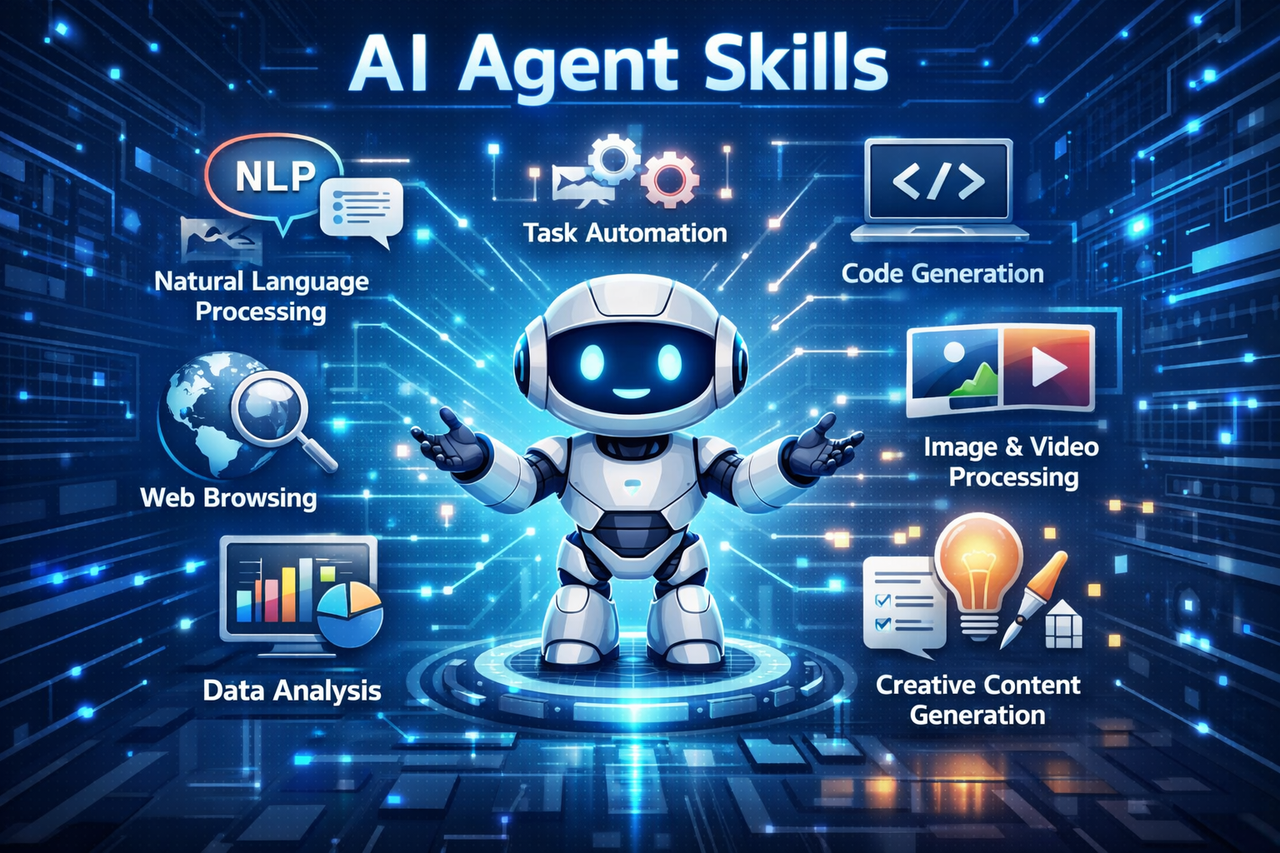
At their core, AI Agent Skills are executable capability modules. Unlike traditional APIs that provide atomic-level functions, Skills package multiple steps into a complete task, such as “retrieving BTC market data and generating trading signals” or “placing orders automatically based on conditions.”
This abstraction allows AI Agents to perform complex operations without needing to understand low-level interfaces. At the same time, Skills have clear boundaries, they are responsible for execution, not final decision-making. Decisions are typically made by AI models or strategy logic, while Skills act as the execution layer, translating decisions into concrete actions.
In this sense, Skills can be viewed as capability units, while the AI Agent serves as the orchestration system. Only when the two work together can true automation be achieved.
Core Application Scenarios of AI Agent Skills
As the crypto ecosystem becomes more data-intensive and interaction-heavy, AI Agent Skills have already been applied across several key scenarios.
Market Data Analysis and Signal Generation
In a fast-moving, information-dense market, AI Agent Skills can continuously pull real-time price feeds, order book data, and technical indicators to perform structured market analysis. Compared to manual analysis, this approach runs continuously and responds instantly to market changes, producing more timely and actionable trading signals.
Automated Trading and Strategy Execution
At the trading layer, Execution Skills enable agents to automatically place orders, manage stop-loss and take-profit levels, and adjust positions.
When combined with predefined strategies or real-time signals, AI Agents can react to market changes within milliseconds, enabling high-frequency or strategy-driven trading. This is particularly valuable in the highly volatile crypto market, where it improves execution efficiency and reduces emotional interference.
On-Chain Interaction and Data Query Capabilities
On-chain operations lie at the heart of Web3, and Interaction Skills allow agents to directly engage with blockchain networks.
These capabilities include querying wallet balances, calling smart contracts, participating in DeFi protocols, and executing cross-chain operations. Through these Skills, AI Agents evolve from analytical tools into on-chain executors, actively participating in decentralized ecosystems.
From Skill to Agent: Building a Complete Execution Pipeline
A single Skill cannot handle complex tasks on its own. The key lies in orchestrating multiple Skills into a cohesive execution pipeline.
A typical workflow includes:
-
Data collection Skills gather market and on-chain data
-
Analysis Skills generate decision signals
-
A decision module determines whether to act
-
Execution Skills carry out trades or on-chain interactions
This closed loop of perception, analysis, decision, and execution enables AI Agents to independently complete complex tasks, gradually evolving toward autonomous intelligence.
Advantages and Challenges of AI Agent Skills
The primary strengths of AI Agent Skills lie in modularity and scalability. Developers can flexibly combine different Skills to quickly build agents with specific capabilities. This architecture also reduces development costs and improves system flexibility.
However, several challenges remain.
For example, data quality directly affects analytical outcomes, on-chain operations introduce security risks, and complex strategies may suffer from model misjudgments. In addition, compatibility and standardization across different Skills still need improvement.
Future Trends: Skill Marketplace and Agent Economy
As AI Agents continue to integrate with Web3, Skills may evolve into independent digital assets. In this model, developers can create and publish Skills, while users or agents can access them on demand, forming a Skill Marketplace.
Building on this, an Agent Economy may emerge. AI Agents will not only function as tools but also as economic actors, completing tasks through Skills and earning rewards. For instance, automated trading agents or DeFi yield optimization agents could operate as independent digital labor.
This trend is likely to further accelerate the convergence of AI and Web3, creating a more intelligent and automated decentralized ecosystem.
Conclusion
AI Agent Skills are redefining how interactions occur in the crypto industry. From market analysis and trade execution to on-chain operations, Skills modularize complex capabilities, enabling AI Agents to actively participate in and execute a wide range of tasks.
While challenges around standardization and security still exist, the development of Skill Marketplaces and the Agent Economy suggests that AI Agent Skills will play an increasingly central role in the future Web3 ecosystem.
FAQs
What is the difference between AI Agent Skills and APIs?
APIs provide low-level interfaces that require developers to build their own logic, while AI Agent Skills are higher-level abstractions that package these interfaces into complete tasks, making them more suitable for AI Agents.
Do you need programming skills to use AI Skills?
Not necessarily. In many Skills hubs, capabilities are already standardized, allowing users to invoke them through configuration or natural language without writing complex code.
What crypto use cases can AI Agent Skills support?
They are mainly used in scenarios such as market analysis, automated trading, on-chain interactions, and DeFi operations.
Are AI Agent Skills secure?
Security depends on permission control and execution mechanisms. Proper API key management, access isolation, and risk control systems are essential.
Can AI Agent Skills be used in DeFi?
Yes. Beyond centralized trading, Skills can be extended to on-chain interactions such as wallet operations, liquidity provision, and data queries.
What is the future direction of AI Agent Skills?
They are likely to evolve toward a Skill Marketplace and Agent Economy, where Skills become tradable and composable digital resources.