🔥 Gate Square Event: #PostToWinNIGHT 🔥
Post anything related to NIGHT to join!
Market outlook, project thoughts, research takeaways, user experience — all count.
📅 Event Duration: Dec 10 08:00 - Dec 21 16:00 UTC
📌 How to Participate
1️⃣ Post on Gate Square (text, analysis, opinions, or image posts are all valid)
2️⃣ Add the hashtag #PostToWinNIGHT or #发帖赢代币NIGHT
🏆 Rewards (Total: 1,000 NIGHT)
🥇 Top 1: 200 NIGHT
🥈 Top 4: 100 NIGHT each
🥉 Top 10: 40 NIGHT each
📄 Notes
Content must be original (no plagiarism or repetitive spam)
Winners must complete Gate Square identity verification
Gat
Goldman Sachs: Gold has significant upside potential, reaching $4,900 by 2026
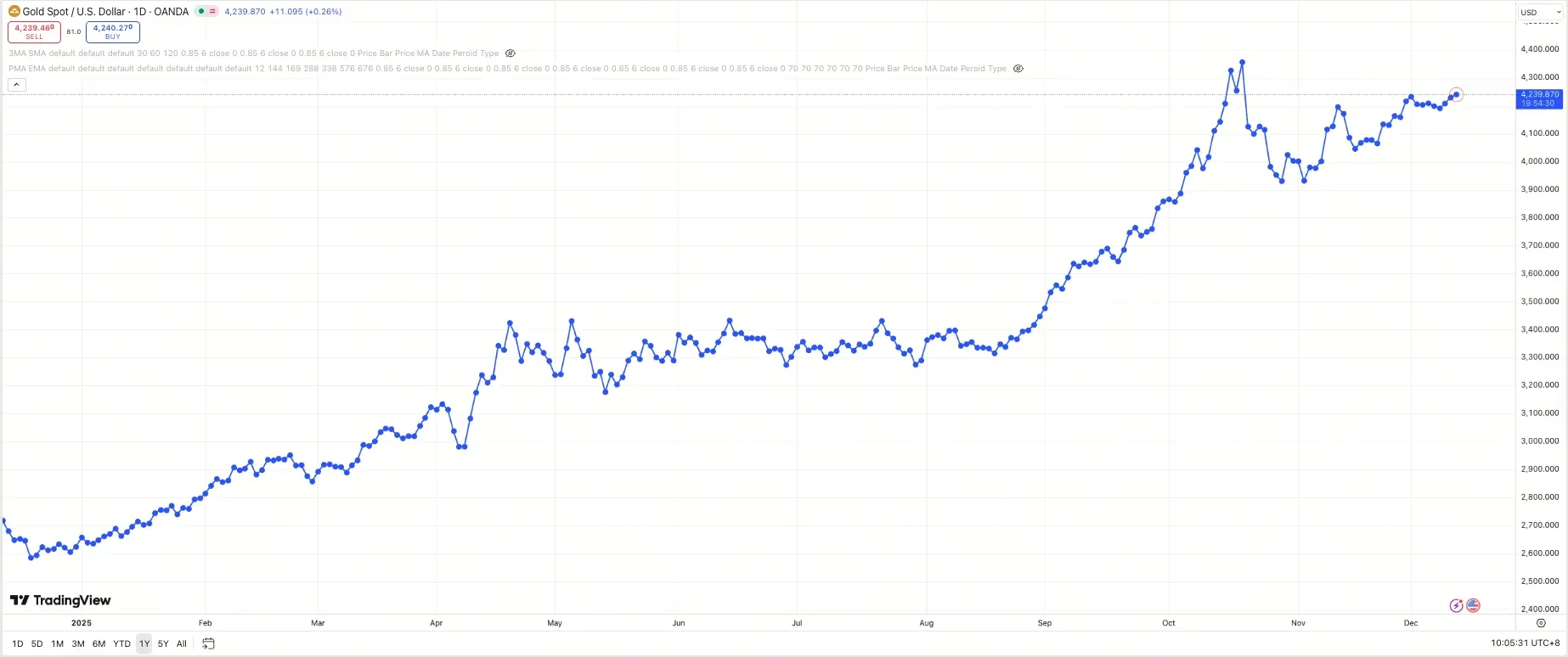
Goldman Sachs states that given the currently low levels of gold holdings and the potential for investor diversification, there is significant upside potential for the gold price to reach $4,900 per ounce by the end of 2026. A survey conducted by Goldman Sachs’ Marquee platform among over 900 institutional investor clients shows that 36% of respondents (the largest group) expect gold to surpass $5,000 per ounce before the end of next year.
From $4,000 to $4,900: The Three Key Logic Behind Goldman Sachs’ Target
(Source: Trading View)
Goldman Sachs’ forecast of $4,900 per ounce for gold by the end of 2026 implies about a 17% upside from current levels. This target is not arbitrary but based on three core logical reasons. First, the current level of gold holdings among institutional investors is relatively low. Despite a sharp rise in prices this year, many traditional asset management firms’ gold allocations remain below historical averages, leaving room for additional capital inflows.
Second, the potential for investor diversification is being unleashed. Goldman Sachs points out, “Recent calls from some investors to increase gold allocations,” emphasizing that the shift toward diversification may enhance the appeal of this precious metal. Against the backdrop of geopolitical uncertainties, inflation concerns, and dollar fluctuations, gold’s value as a non-correlated asset is being rediscovered. The traditional 60/40 stock-bond allocation model is evolving into a diversified portfolio that includes gold, cryptocurrencies, and other alternative assets.
Third, central bank purchasing behavior provides structural support. Surveys show that 38% of respondents believe central bank gold purchases are the main driver of rising prices, while 27% cite fiscal issues. Central banks around the world are flooding the market, attracted by gold’s high liquidity, no default risk, and its overall neutral status as a reserve asset. Data from the World Gold Council shows that in the first three quarters of 2024, global central banks net purchased over 800 tons of gold, continuing the strong buying trend since 2022.
Goldman Sachs’ forecast also considers technical factors. After breaking above $4,000, the next psychological threshold is $5,000. Historically, gold tends to extend its rally after breaking significant round numbers, encountering notable resistance only near the next key level. The target of $4,900 sits just below $5,000, indicating that Goldman Sachs expects gold to approach but possibly not fully break through this historic level.
Institutional Survey Reveals: 70% Bullish Consensus Formed
From November 12 to 14, Goldman Sachs’ Marquee platform surveyed over 900 institutional investor clients, revealing that over 70% expect gold prices to rise next year. This overwhelming bullish consensus is quite rare in gold markets and typically appears early or mid-stage in a major trend.
The survey details are even more revealing. 36% of respondents expect gold to exceed $5,000 per ounce, more aggressive than Goldman Sachs’ official forecast of $4,900. Another 33% expect prices between $4,500 and $5,000, meaning 69% of institutional investors believe gold will at least reach $4,500. In contrast, only slightly over 5% believe that prices will fall back to between $3,500 and $4,000 within the next 12 months.
The distribution of these results shows a clear right-skewed tendency, indicating very low market concern over downside risks and very high expectations for upside potential. From a behavioral finance perspective, when institutional investors form such a strong and unanimous expectation, it often signals trend persistence. However, it also harbors reverse risks: if everyone is already bullish and positioned accordingly, marginal buying may diminish.
Three Core Drivers of Institutional Bullishness on Gold
Central Bank Continual Buying: 38% see this as the main driver, especially active in emerging markets
Fiscal Deficit Concerns: 27% worry that rising national debt will boost demand for precious metals as safe havens
Diversification Needs: Traditional stock-bond portfolios perform poorly in high-volatility environments, making gold a necessary hedge
Blue Line Futures chief market strategist Phil Streible told CNBC that the bull market in gold could last until 2026. He stated, “The global economic outlook continues to support gold prices.” Many countries still face slowing economic growth and rising inflation, creating a “stagflation” environment historically favorable for gold.
From Retail to Hedge Funds: Buying Structure Expands Fully
This year, from retail buyers to hedge funds, large numbers of investors have turned to gold—traditionally seen as a safe-haven asset during turbulent times—to hedge against inflation, geopolitical fractures, and dollar depreciation. This broad expansion of buying structure is the fundamental reason behind the 58.6% increase in gold prices this year.
Central bank purchases and widespread investor demand have pushed precious metal prices to record highs. Gold has risen 58.6% this year, breaking above $4,000 for the first time on October 8. Commodity prices reached a two-week high on Friday, boosted by expectations of Fed rate cuts, with spot prices up 0.45% to $4,175.50 per ounce and futures rising 0.53% to $4,187.40.
Other investors are also rushing into the mining sector, optimistic about this commodity. Stephen Yiu of Blue Whale Capital recently told CNBC that he is betting on Newmont Mining, the world’s largest gold producer. Carson Bruck, founder of Muddy Waters Capital known for short-selling, issued bullish options on Snowline Gold, a Canadian small-cap miner. At this year’s Sohn London Investment Conference, Bruck said he sees Snowline as an attractive acquisition target amid increasing industry consolidation.
Goldman Sachs emphasizes that recent calls from investors to increase gold allocations are strengthening, and this trend shift could further push prices higher. As institutions begin shifting gold from tactical to strategic core assets, both demand sustainability and stability are greatly enhanced.