As generative AI and blockchain technology converge, the on-chain economy is evolving from manual user operations to automated execution by intelligent agents. In this context, Pieverse streamlines Web3 usage and delivers auditable payment and settlement capabilities for AI Agent, enabling participation in increasingly complex economic activities.
Definition and Development Background of Pieverse
AI Agent is transitioning from a simple tool to an autonomous participant with self-executing capabilities. Within the Web3 ecosystem, these agents not only facilitate trades but also automate asset management and strategy implementation based on user instructions.
Pieverse emerges in response to this trend, focusing on providing AI Agent with standardized payment functionality and interaction interfaces, eliminating reliance on traditional wallet operations for on-chain activity. This approach expands the role of AI Agent from a supporting tool to an integral economic actor in Web3.
Core Mechanisms and Operational Logic of Pieverse
Pieverse operates through the coordinated integration of several key modules, including the x402b payment protocol, execution logic, and data recording mechanisms.
The payment layer leverages a gasless model to minimize user interaction costs, allowing trades to be executed without users directly paying gas fees. The execution layer is managed by AI Agent, which initiates on-chain actions based on input instructions. The data layer records transaction details with timestamps, ensuring every action is verifiable.
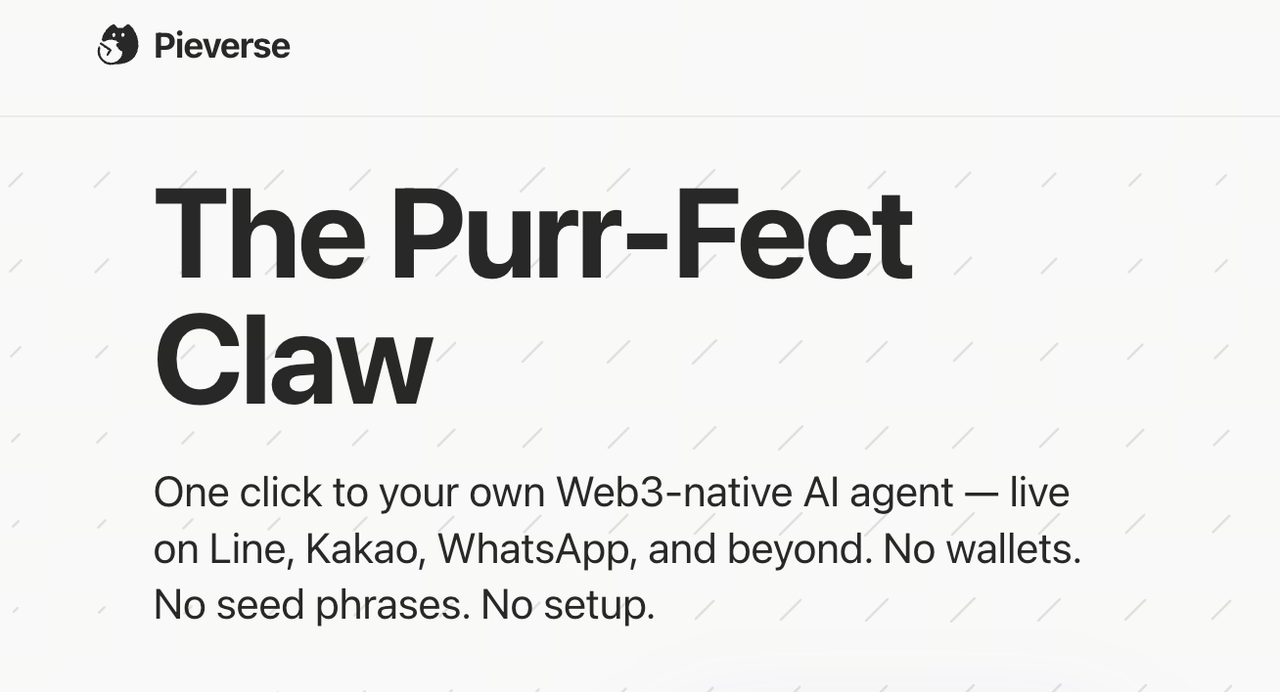
Purr-Fect Claw: Wallet-Free Web3 Interaction Gateway
Purr-Fect Claw introduces a chat-based Web3 interface, enabling users to access on-chain functions directly through familiar messaging platforms.
This model simplifies traditional wallet management, eliminating the need for private key storage and signature processes. Users can initiate transactions via natural language input, while the system handles execution.
Pieverse's Agent Economic Model
Within the Pieverse framework, AI Agent functions not only as an execution tool but also as a participant in value exchange.
This paradigm is known as the Agentic Economy, where agents drive the economic system. Agents can execute payments, manage assets, and interact with other agents.
Application Scenarios for Pieverse
Pieverse is designed for diverse scenarios that integrate both on-chain and off-chain activities.
In automated trading, agents execute buy and sell operations according to predefined rules. In enterprise settings, the system generates auditable payment records. In social contexts, users can complete on-chain interactions directly via chat interfaces.
Advantages and Limitations of Pieverse
Pieverse significantly lowers the barrier to entry, enabling broader participation in Web3 through wallet-free design. Its auditable structure also supports compliance requirements.
However, this model introduces new challenges, including execution risks associated with AI Agent, permission management, and potential security vulnerabilities.
Pieverse vs Traditional Web3 Payment Systems
Traditional Web3 interactions depend on wallets for signature and transaction confirmation, requiring users to manually complete multiple steps.
Pieverse, by contrast, enables AI Agent to automatically execute transactions, abstracting the process into simple instruction input. This difference impacts both the interaction model and user experience, as well as risk management.
A comparison between the Web3 wallet and agent-based models clarifies their practical distinctions.
Summary
Pieverse marks a shift from user-driven to agent-driven Web3 interaction. Through wallet-free access, automated execution, and auditable records, it provides foundational infrastructure for AI Agent participation in the on-chain economy.
As AI and blockchain continue to merge, this model is poised to play an increasingly vital role in the digital economy.
FAQ
Does Pieverse require a traditional crypto wallet?
Pieverse is designed so that users can interact without directly using a traditional wallet in most cases, though it still relies on the underlying on-chain account system.
What is the primary function of Purr-Fect Claw?
Its core function is to provide a chat-based interface, enabling users to access on-chain features through natural language commands.
How does AI Agent execute transactions in Pieverse?
AI Agent triggers transactions based on user input or preset rules, with the system handling payment and recordkeeping.
Does Pieverse support enterprise-grade applications?
Its auditable and timestamped recordkeeping makes it suitable for scenarios requiring compliance and financial transparency.
What are the main differences between Pieverse and traditional Web3 payment systems?
The primary change is a shift from manual operations to automated execution, which lowers the entry barrier for users.