As demand for artificial intelligence computing grows rapidly, traditional cloud computing is facing challenges such as high costs, concentrated resources, and access barriers. These issues have accelerated the development of decentralized compute networks.
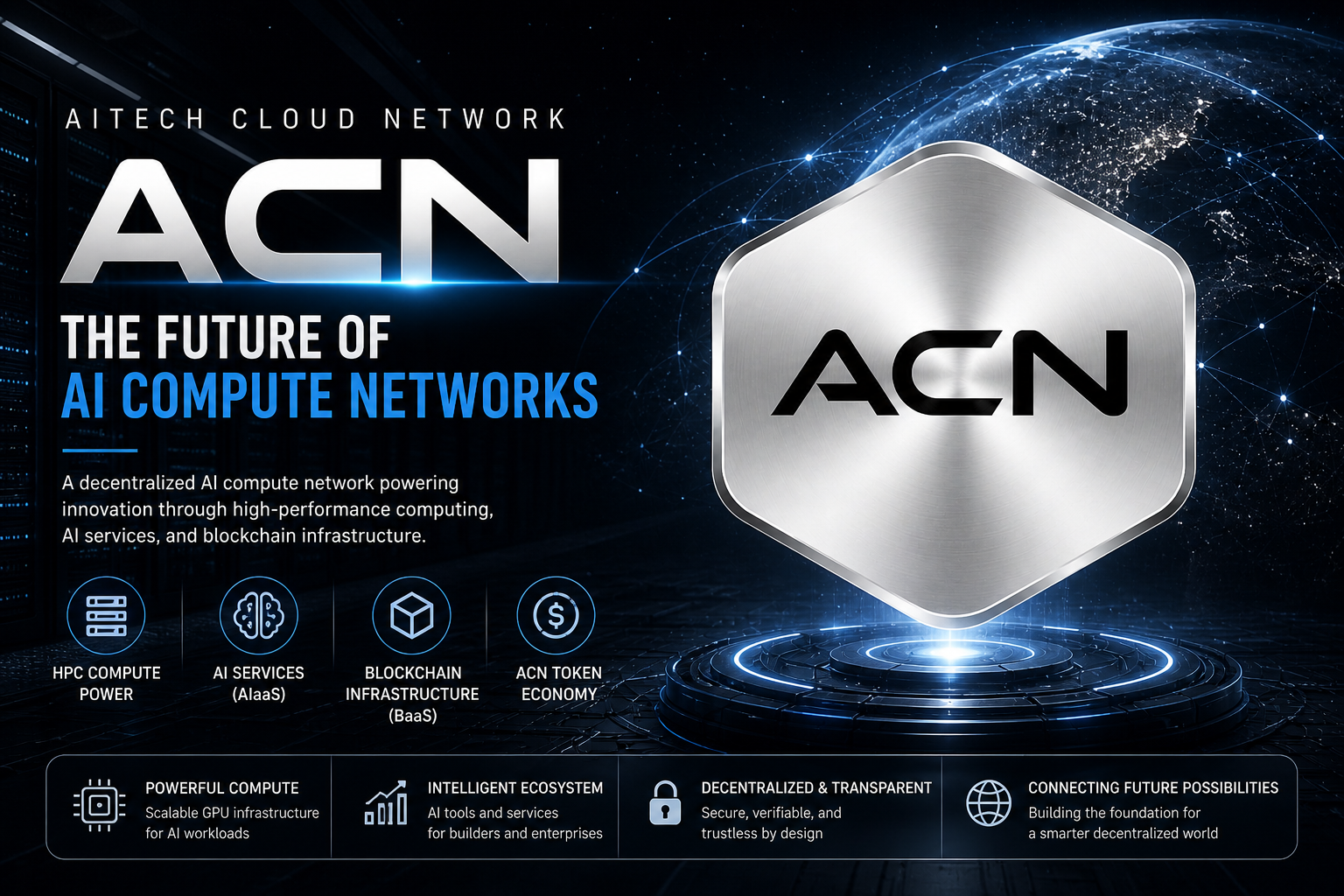
Structurally, AITECH Cloud Network is built around high performance computing, AI services, blockchain infrastructure, and a token economy model. Its core components cover network architecture, service mechanisms, and the broader application ecosystem.
What Is AITECH Cloud Network (ACN)?
AITECH Cloud Network can be understood as a compute infrastructure designed for AI applications. Its core purpose is to integrate high performance computing resources with blockchain based settlement mechanisms, creating a unified AI service network. The network maps traditional data center capabilities into an on chain economic system, turning compute power into a tradable resource.
In terms of how it operates, the network provides GPU resources through centralized high performance computing centers, while blockchain systems handle payment settlement and access control. Users can access AI models, data analytics services, or computing power through tokens.
The importance of this design lies in how it connects AI computing demand with a blockchain economic model. This allows supply and demand for compute resources to be adjusted through market mechanisms, which can improve resource utilization efficiency.
ACN’s Core Architecture and Operating Mechanism
ACN’s core architecture consists of a high performance computing layer, an AI service layer, and a blockchain settlement layer. In essence, it separates computing resources, service interfaces, and the economic system into distinct layers.
Structurally, the high performance computing layer provides GPU compute power, the AI service layer handles model calls and data processing, and the blockchain layer manages transaction records and payment systems. This layered structure can be viewed as a separation of computing, services, and settlement.
| Layer |
Function |
Role |
| HPC layer |
Provides compute resources |
Supports AI training and inference |
| AI service layer |
Provides AI tools |
Enables data analytics and automation |
| Blockchain layer |
Records and settles transactions |
Ensures transaction transparency |
The impact of this architecture is that layered design improves system scalability while reducing coupling between different functional modules, allowing the network to support a wide range of AI applications.
High performance computing is the foundational capability of AITECH Cloud Network. Its core role is to provide large scale GPU compute power to support complex AI tasks. This computing layer can be seen as the resource foundation of the entire network.
In the operating mechanism, computing resources are centrally managed through data centers and allocated according to user needs. After a user submits a computing request, the system schedules the corresponding compute resources to complete the task.
This capability matters because AI model training and inference typically require substantial computing power. High performance computing can shorten task execution time while improving computational efficiency.
How AI Services (AIaaS) Build the Application Ecosystem
The AI service layer serves as the application entry point for AITECH Cloud Network. Its core function is to package complex AI capabilities into callable services. This model can be understood as modular delivery of AI capabilities.
In practice, developers can call AI models through APIs to complete data analysis, automation tasks, or predictive computing. Users can access AI functions without directly managing the underlying compute resources.
The impact of this structure is that the AI service layer lowers the development barrier, allowing more applications to integrate AI capabilities and helping the ecosystem expand.
The Function of Blockchain Services (BaaS) in the System
The blockchain service layer is responsible for transaction records and settlement within ACN. Its core purpose is to ensure data transparency and payment reliability through an on chain system. This layer can be understood as the network’s economic infrastructure.
Mechanically, all compute usage and AI service calls are recorded through the blockchain and settled using ACN tokens. After users pay fees, the system distributes funds to compute providers.
The importance of this design lies in its ability to minimize trust through blockchain, allowing different participants to exchange resources without needing to trust one another directly.
ACN’s Business Model and Revenue Sources
AITECH Cloud Network’s business model can be understood as a fee based system built on compute power and AI services. Its core revenue comes from resource leasing and service calls.
In its operating logic, users first purchase compute power or AI services, then complete payment through tokens. The network then distributes the fees to computing resource providers and service operators.
The impact of this model is that network revenue is directly tied to demand for computing power and the frequency of AI service usage, giving the business model room to scale.
AITECH Cloud Network Use Cases
AITECH Cloud Network’s use cases are mainly concentrated in areas that require high levels of computing power. Its core value lies in using AI computing capabilities to solve complex problems.
In real world applications, the network can be used for financial analysis, medical data processing, supply chain optimization, and automation systems. These scenarios depend on AI models and large scale computing resources.
The importance of this application structure is that it provides a unified compute platform, making it easier for different industries to use AI capabilities.
The differences between ACN and traditional cloud computing platforms mainly appear in resource management, payment mechanisms, and data control models. The core distinction is whether a blockchain-based economic system is introduced.
| Comparison Dimension |
ACN |
Traditional Cloud Computing |
| Resource model |
Tokenized compute power |
Resource leasing |
| Payment method |
Token settlement |
Fiat settlement |
| Data control |
Decentralized |
Platform controlled |
| Transparency |
On chain verifiability |
Opaque |
| Application model |
Open ecosystem |
Closed services |
Based on this comparison, ACN improves transparency and openness by introducing blockchain and token mechanisms, while traditional cloud computing places greater emphasis on centralized management and stable service delivery.
ACN’s Advantages and Potential Limitations
ACN’s advantage lies in integrating AI compute power with blockchain mechanisms to improve resource utilization efficiency and system transparency. Its core goal is to build an open AI computing network.
Mechanically, the network lowers trust costs through tokenization and distributed settlement while improving resource liquidity. However, this structure also brings technical complexity and cost pressure.
Its potential limitations mainly involve the cost of building compute capacity, market competition, and dependence on real demand. These factors may affect the network’s development.
Conclusion
AITECH Cloud Network integrates high performance computing, AI services, and blockchain settlement systems to build a compute network for AI applications. Its core structure includes a computing layer, a service layer, and a settlement layer.
Overall, the network connects compute supply and demand through a token mechanism, supports multi-industry applications through modular services, and also faces challenges such as cost and competition.
FAQ
What Is AITECH Cloud Network (ACN)?
AITECH Cloud Network is an AI compute network that combines high performance computing with blockchain. It provides AI services and computing resources, while using tokens for payment and settlement.
What Is the Role of the ACN Token?
The ACN token is used to pay for compute fees, AI service fees, and participation in network economic activities. It is the core settlement tool within the system.
How Is ACN Different from Traditional Cloud Computing?
ACN uses blockchain to enable tokenized settlement and data transparency, while traditional cloud computing mainly relies on centralized platforms to provide services.
What Are the Use Cases of AITECH Cloud Network?
Its main use cases include financial analysis, medical data processing, supply chain optimization, and automation systems, especially in areas that require high levels of computing power.
What Is ACN’s Business Model?
Its business model is based on compute leasing and AI service fees, with revenue distributed through user payments.







