What is XRP: A Comprehensive Guide to Ripple's Native Cryptocurrency and Its Role in Global Payments
XRP's Positioning and Significance
In 2013, Ripple Labs introduced XRP (XRP), aiming to address inefficiencies in cross-border payments and financial inclusivity.
As one of the fastest and most scalable digital assets, XRP plays a crucial role in the payments sector, particularly in facilitating rapid and low-cost international transactions.
As of 2025, XRP has established itself as a top 5 cryptocurrency by market capitalization, boasting over 7.4 million holders and an active developer community. This report will delve into its technical architecture, market performance, and future potential.
Origin and Development History
Birth Background
XRP was created by Ripple Labs in 2013 to tackle the challenges of slow and expensive cross-border payments. It emerged during a period of growing interest in blockchain technology, aiming to provide a fast, cheap, and scalable solution for global money transfers. XRP's launch opened new possibilities for financial institutions and individuals seeking efficient international transactions.
Important Milestones
- 2013: XRP Ledger launched, achieving high transaction speeds (1,500+ TPS) and low costs.
- 2018: Adoption by various financial institutions drove the price to its all-time high of $3.65.
- 2025: Ecosystem expansion with numerous DeFi protocols and payment platforms integrating XRP.
With support from Ripple and the XRP community, the network continues to optimize its technology, security, and real-world applications.
How Does XRP Work?
No Central Control
XRP operates on a decentralized network of computers (nodes) worldwide, free from control by banks or governments. These nodes collaborate to validate transactions, ensuring system transparency and attack resistance, granting users greater autonomy and enhancing network resilience.
Blockchain Core
XRP's blockchain is a public, immutable digital ledger recording every transaction. Transactions are grouped into blocks, linked through cryptographic hashes to form a secure chain. Anyone can view the records, establishing trust without intermediaries. XRP Ledger's unique consensus mechanism further enhances performance and efficiency.
Ensuring Fairness
XRP uses a unique consensus algorithm to validate transactions and prevent fraudulent activities like double-spending. Validators maintain network security by participating in the consensus process, with no mining or staking rewards. Its innovation lies in its energy efficiency and high transaction throughput.
Secure Transactions
XRP employs public-private key cryptography to protect transactions:
- Private keys (like secret passwords) are used to sign transactions
- Public keys (like account numbers) are used to verify ownership
This mechanism ensures fund security, while transactions remain pseudonymous. Additional features like multisignature support enhance security for institutional users.
XRP's Market Performance
Circulation Overview
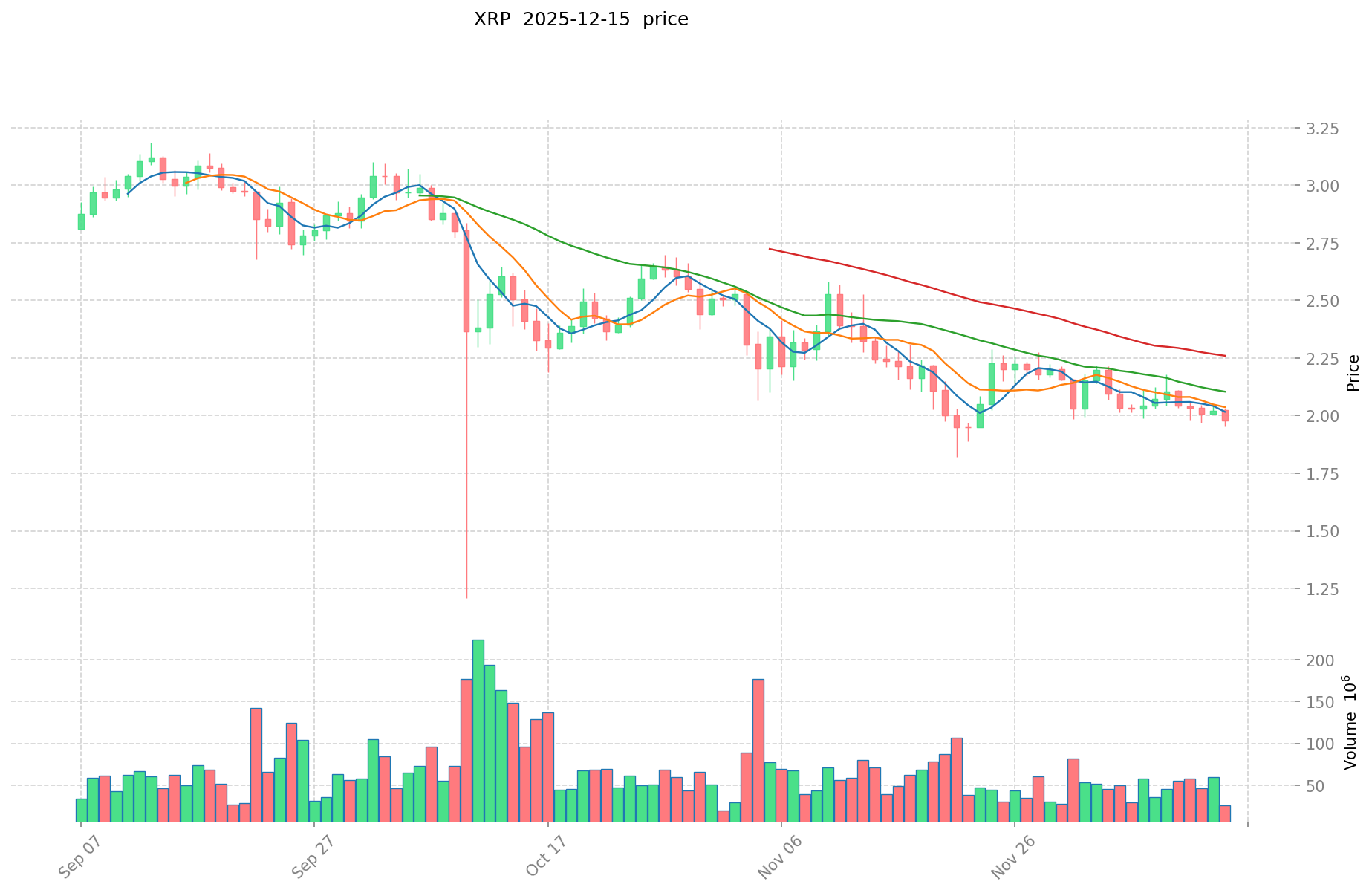
As of December 15, 2025, XRP's circulating supply is 60,491,484,708 coins, with a total supply of 99,985,744,733. The maximum supply is capped at 100,000,000,000 XRP.
Price Fluctuations
XRP reached its all-time high of $3.65 on July 18, 2025, driven by overall market bullishness and increased institutional adoption.
Its lowest price was $0.00268621, occurring on May 22, 2014, likely due to early market uncertainty and limited adoption.
These fluctuations reflect market sentiment, adoption trends, and external factors.
Click to view the current XRP market price
On-chain Metrics
- Daily Transaction Volume: 61,288,655.439506 XRP (indicating network activity)
- Active Addresses: 7,405,128 (reflecting user engagement)
XRP Ecosystem Applications and Partnerships
Core Use Cases
XRP's ecosystem supports various applications:
- Cross-border Payments: RippleNet, providing fast and low-cost international transactions.
- DeFi: Projects like Flare Network, enabling smart contract functionality on the XRP Ledger.
Strategic Collaborations
XRP has established partnerships with major financial institutions and payment providers, enhancing its technological capabilities and market influence. These partnerships provide a solid foundation for XRP's ecosystem expansion.
Controversies and Challenges
XRP faces the following challenges:
- Regulatory Issues: Ongoing legal disputes with regulatory bodies
- Centralization Concerns: Debates over the level of decentralization in the XRP network
- Competitive Pressure: The rise of other blockchain platforms offering similar solutions
These issues have sparked discussions within the community and market, driving continuous innovation for XRP.
XRP Community and Social Media Atmosphere
Fan Enthusiasm
XRP's community is vibrant, with daily transaction volumes reaching millions and a growing user base.
On X, related posts and hashtags like #XRP frequently trend, with monthly post volumes in the millions.
Price movements and development updates often ignite community enthusiasm.
Social Media Sentiment
Sentiment on X shows polarization:
- Supporters praise XRP's speed and efficiency, viewing it as the "future of global payments".
- Critics focus on regulatory uncertainties and centralization issues.
Recent trends indicate cautious optimism amidst regulatory challenges.
Hot Topics
X users actively discuss XRP's regulatory status, adoption by financial institutions, and technological advancements, highlighting both its transformative potential and the hurdles it faces in mainstream adoption.
More Information Sources for XRP
- Official Website: Visit XRP official website for features, use cases, and latest updates.
- X Updates: On X, XRP uses @Ripple handle, with millions of followers as of December 2025, posts cover technology updates, community events, and partnership news, generating significant engagement.
XRP Future Roadmap
- 2026: Launch enhanced smart contract capabilities, improving scalability and interoperability
- Ecosystem Goals: Support thousands of DApps and attract hundreds of millions of users
- Long-term Vision: Become the standard for global cross-border payments and financial infrastructure
How to Participate in XRP?
- Purchase Channels: Buy XRP on Gate.com
- Storage Solutions: Use secure wallets recommended by the XRP community
- Participate in Governance: Follow XRP community forums for decision-making processes
- Build on the Ecosystem: Visit XRP Ledger Dev Portal to develop applications or contribute code
Summary
XRP is redefining digital currency through blockchain technology, offering transparency, security, and efficient payments. Its active community, rich resources, and strong market performance make it stand out in the cryptocurrency space. Despite facing regulatory challenges and technological hurdles, XRP's innovative spirit and clear roadmap secure its important position in the future of decentralized technology. Whether you're a newcomer or a seasoned player, XRP is worth watching and participating in.
FAQ
What does XRP actually do?
XRP facilitates fast, low-cost global transactions on the XRP Ledger. It's primarily used for cross-border payments and remittances, enhancing financial efficiency.
How much will 1 XRP be worth in 2030?
Based on optimistic forecasts, 1 XRP could potentially reach $1,000 by 2030. However, this is highly speculative and not guaranteed.
Is XRP a good investment?
Yes, XRP is a good investment in 2025 for aggressive growth investors. It offers exposure to the global payments revolution, benefits from regulatory clarity, and has a massive addressable market in cross-border transactions.
How much XRP will $100 dollars buy?
As of 2025-12-15, $100 will buy approximately 47.88 XRP, based on an exchange rate of 0.4788 USD per XRP.
Share
Content
XRP's Positioning and Significance
Origin and Development History
How Does XRP Work?
XRP's Market Performance
XRP Ecosystem Applications and Partnerships
Controversies and Challenges
XRP Community and Social Media Atmosphere
More Information Sources for XRP
XRP Future Roadmap
How to Participate in XRP?
Summary
FAQ
How to Buy Cryptocurrency


Trending Cryptocurrencies



XZXX: A Comprehensive Guide to the BRC-20 Meme Token in 2025

Bitcoin Fear and Greed Index: Market Sentiment Analysis for 2025
Top Crypto ETFs to Watch in 2025: Navigating the Digital Asset Boom
5 ways to get Bitcoin for free in 2025: Newbie Guide

Bitcoin Market Cap in 2025: Analysis and Trends for Investors

2025 Bitcoin Price Prediction: Trump's Tariffs' Impact on BTC

Is HTX DAO (HTX) a good investment?: A Comprehensive Analysis of Tokenomics, Use Cases, and Market Potential

Is Internet Computer (ICP) a good investment?: A Comprehensive Analysis of Risk, Potential Returns, and Market Outlook for 2024

Is Ethena (ENA) a good investment?: A Comprehensive Analysis of Risks, Rewards, and Market Potential in 2024

Is Pi Network (PI) a good investment?: Analyzing the potential returns and risks of this emerging cryptocurrency project

Is Pepe (PEPE) a good investment?: A Comprehensive Analysis of Risk, Potential Returns, and Market Fundamentals for Cryptocurrency Investors