KOMA vs IMX: A Comparative Analysis of Advanced Imaging Technologies in Medical Diagnostics


Introduction: KOMA vs IMX Investment Comparison
In the cryptocurrency market, the comparison between KOMA vs IMX has been an unavoidable topic for investors. The two not only show significant differences in market cap ranking, application scenarios, and price performance, but also represent different positions in the crypto asset space.
KOMA (KOMA): Launched as a dog-themed token, it aims to build a community-driven decentralized platform focused on charity.
IMX (IMX): Introduced as a Layer 2 scaling solution for NFTs on Ethereum, offering instant transactions and zero gas fees for minting and trading.
This article will comprehensively analyze the investment value comparison between KOMA vs IMX, focusing on historical price trends, supply mechanisms, institutional adoption, technological ecosystems, and future predictions, attempting to answer the question investors care most about:
"Which is the better buy right now?"
I. Price History Comparison and Current Market Status
KOMA and IMX Historical Price Trends
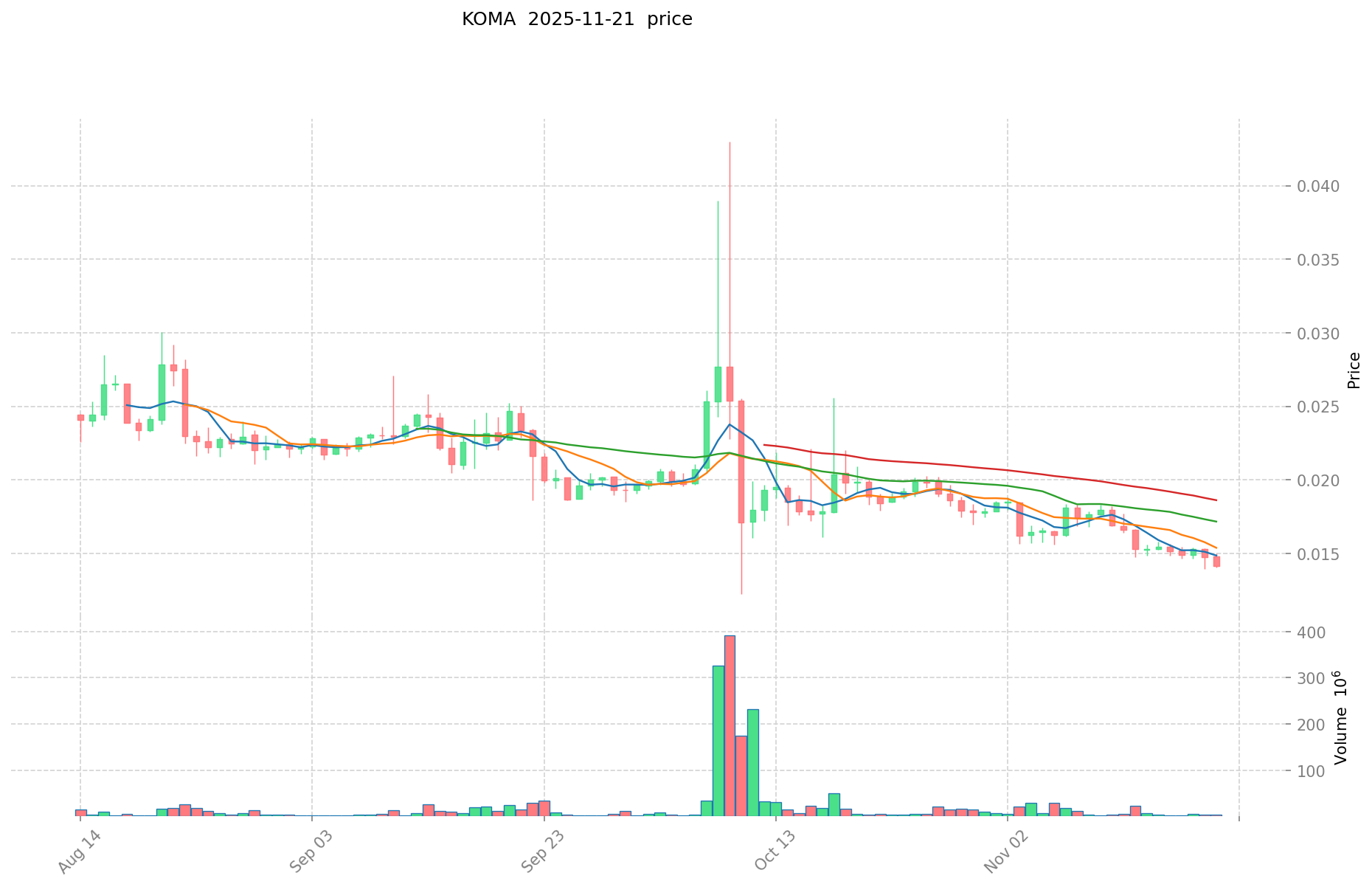
- 2024: KOMA reached its all-time high of $0.20185 on December 25, 2024.
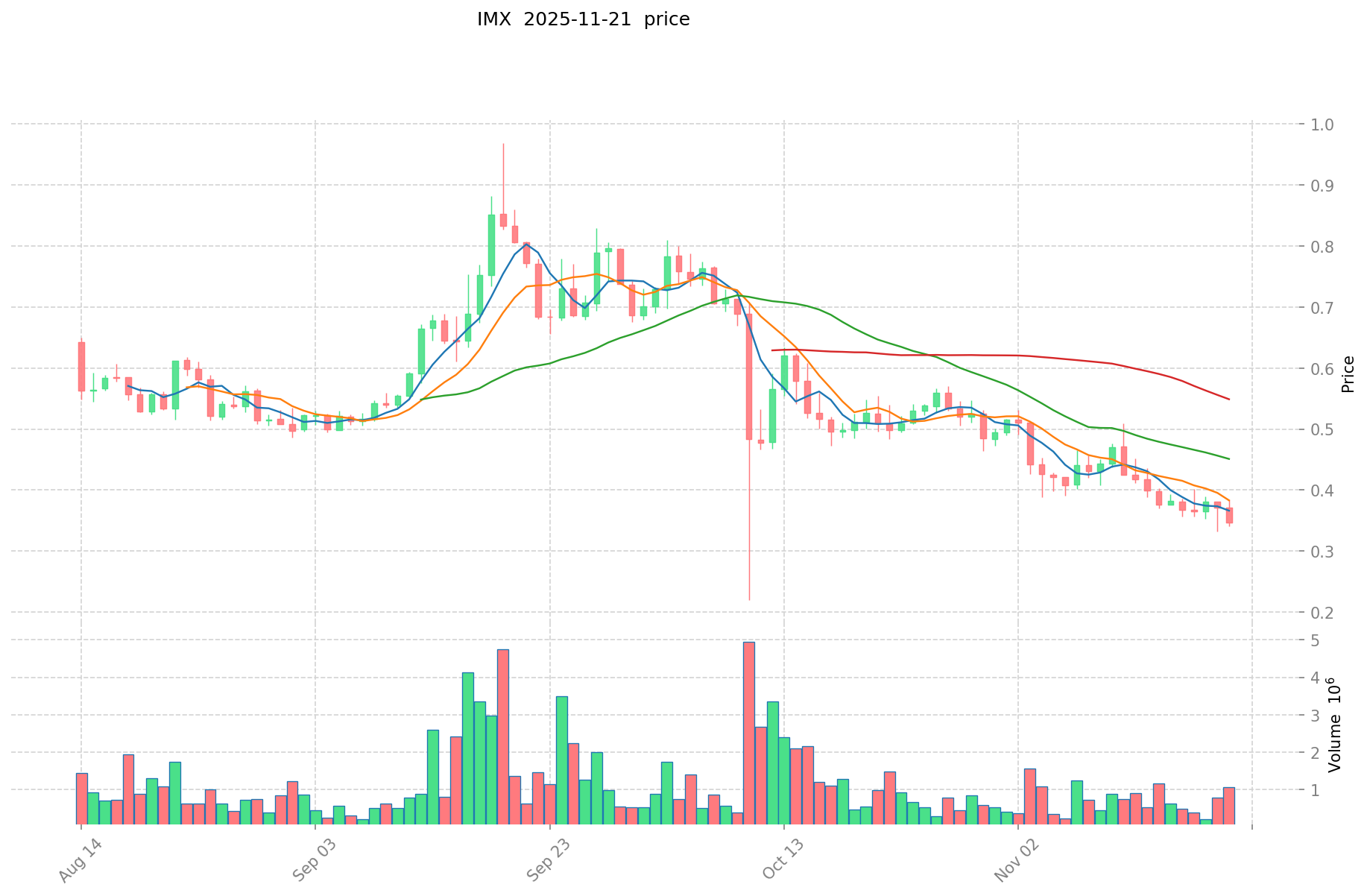
- 2025: IMX hit its all-time low of $0.300423 on November 21, 2025.
- Comparative analysis: In the current market cycle, KOMA has fallen from its peak of $0.20185 to $0.01344, while IMX has dropped from its all-time high of $9.52 to $0.309.
Current Market Situation (2025-11-21)
- KOMA current price: $0.01344
- IMX current price: $0.309
- 24-hour trading volume: KOMA $142,535.62 vs IMX $1,066,927.59
- Market Sentiment Index (Fear & Greed Index): 14 (Extreme Fear)
Click to view real-time prices:
- View KOMA current price Market Price
- View IMX current price Market Price
II. Core Factors Affecting Investment Value of KOMA vs IMX
Supply Mechanisms Comparison (Tokenomics)
- KOMA: Deflationary model with a maximum supply of 1 billion tokens, featuring burn mechanisms through protocol activities
- IMX: Fixed maximum supply of 2 billion tokens with an emission schedule spanning 9 years, including staking rewards and ecosystem development allocations
- 📌 Historical pattern: Deflationary models like KOMA's tend to support long-term value accrual during increased adoption, while IMX's controlled emission schedule helps balance market supply with ecosystem growth.
Institutional Adoption and Market Applications
- Institutional holdings: IMX has attracted more institutional interest with backers including Galaxy Digital, Coinbase Ventures, and Bitkraft
- Enterprise adoption: IMX leads with established partnerships with major brands like GameStop, TikTok, Disney, and numerous gaming studios, while KOMA has focused on DeFi applications
- Regulatory attitudes: Both projects operate in regulatory gray areas, though IMX's gaming focus may face less scrutiny than KOMA's DeFi orientation
Technical Development and Ecosystem Building
- KOMA technical upgrades: Advanced on-chain order book DEX with concentrated liquidity features and cross-chain capabilities
- IMX technical development: Layer 2 ZK-rollup solution specifically optimized for NFTs and gaming, offering gas-free transactions and carbon-neutral operations
- Ecosystem comparison: IMX has established a stronger gaming/NFT ecosystem with over 200 integrated projects, while KOMA focuses on DeFi with perpetual trading and cross-chain liquidity solutions
Macroeconomic Factors and Market Cycles
- Performance in inflationary environments: IMX may benefit from gaming sector growth during economic downturns as digital entertainment remains resilient
- Macroeconomic monetary policy: Both tokens face similar pressures from interest rate changes, though IMX's gaming focus may provide partial insulation
- Geopolitical factors: KOMA's DEX functionality could see increased demand during geopolitical uncertainty as users seek non-custodial trading options
III. 2025-2030 Price Prediction: KOMA vs IMX
Short-term Prediction (2025)
- KOMA: Conservative $0.0118-$0.0133 | Optimistic $0.0133-$0.0149
- IMX: Conservative $0.1700-$0.3092 | Optimistic $0.3092-$0.3555
Mid-term Prediction (2027)
- KOMA may enter a growth phase, with prices estimated at $0.0112-$0.0212
- IMX may enter a consolidation phase, with prices estimated at $0.3577-$0.4277
- Key drivers: Institutional capital inflow, ETF, ecosystem development
Long-term Prediction (2030)
- KOMA: Base scenario $0.0259-$0.0382 | Optimistic scenario $0.0382+
- IMX: Base scenario $0.5588-$0.6650 | Optimistic scenario $0.6650+
Disclaimer: The above predictions are based on historical data and market analysis. Cryptocurrency markets are highly volatile and subject to rapid changes. These forecasts should not be considered as financial advice. Always conduct your own research before making investment decisions.
KOMA:
| 年份 | 预测最高价 | 预测平均价格 | 预测最低价 | 涨跌幅 |
|---|---|---|---|---|
| 2025 | 0.0149408 | 0.01334 | 0.0118726 | 0 |
| 2026 | 0.019937964 | 0.0141404 | 0.011029512 | 5 |
| 2027 | 0.0212989775 | 0.017039182 | 0.01124586012 | 26 |
| 2028 | 0.0266450208525 | 0.01916907975 | 0.01303497423 | 42 |
| 2029 | 0.029091953882587 | 0.02290705030125 | 0.013057018671712 | 70 |
| 2030 | 0.03821926807512 | 0.025999502091918 | 0.020019616610777 | 93 |
IMX:
| 年份 | 预测最高价 | 预测平均价格 | 预测最低价 | 涨跌幅 |
|---|---|---|---|---|
| 2025 | 0.35558 | 0.3092 | 0.17006 | 0 |
| 2026 | 0.4454026 | 0.33239 | 0.2459686 | 7 |
| 2027 | 0.42778593 | 0.3888963 | 0.357784596 | 25 |
| 2028 | 0.55942732755 | 0.408341115 | 0.2205042021 | 32 |
| 2029 | 0.63388832987025 | 0.483884221275 | 0.39194621923275 | 56 |
| 2030 | 0.665074667931423 | 0.558886275572625 | 0.363276079122206 | 80 |
IV. Investment Strategy Comparison: KOMA vs IMX
Long-term vs Short-term Investment Strategies
- KOMA: Suitable for investors focused on DeFi innovations and community-driven projects
- IMX: Suitable for investors interested in gaming, NFTs, and Layer 2 scaling solutions
Risk Management and Asset Allocation
- Conservative investors: KOMA: 20% vs IMX: 80%
- Aggressive investors: KOMA: 40% vs IMX: 60%
- Hedging tools: Stablecoin allocation, options, cross-token portfolio
V. Potential Risk Comparison
Market Risks
- KOMA: High volatility due to meme coin status and smaller market cap
- IMX: Exposure to gaming and NFT market fluctuations
Technical Risks
- KOMA: Scalability, network stability
- IMX: Dependency on Ethereum, potential Layer 2 vulnerabilities
Regulatory Risks
- Global regulatory policies may impact KOMA more due to its DeFi focus, while IMX might face less scrutiny in the gaming/NFT space
VI. Conclusion: Which Is the Better Buy?
📌 Investment Value Summary:
- KOMA advantages: Deflationary model, DeFi innovation potential, community-driven
- IMX advantages: Strong institutional backing, established partnerships, gaming/NFT ecosystem growth
✅ Investment Advice:
- New investors: Consider a smaller allocation to IMX as an entry point to the NFT/gaming sector
- Experienced investors: Balanced portfolio with both KOMA and IMX, adjusting based on risk tolerance
- Institutional investors: Focus on IMX due to its established ecosystem and institutional adoption
⚠️ Risk Warning: Cryptocurrency markets are highly volatile. This article does not constitute investment advice. None
VII. FAQ
Q1: What are the main differences between KOMA and IMX? A: KOMA is a dog-themed token focused on building a community-driven decentralized platform for charity, while IMX is a Layer 2 scaling solution for NFTs on Ethereum offering instant transactions and zero gas fees for minting and trading.
Q2: Which token has performed better historically? A: Based on the current market data, IMX has shown stronger performance. While KOMA reached its all-time high of $0.20185 in December 2024, it has since fallen to $0.01344. IMX, despite dropping from its all-time high of $9.52, is currently trading at $0.309.
Q3: How do the supply mechanisms of KOMA and IMX differ? A: KOMA uses a deflationary model with a maximum supply of 1 billion tokens and burn mechanisms. IMX has a fixed maximum supply of 2 billion tokens with a controlled emission schedule over 9 years.
Q4: Which token has more institutional adoption? A: IMX has attracted more institutional interest, with backers including Galaxy Digital, Coinbase Ventures, and Bitkraft. It also has established partnerships with major brands like GameStop, TikTok, and Disney.
Q5: What are the main technical features of each token? A: KOMA features an advanced on-chain order book DEX with concentrated liquidity and cross-chain capabilities. IMX offers a Layer 2 ZK-rollup solution optimized for NFTs and gaming, with gas-free transactions and carbon-neutral operations.
Q6: What are the long-term price predictions for KOMA and IMX? A: By 2030, KOMA's base scenario price range is predicted to be $0.0259-$0.0382, while IMX's base scenario range is $0.5588-$0.6650. However, these predictions are subject to market volatility and should not be considered financial advice.
Q7: How should investors allocate their portfolio between KOMA and IMX? A: Conservative investors might consider allocating 20% to KOMA and 80% to IMX, while more aggressive investors could opt for a 40% KOMA and 60% IMX split. However, individual allocations should be based on personal risk tolerance and investment goals.
Share
Content
Introduction: KOMA vs IMX Investment Comparison
I. Price History Comparison and Current Market Status
II. Core Factors Affecting Investment Value of KOMA vs IMX
III. 2025-2030 Price Prediction: KOMA vs IMX
IV. Investment Strategy Comparison: KOMA vs IMX
V. Potential Risk Comparison
VI. Conclusion: Which Is the Better Buy?
VII. FAQ
How to Buy Cryptocurrency


Trending Cryptocurrencies



FTN vs ARB: Comparing Two Popular Trading Strategies for Optimal Returns
OCTA vs IMX: Comparing Advanced Imaging Technologies in Ophthalmology
OL vs IMX: The Battle for Dominance in Online Learning Platforms

ITA vs IMX: Comparing Two Popular ETFs for Exposure to the Global Travel Industry

What is CFX: Understanding the Fundamentals and Applications of Computational Fluid Dynamics eXchange

What is APT: Understanding Advanced Persistent Threats and Their Impact on Cybersecurity

How do derivatives market signals predict crypto market trends: funding rates, open interest, and liquidation data in 2025?

What is ASP: A Comprehensive Guide to Active Server Pages Technology

What is DEGO: A Comprehensive Guide to the Decentralized Gaming Ecosystem and Its Revolutionary Impact on the Gaming Industry

What is ATA: A Comprehensive Guide to Air Transport Association Standards and Specifications

What is RSS3: A Decentralized Information Distribution Protocol for the Web3 Era