Is Mira (MIRA) a good investment?: A Comprehensive Analysis of Technology, Adoption, and Market Potential


Introduction: Mira (MIRA) Investment Position and Market Prospects
Mira is an important asset in the cryptocurrency domain, positioning itself as a decentralized verification network designed to enable truly autonomous AI. Since its launch in September 2025, the project has gained traction as a solution to critical challenges in AI reliability. As of December 20, 2025, MIRA maintains a market capitalization of $124.6 million with a circulating supply of approximately 191.2 million tokens. The current price stands at $0.1246, with the token trading across 27 exchanges.
By addressing the fundamental problem of AI hallucinations and unreliable outputs through consensus-based verification mechanisms, Mira has positioned itself as verification infrastructure for trustworthy AI outputs in high-stakes domains such as healthcare, finance, and legal services. This innovative approach—routing outputs through multiple independent AI models and requiring mathematical agreement—transforms AI from a supervised tool into autonomous intelligence capable of independent operation, establishing MIRA as a focal point when investors evaluate "Is Mira (MIRA) a good investment?"
This article provides a comprehensive analysis of MIRA's investment value, historical price performance, future price forecasts, and associated investment risks to serve as a reference for potential investors.
Mira (MIRA) Cryptocurrency Research Report
I. MIRA Price History Review and Current Investment Value Status
MIRA Historical Price Performance and Investor Returns
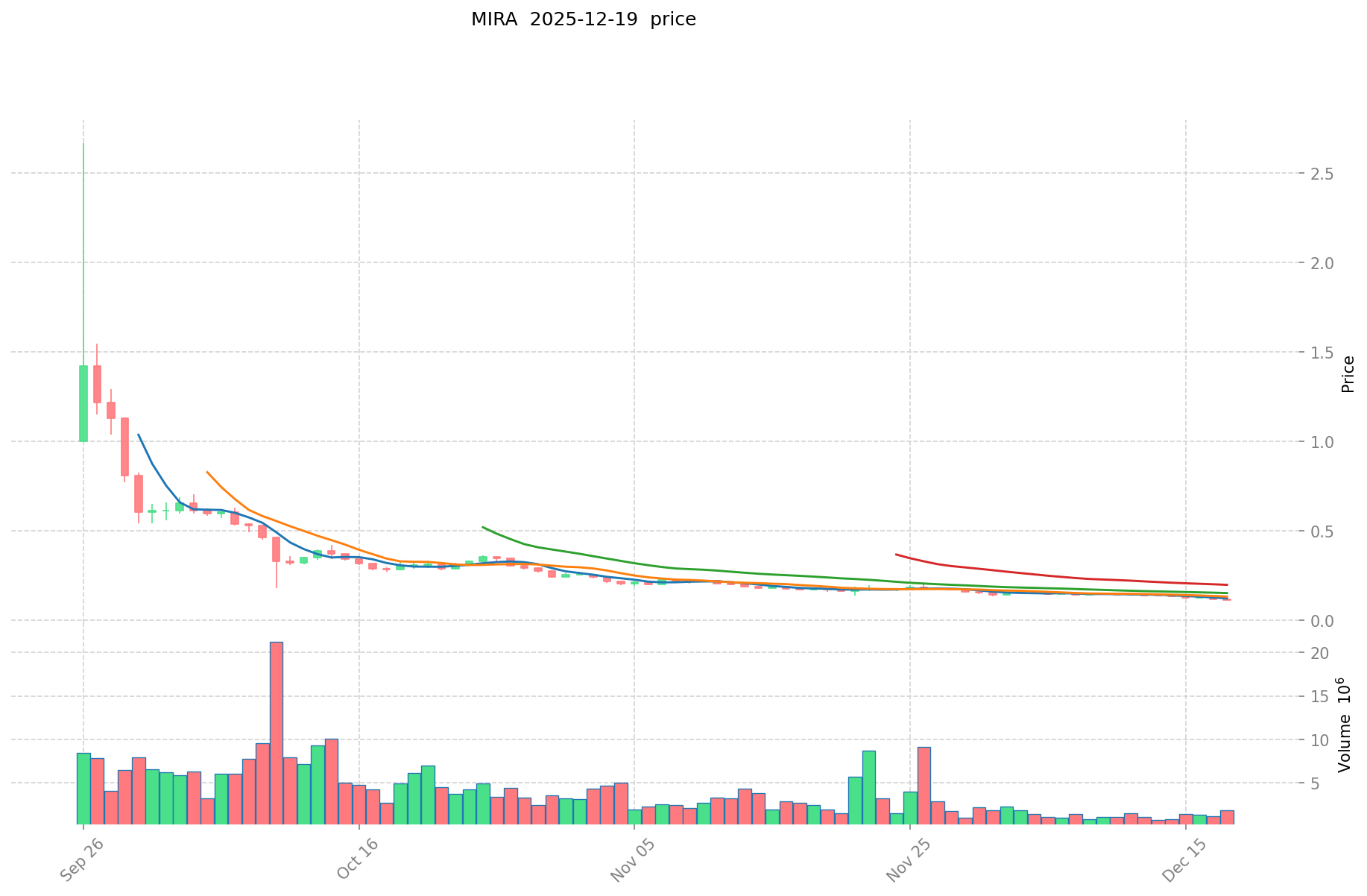
Based on available data as of December 20, 2025, MIRA has experienced significant price volatility since its launch in December 2025:
- All-time high (ATH): $2.6662 (reached on September 26, 2025)
- All-time low (ATL): $0.1122 (reached on December 18, 2025)
- Year-to-date performance: -91.21% (significant decline from peak)
The token's price trajectory shows a sharp contraction from its peak valuation, reflecting typical early-stage token volatility in the cryptocurrency market.
Current MIRA Market Status (December 20, 2025)
Price Metrics:
- Current price: $0.1246
- 24-hour high: $0.1253
- 24-hour low: $0.1149
- 24-hour price change: +8.05%
Market Capitalization & Supply:
- Fully diluted valuation (FDV): $124,600,000
- Current market cap: $23,823,520
- Circulating supply: 191,200,000 MIRA (19.12% of total supply)
- Total supply: 1,000,000,000 MIRA
- Market dominance: 0.0038%
Trading Activity:
- 24-hour trading volume: $230,413.56
- Listed on 27 exchanges
- Active token holders: 12,912
Market Sentiment Indicators:
- 1-hour change: -0.16%
- 7-day change: -11.57%
- 30-day change: -26.27%
- 1-year change: -91.21%
View real-time MIRA market prices: https://www.gate.com/price/mira-mira
II. Project Overview and Core Technology Architecture
Project Mission and Problem Statement
Mira is a decentralized verification network designed to enable truly autonomous artificial intelligence. The project addresses a critical challenge in current AI systems: hallucinations and unreliable outputs that require constant human oversight, preventing deployment in critical applications where accuracy is non-negotiable.
Consensus-Based Verification Mechanism
Mira's core innovation utilizes a consensus-based verification approach:
- Routes AI model outputs through multiple independent AI systems simultaneously
- Requires agreement between independent models before finalizing results
- Produces mathematically verifiable, trustless results without human intervention
- Eliminates single points of failure while maintaining real-time performance
Target Application Domains
The infrastructure supports AI deployment in high-stakes sectors including:
- Healthcare services requiring medical accuracy
- Financial services and transactions
- Legal services and contract analysis
- Other domains where output reliability is critical
Strategic Value Proposition
By providing verification infrastructure for trustworthy AI outputs, Mira positions itself as a foundational layer transforming AI from a supervised tool into autonomous intelligence capable of independent operation. This infrastructure approach enables AI systems to operate without continuous human monitoring in critical applications.
III. Technical Implementation and Network Architecture
Blockchain Deployment
- Blockchain network: BASE EVM (Base Ethereum Virtual Machine)
- Contract address: 0x7aafd31a321d3627b30a8e2171264b56852187fe
- Consensus algorithm: BASE
Community and Resources
- Official website: https://mira.network/
- Technical documentation: Mira Whitepaper
- Community channels: Discord - https://discord.gg/HQnRC8QU
- Social media: Twitter/X - https://x.com/Mira_Network
IV. Market Analysis and Risk Assessment
Market Position
MIRA ranks 794th by market capitalization among all cryptocurrencies, indicating a small-cap asset with limited liquidity compared to established cryptocurrencies. The token's market dominance of 0.0038% reflects minimal influence on broader cryptocurrency markets.
Liquidity and Exchange Presence
With 27 exchange listings and a 24-hour trading volume of approximately $230,413, MIRA exhibits modest liquidity. The relatively low trading volume compared to market cap suggests potential liquidity constraints during high-volume trading periods.
Price Volatility Characteristics
The token demonstrates significant price volatility typical of early-stage cryptocurrency projects:
- Extreme decline from ATH to current levels (-95.8% from peak)
- Recent 24-hour gains (+8.05%) against longer-term downtrend trends
- Substantial swings across different time horizons reflecting speculative trading patterns
Token Distribution and Dilution
With only 19.12% of maximum supply currently in circulation, MIRA faces potential significant dilution as remaining tokens enter circulation over time. This factor may influence long-term price dynamics and represents a structural consideration for market participants.
V. Conclusion and Observations
Mira represents an infrastructure project attempting to solve a genuine technical problem in autonomous AI deployment through consensus-based verification mechanisms. The project's positioning within the AI verification infrastructure space reflects emerging interest in trustworthy AI solutions.
However, as an early-stage cryptocurrency token with limited market capitalization, modest liquidity, and substantial price volatility, MIRA exhibits characteristics typical of speculative assets. The project's technical merit and market traction remain factors to monitor for interested parties conducting independent due diligence.
Report Date: December 20, 2025
Mira (MIRA) Cryptocurrency Investment Analysis Report
Report Date: December 20, 2025
I. Executive Summary
Mira (MIRA) is a decentralized verification network designed to enable truly autonomous AI through consensus-based verification mechanisms. As of December 20, 2025, MIRA is trading at $0.1246 with a market capitalization of $124.6 million, ranking 794th among cryptocurrencies. The token has experienced significant volatility, with a year-to-date decline of 91.21% from its all-time high of $2.6662 (September 26, 2025).
II. Core Factors Affecting Whether Mira (MIRA) Is a Good Investment
Supply Mechanism and Scarcity
- Total Supply: 1,000,000,000 MIRA tokens
- Circulating Supply: 191,200,000 tokens (19.12% of total supply)
- Circulating Ratio: 19.12%
- Impact: The relatively low circulation ratio indicates significant token inflation potential as more tokens enter circulation. This represents a potential headwind for price appreciation, as the market must absorb substantial additional supply over time.
Market Position and Adoption
- Market Rank: 794th among all cryptocurrencies
- Exchange Listings: Available on 27 exchanges
- Token Holders: 12,912 unique holders
- Market Share: 0.0038% of total cryptocurrency market
The modest number of holders relative to total supply suggests concentrated ownership, which may indicate limited mainstream adoption and diffusion risk.
Technology and Ecosystem Development
Mira's core value proposition centers on solving critical AI reliability challenges:
- Consensus-Based Verification: Routes AI outputs through multiple independent models requiring agreement, creating mathematically verifiable, trustless results without human intervention
- Single Point of Failure Elimination: Architecture design eliminates dependency on any single AI model
- Real-Time Performance: Maintains operational efficiency despite distributed verification
- Target Applications: Healthcare, finance, and legal services where accuracy is non-negotiable
The project operates on the BASE blockchain, positioning it within the established Ethereum ecosystem.
III. Market Performance Analysis
Recent Price Dynamics
| Time Period | Price Change | Change Amount |
|---|---|---|
| 1 Hour | -0.16% | -$0.000200 |
| 24 Hours | +8.05% | +$0.009283 |
| 7 Days | -11.57% | -$0.016302 |
| 30 Days | -26.27% | -$0.044395 |
| 1 Year | -91.21% | -$1.292920 |
Current Metrics:
- Price: $0.1246
- 24-Hour High: $0.1253
- 24-Hour Low: $0.1149
- 24-Hour Volume: $230,413.56
Historical Price Range
- All-Time High: $2.6662 (September 26, 2025)
- All-Time Low: $0.1122 (December 18, 2025)
- Current Distance from ATH: -95.32%
- Current Distance from ATL: +11.04%
IV. Broader Industry Context
The AI cryptocurrency sector experienced significant headwinds in 2025:
- Sector Market Cap Decline: Fell from $43 billion (March 2025) to $17 billion (December 2025), representing a 60.5% contraction
- Enterprise Adoption Delays: Enterprises delayed blockchain adoption, contributing to sector weakness
- Market Sentiment: The contraction in the AI crypto sector reflects broader challenges in converting AI innovation narratives into sustained investment demand
V. Project Information and Resources
Official Channels:
- Website: https://mira.network/
- Whitepaper: https://mira.network/research/mira-whitepaper.pdf
- Twitter: https://x.com/Mira_Network
- Discord: https://discord.gg/HQnRC8QU
Blockchain Integration:
- Chain: BASE EVM
- Contract Address: 0x7aafd31a321d3627b30a8e2171264b56852187fe
- Block Explorer: https://basescan.org/token/0x7aafd31a321d3627b30a8e2171264b56852187fe
VI. Key Observations
Positive Factors:
- Addresses a genuine technical problem in AI reliability and autonomous operation
- Operates within the established BASE/Ethereum ecosystem
- Listed on 27 exchanges providing reasonable liquidity access
- Technology focuses on high-value applications (healthcare, finance, legal)
Risk Factors:
- Extreme price volatility (91.21% annual decline from peak)
- Limited holder base (12,912 addresses) suggesting concentration risk
- Substantial unreleased supply (80.88% not yet circulating) creating dilution potential
- Broader AI crypto sector contraction indicates challenging market conditions
- Recent all-time low established just two days prior (December 18, 2025)
- Market capitalization of $124.6 million indicates small-cap status with elevated volatility
Disclaimer
This report presents factual market data and project information as of December 20, 2025. It does not constitute investment advice, financial recommendation, or endorsement. Cryptocurrency investments involve substantial risk including potential loss of principal. Market conditions and project fundamentals may change rapidly. Investors should conduct independent research, consult qualified financial advisors, and carefully assess their risk tolerance before making investment decisions.
III. MIRA Future Investment Predictions and Price Outlook (Is Mira(MIRA) worth investing in 2025-2030?)
Short-term Investment Prediction (2025, short-term MIRA investment outlook)
- Conservative forecast: $0.0948 - $0.1210
- Neutral forecast: $0.1210 - $0.1710
- Optimistic forecast: $0.1710 - $0.1900
Mid-term Investment Outlook (2026-2029, mid-term Mira(MIRA) investment forecast)
-
Market stage expectation: Mira is in the early commercialization phase as a decentralized AI verification network. The period 2026-2029 represents a critical development window where ecosystem adoption and integration with AI infrastructure will determine market positioning.
-
Investment return forecast:
- 2026: $0.1213 - $0.1730 (estimated 18% increase)
- 2027: $0.0947 - $0.1701 (estimated 28% increase)
- 2028: $0.1058 - $0.2347 (estimated 32% increase)
- 2029: $0.1160 - $0.2520 (estimated 60% increase)
-
Key catalysts: Protocol upgrades and scalability improvements; expansion of AI model partnerships in healthcare, finance, and legal sectors; ecosystem adoption metrics; regulatory clarity on AI verification infrastructure; network security validations.
Long-term Investment Outlook (Is Mira a good long-term investment?)
-
Base scenario: $0.2056 - $0.2893 USD (corresponding to steady adoption of consensus-based verification mechanisms and mainstream enterprise integration through 2030)
-
Optimistic scenario: $0.35 - $0.50 USD (corresponding to widespread adoption of trustless AI verification across critical industries and substantial expansion of the verification node ecosystem)
-
Risk scenario: $0.08 - $0.12 USD (corresponding to slower adoption rates, emergence of competing verification solutions, or regulatory obstacles to autonomous AI deployment)
Visit MIRA long-term investment and price prediction: Price Prediction
2025-12-31 to 2030-12-31 Long-term Outlook
-
Base scenario: $0.2056 - $0.2893 USD (corresponding to steady growth in AI verification adoption and incremental enterprise partnerships)
-
Optimistic scenario: $0.35 - $0.55 USD (corresponding to large-scale enterprise adoption of decentralized verification and favorable market conditions for AI infrastructure)
-
Transformative scenario: $0.75 USD and above (corresponding to breakthrough ecosystem expansion and mainstream adoption of trustless AI verification across multiple sectors)
-
2030-12-31 predicted high: $0.2893 USD (based on conservative optimization of development assumptions)
Disclaimer
This analysis is provided for informational purposes only and should not be construed as investment advice. Price predictions carry substantial uncertainty and are subject to market volatility, regulatory changes, and technological developments. Past performance does not guarantee future results. Investors should conduct independent research and consult qualified financial advisors before making investment decisions.
| 年份 | 预测最高价 | 预测平均价格 | 预测最低价 | 涨跌幅 |
|---|---|---|---|---|
| 2025 | 0.170976 | 0.1248 | 0.094848 | 0 |
| 2026 | 0.17302896 | 0.147888 | 0.12126816 | 18 |
| 2027 | 0.1700859888 | 0.16045848 | 0.0946705032 | 28 |
| 2028 | 0.234686572848 | 0.1652722344 | 0.105774230016 | 32 |
| 2029 | 0.25197404856624 | 0.199979403624 | 0.11598805410192 | 60 |
| 2030 | 0.289250209401753 | 0.22597672609512 | 0.205638820746559 | 81 |
Mira (MIRA) Research Report
I. Project Overview
Project Introduction
Mira is a decentralized verification network designed to enable truly autonomous AI. Current AI systems frequently produce hallucinations and unreliable outputs, requiring constant human oversight that prevents their deployment in critical applications.
Mira addresses this challenge through consensus-based verification—routing outputs through multiple independent AI models and requiring agreement between them. This creates mathematically verifiable, trustless results without human intervention, eliminating single points of failure while maintaining real-time performance.
With Mira, AI can operate autonomously in high-stakes domains such as healthcare, finance, and legal services where accuracy is non-negotiable. By providing the verification infrastructure for trustworthy AI outputs, Mira transforms AI from a supervised tool into autonomous intelligence capable of independent operation.
Token Details
| Parameter | Value |
|---|---|
| Token Name | Mira |
| Token Symbol | MIRA |
| Blockchain | Base (BASE) |
| Contract Address | 0x7aafd31a321d3627b30a8e2171264b56852187fe |
| Total Supply | 1,000,000,000 |
| Circulating Supply | 191,200,000 |
| Circulation Ratio | 19.12% |
| Total Holders | 12,912 |
II. Market Performance Analysis
Current Market Status (As of December 20, 2025)
| Metric | Value |
|---|---|
| Current Price | $0.1246 |
| Market Capitalization | $23,823,520 |
| Fully Diluted Valuation | $124,600,000 |
| 24-Hour Volume | $230,413.56 |
| Market Dominance | 0.0038% |
| Market Ranking | #794 |
| Exchange Listings | 27 |
Price Performance
| Timeframe | Change | Notes |
|---|---|---|
| 1 Hour | -0.16% | Minor decline |
| 24 Hours | +8.05% | Positive momentum |
| 7 Days | -11.57% | Weekly downtrend |
| 30 Days | -26.27% | Monthly decline |
| 1 Year | -91.21% | Significant long-term decline |
Historical Price Levels
| Metric | Value | Date |
|---|---|---|
| All-Time High (ATH) | $2.6662 | September 26, 2025 |
| All-Time Low (ATL) | $0.1122 | December 18, 2025 |
| 24-Hour High | $0.1253 | |
| 24-Hour Low | $0.1149 |
Analysis: MIRA has experienced substantial depreciation from its all-time high, declining approximately 95.3% from peak levels. The token currently trades significantly below its historical highs, reflecting market sentiment shifts and broader market dynamics within the crypto sector.
III. Risk Assessment
Market Risk
The token exhibits high volatility, evidenced by its dramatic price fluctuations. The 91.21% decline over the past year and recent price corrections demonstrate exposure to significant market risk. Current price action shows weakness despite positive 24-hour performance.
Liquidity Risk
With 24-hour trading volume of $230,413.56 against a market cap of $23,823,520, the liquidity-to-market cap ratio indicates moderate trading activity. The presence on 27 exchanges provides reasonable market access, though concentrated trading on fewer platforms could increase execution risk.
Project-Specific Risk
As an early-stage infrastructure protocol addressing AI verification, Mira operates in an emerging segment with unproven market adoption. The success of consensus-based AI verification mechanisms depends on achieving critical mass among AI model operators and end-users in target applications.
Regulatory Risk
The cryptocurrency regulatory landscape remains uncertain across jurisdictions. Changes in staking regulations, token classification, or AI-related compliance requirements could affect MIRA's operational framework and token utility.
Disclaimer: This report is provided for informational purposes only and does not constitute investment advice. Cryptocurrency investment carries substantial risk, including potential loss of principal. Investors should conduct independent research and consult qualified financial advisors before making investment decisions.
Last Updated: December 20, 2025
Mira (MIRA) Cryptocurrency Investment FAQ
I. What is Mira (MIRA) and what problem does it solve?
Mira is a decentralized verification network designed to enable truly autonomous artificial intelligence. The project addresses a critical challenge in current AI systems: hallucinations and unreliable outputs that require constant human oversight. Mira's solution routes AI model outputs through multiple independent AI systems simultaneously and requires mathematical agreement between them before finalizing results. This consensus-based verification mechanism produces trustless, verifiable outcomes without human intervention, enabling AI deployment in high-stakes domains such as healthcare, finance, and legal services where accuracy is non-negotiable.
II. What is the current market status of MIRA as of December 20, 2025?
MIRA is currently trading at $0.1246 with a market capitalization of $124.6 million (fully diluted valuation). The token ranks 794th among all cryptocurrencies and is listed on 27 exchanges. Key metrics include: circulating supply of 191.2 million tokens (19.12% of total supply), 24-hour trading volume of $230,413.56, and 12,912 active token holders. The token has experienced significant volatility, declining 91.21% year-to-date from its all-time high of $2.6662 reached on September 26, 2025.
III. What are the key risks associated with investing in MIRA?
MIRA faces several significant risks: extreme price volatility (95.32% decline from all-time high), substantial unreleased supply (80.88% not yet circulating) creating significant dilution potential, limited holder base (12,912 addresses) suggesting concentration risk, modest liquidity relative to market capitalization, and operating within a broader AI crypto sector that contracted 60.5% from March to December 2025. Additionally, the project's reliance on widespread adoption of consensus-based AI verification remains unproven, and the emergence of competing verification solutions could impact market positioning.
IV. What are the price predictions for MIRA through 2030?
Price forecasts indicate varied scenarios: short-term (2025) conservative estimate of $0.0948-$0.1210, neutral forecast of $0.1210-$0.1710, and optimistic forecast of $0.1710-$0.1900. Mid-term projections (2026-2029) suggest potential appreciation to $0.1213-$0.1730 by 2026 and $0.1160-$0.2520 by 2029 (estimated 60% increase). Long-term scenarios for 2030 range from base case of $0.2056-$0.2893, optimistic scenario of $0.35-$0.55, to transformative scenario of $0.75 and above. These predictions carry substantial uncertainty and depend on ecosystem adoption, enterprise partnerships, and regulatory developments.
V. What is the token distribution and dilution outlook for MIRA?
MIRA has a total supply of 1 billion tokens with only 191.2 million currently in circulation, representing a 19.12% circulation ratio. This means 80.88% of maximum supply remains unreleased and will eventually enter circulation. This significant unreleased supply represents a structural dilution risk, as the market must absorb substantial additional tokens over time. This factor may exert downward pressure on long-term price dynamics and represents an important consideration for investors evaluating extended holding periods.
VI. On which blockchain does MIRA operate and how can I access it?
MIRA operates on the BASE EVM (Base Ethereum Virtual Machine) blockchain, positioning it within the established Ethereum ecosystem. The contract address is 0x7aafd31a321d3627b30a8e2171264b56852187fe. The token is available for trading on 27 exchanges. Official project resources include: website at https://mira.network/, whitepaper at https://mira.network/research/mira-whitepaper.pdf, Discord community at https://discord.gg/HQnRC8QU, and Twitter/X at https://x.com/Mira_Network. Users can track real-time prices through block explorers and cryptocurrency data platforms.
VII. Is MIRA a good investment?
MIRA presents a mixed investment profile. Positive factors include addressing a genuine technical problem in AI reliability, operation within the established BASE/Ethereum ecosystem, listing on 27 exchanges, and focus on high-value applications. However, significant concerns include extreme price volatility (-91.21% annually), concentrated holder base (12,912 addresses), substantial dilution potential (80.88% supply unreleased), and broader AI crypto sector contraction. As an early-stage small-cap cryptocurrency (market rank 794), MIRA exhibits characteristics of speculative assets with elevated risk. Investment suitability depends entirely on individual risk tolerance, investment horizon, and portfolio diversification strategy. Potential investors should conduct independent due diligence and consult qualified financial advisors before making decisions.
VIII. What market catalysts could influence MIRA's price performance?
Key catalysts that could impact MIRA's future performance include: protocol upgrades and scalability improvements, expansion of AI model partnerships in healthcare, finance, and legal sectors, ecosystem adoption metrics demonstrating real-world network utilization, regulatory clarity regarding AI verification infrastructure and autonomous systems, successful network security validations, enterprise integration announcements, and broader cryptocurrency market sentiment shifts. Performance within the AI verification space relative to competing solutions will be particularly influential. Additionally, mainstream adoption metrics and developer ecosystem growth would provide important indicators of fundamental traction beyond speculative trading activity.
Disclaimer: This FAQ is provided for informational purposes only and does not constitute investment advice, financial recommendation, or endorsement. Cryptocurrency investments carry substantial risk including potential loss of principal. Market conditions, project fundamentals, and regulatory environments may change rapidly. All investors should conduct independent research, carefully assess their risk tolerance, and consult qualified financial advisors before making investment decisions.
Share
How to Buy Cryptocurrency


Trending Cryptocurrencies



Is AVA (AVAAI) a good investment?: Analyzing the Potential Returns and Risks of the Emerging AI Token

AIV vs CRO: A Comparative Analysis of AI-Driven Value and Conversion Rate Optimization Strategies

Is ai16z (AI16Z) a good investment?: Analyzing the potential and risks of this emerging AI fund

Is Holoworld AI (HOLO) a good investment?: Analyzing the potential and risks of this emerging AI cryptocurrency

Is VaderAI by Virtuals (VADER) a good investment?: Analyzing the Potential and Risks of this Emerging AI Token in Today's Crypto Market
Is Wisdomise AI (WSDM) a good investment?: Analyzing the Potential and Risks of this Emerging AI Stock
Top TRC20 Wallet App for USDT Transfers

What is CAKE token market overview: price, market cap, trading volume and supply explained

What is THQ price volatility and why did it drop 38.9% in 24 hours?

Understanding Cloud Mining: A Beginner's Guide to Cryptocurrency Mining

Discover the Panda Crypto Airdrop: Unleashing Community-Driven Potential