Can XRP Reach a Value of $1000 by 2024?
Will XRP Hit $1,000? (Answer May Surprise You)
What is XRP?
XRP is a cryptocurrency created by Ripple Labs, specifically engineered to revolutionize cross-border payment systems. Unlike many cryptocurrencies designed primarily as stores of value, XRP was conceived with a distinct practical purpose: enabling faster and more cost-effective international transactions.
Ripple's network infrastructure allows banks and financial institutions to settle transactions in mere seconds, dramatically reducing the time and expense associated with traditional payment methods. This technological advancement represents a significant departure from conventional banking infrastructure that often requires days to clear international payments.
XRP experienced its initial surge during the cryptocurrency boom of 2017, capturing significant market attention and investment. However, the cryptocurrency faced considerable headwinds following a 2020 lawsuit filed by the Securities and Exchange Commission (SEC), which alleged that XRP was an unregistered security. This legal battle resulted in years of stagnation for the asset. The situation shifted dramatically in recent years, when XRP's price began a notable recovery. As of the current period, XRP ranks as the 4th-most valuable cryptocurrency globally by market capitalization.
Why is XRP rising?
XRP experienced substantial price appreciation in recent market cycles, driven by optimism regarding cryptocurrency-friendly policy positions and renewed prospects for XRP exchange-traded fund (ETF) approval.
The momentum has continued with increasingly favorable developments. Recent regulatory announcements have signaled potential official recognition and support for digital assets. Most significantly, regulatory uncertainties that had previously constrained XRP's adoption and market performance have begun to diminish, with improved clarity on the asset's classification and legal standing.
Is it possible for XRP to hit $1,000?
From a mathematical perspective, XRP reaching a price of $1,000 per token appears highly improbable, though not theoretically impossible. This assessment is based on fundamental market capitalization calculations.
XRP currently has a circulating supply of 57.1 billion tokens. Should XRP attain a price of $1,000 per token, its resulting market capitalization would reach $57 trillion—a figure that would exceed double the entire U.S. Gross Domestic Product and represent more than half of the total global stock market valuation, estimated at approximately $110 trillion as of late 2025.
For context, consider the current market capitalizations of the world's two most valuable cryptocurrencies: Bitcoin maintains a market cap of approximately $1.7 trillion or greater, while Ethereum's market cap stands at approximately $230 billion or more. These figures demonstrate the extraordinary market expansion that would be required for XRP to achieve a $1,000 price point.
What's the bull case for XRP?
Proponents of XRP present a compelling thesis centered on the cryptocurrency's potential to disrupt and eventually replace SWIFT (Society for Worldwide Interbank Financial Telecommunication), the established messaging standard employed by banks for payment instruction transmission.
Under the current SWIFT system, international transactions follow a time-consuming and expensive process. For example, when transferring $10,000 from the United States to France, the sending U.S. bank transmits a SWIFT message containing payment instructions to the recipient's French bank. The actual currency movement occurs through multiple intermediary banks in a chain settlement process, consuming considerable time and accumulating fees throughout the transaction chain.
XRP technology offers a compelling alternative, enabling settlement of identical transactions in seconds with minimal associated fees. The potential market opportunity is substantial—major financial institutions process an estimated $10 trillion in payments daily, illustrating the enormous financial flows that could potentially migrate to XRP-enabled networks if institutional adoption accelerates.
What's the bear case for XRP?
Critical analysis reveals significant obstacles to XRP's path toward mainstream adoption and price appreciation. The most substantial challenge is the implausibility of rapid SWIFT replacement. Such a transition would require not only sophisticated technical integration across global banking infrastructure but also unprecedented coordination and cooperation from financial institutions and regulatory bodies worldwide—a complex undertaking with substantial friction.
Additionally, XRP exhibits pronounced price volatility driven substantially by speculative investor behavior rather than fundamental value drivers. This volatility pattern suggests that XRP's valuation remains partially disconnected from underlying utility and adoption metrics, presenting considerable risk for investors.
Can XRP be the next Bitcoin?
While XRP's lower market capitalization relative to Bitcoin theoretically provides greater percentage growth potential in shorter timeframes, several fundamental distinctions limit direct comparison. Improved regulatory conditions combined with increased institutional support could indeed catalyze significant bull-market dynamics for XRP.
However, historical precedent suggests that no digital asset has successfully replicated Bitcoin's extraordinary market trajectory. Bitcoin's pioneering status as the world's first and most recognized cryptocurrency provides substantial network effects and brand advantages that prove extraordinarily difficult for competitors to overcome.
Furthermore, Bitcoin and XRP were architected for fundamentally different purposes, making performance comparison challenging. Bitcoin functions as a store of value and medium of exchange, frequently termed "digital gold" for its value preservation characteristics. Conversely, XRP was specifically designed to facilitate high-speed, low-cost international transactions—a more specialized use case focused on functionality rather than wealth preservation.
Does XRP have institutional support?
XRP has demonstrated genuine institutional adoption and support, distinguishing it from purely speculative cryptocurrencies. Santander Bank integrates XRP within its One Pay FX platform, leveraging the asset's capabilities to accelerate international money transfer execution. Bank of America has progressed adoption further, routing significant portions of its transactions through Ripple's network infrastructure.
Institutional validation has accelerated in recent periods, with multiple financial firms expressing interest in XRP investment vehicles. This growing institutional sophistication signals genuine interest in providing mainstream investment options for XRP exposure, representing material progress toward mainstream financial integration.
XRP vs. other cryptocurrencies
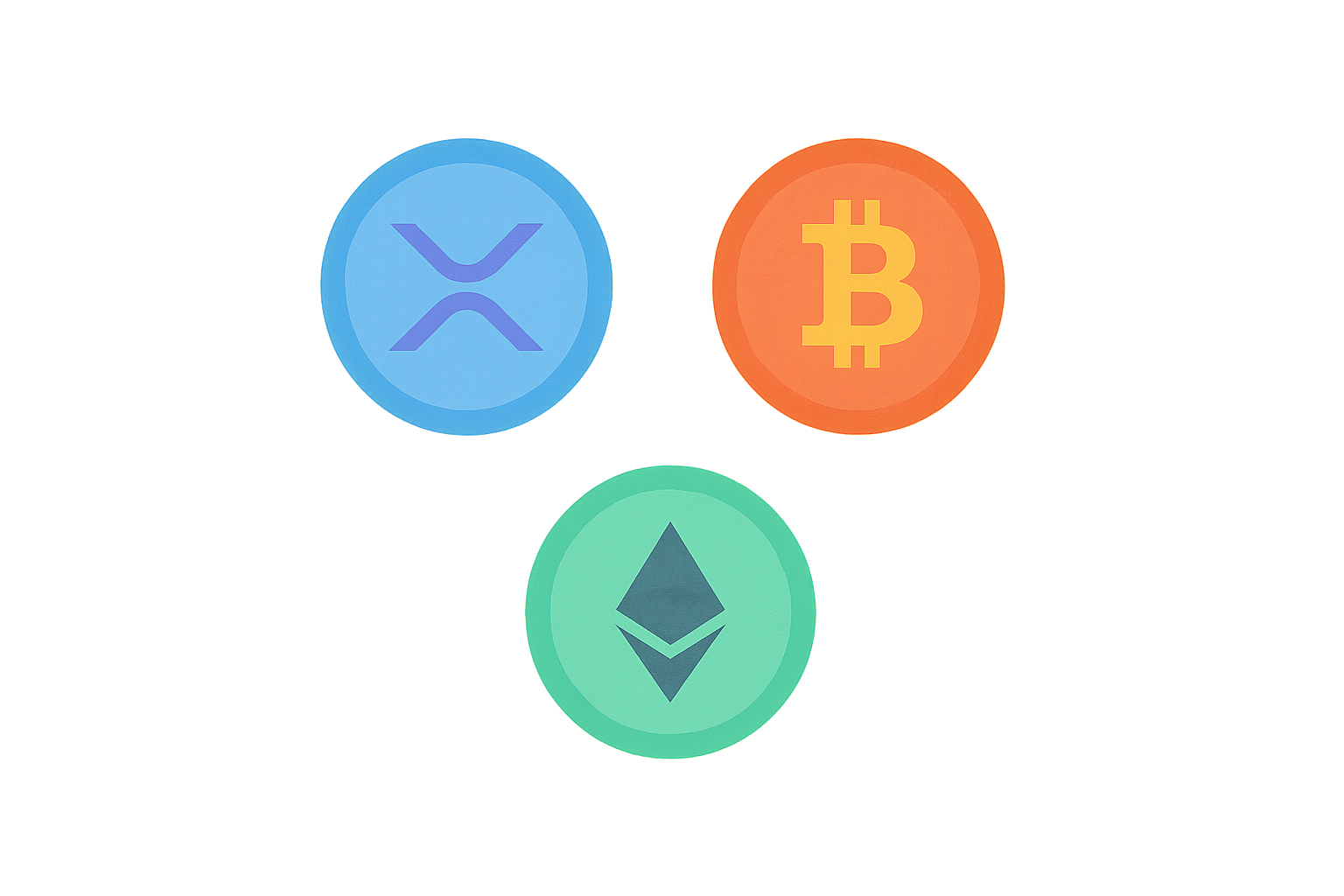
XRP occupies a distinct position within the cryptocurrency ecosystem, differentiated from both Bitcoin and Ethereum through purpose and design.
Bitcoin represents the more established and decentralized cryptocurrency, enjoying the substantial first-mover advantage of being the original blockchain-based asset. However, Bitcoin sacrifices transaction speed and cost efficiency—design characteristics inherent to its security and decentralization focus. Bitcoin was engineered primarily as a store of wealth rather than as a transaction mechanism for cross-border payments.
Ethereum was constructed to enable smart contracts and decentralized applications, establishing itself as the foundational network supporting the majority of popular decentralized finance applications and NFT marketplaces. While Ethereum boasts a substantially broader ecosystem and greater decentralization than XRP, it was not optimized for cross-border transactions and typically charges higher transaction fees than XRP. These design differences reflect each network's distinct architectural priorities.
What's the future of XRP after regulatory developments?
The 2020 SEC lawsuit against Ripple, which alleged that XRP constituted an unregistered security, significantly constrained XRP adoption and precipitated years of price stagnation. This regulatory uncertainty created substantial adoption friction among financial institutions hesitant to embrace an asset facing potential security classification.
A significant turning point occurred when court rulings determined that XRP's classification and legal standing would not prevent its continued development and use. These judicial decisions validated the path forward and provided regulatory clarity. The resolution of previous regulatory uncertainties removes impediments to institutional adoption, positioning the cryptocurrency for accelerated growth in subsequent periods.
Regulatory environment and policy support
Recent developments have generated optimism regarding potential favorable regulatory conditions for digital assets. The appointment of crypto-friendly officials to key regulatory positions signals potential receptivity toward favorable cryptocurrency regulations and policies.
Rumors regarding potential XRP ETF approval have intensified investor interest, though approvals proceed through standard regulatory processes. Given the changing regulatory environment toward cryptocurrency, institutional observers anticipate that digital asset investment vehicles may continue to develop in the near term, potentially catalyzing broader investment flows.
Conclusion
While mathematical analysis strongly suggests that XRP achieving a $1,000 price point remains improbable under realistic market scenarios, the cryptocurrency presents a compelling narrative regarding potential price appreciation driven by institutional adoption expansion and improving regulatory conditions. The resolution of previous regulatory challenges, combined with demonstrated institutional support from major financial entities and improving policy clarity, establishes a more favorable foundation for XRP's developmental trajectory.
However, prospective investors should recognize that cryptocurrency investments remain inherently volatile and speculative. Any investment decision should carefully consider individual financial circumstances, risk tolerance, and comprehensive market analysis rather than relying solely on price prediction narratives. The question of whether XRP can reach $1,000 USD requires careful evaluation of both technological adoption trends and market realities.
FAQ
Is it possible for XRP to reach 1000?
Yes, it's theoretically possible for XRP to reach $1,000, though it would require substantial market growth and adoption. Such a price level would depend on significant increases in trading volume, institutional adoption, and overall cryptocurrency market expansion over an extended period.
Will XRP reach $500 dollars?
Reaching $500 would require a market cap of approximately $27 trillion, far exceeding Bitcoin's all-time high. This is highly unlikely given current supply and market conditions. Significant regulatory clarity and institutional adoption would be necessary for substantial price increases.
Can XRP hit $1000 by the end of 2025?
No. XRP has not reached $1,000 as of December 2025. While some analysts made bold predictions, XRP's actual price remains significantly below this target. Current market conditions and historical performance suggest this price level is unlikely without extraordinary circumstances.
What factors would need to change for XRP to reach $1000?
For XRP to reach $1,000, several factors must align: massive global adoption of its payment technology, strong regulatory approval worldwide, significant increase in transaction volume and liquidity, and broader cryptocurrency market expansion. The price would need to surge approximately 46,848% from current levels.
What is XRP's all-time high price and how does it compare to a $1000 target?
XRP's all-time high was $3.86 in 2017. A $1000 target represents significant growth potential, requiring substantial market expansion and increased adoption of XRP's payment solutions.
Share
Content
What is XRP?
Why is XRP rising?
Is it possible for XRP to hit $1,000?
What's the bull case for XRP?
What's the bear case for XRP?
Can XRP be the next Bitcoin?
Does XRP have institutional support?
XRP vs. other cryptocurrencies
What's the future of XRP after regulatory developments?
Regulatory environment and policy support
Conclusion
FAQ
How to Buy Cryptocurrency


Trending Cryptocurrencies



How Will XRP Price Evolve in 2025: Analyzing Support Levels and $4 Predictions

How Will XRP's $1 Billion ETF Inflows Impact Institutional Holdings in 2025?

How Does XRP's Institutional Inflow Impact Its Price in 2025?

why is crypto crashing and will it recover ?

$XRP (Ripple) $5-$20 Price Potential This Bull Run

Crypto Crash or Just a Correction?

Understanding Actively Validated Services (AVS) Systems

Understanding the Difference Between Mark Price and Latest Price in Crypto Futures

Exploring Elon Musk's Business Ownership in American Companies
Understanding Cryptocurrency Bags: Effective Management Tips

What is SCA: A Comprehensive Guide to Strong Customer Authentication in Digital Payment Security